







VP calls for major investment to drive national digital economy
‘Iran is on the verge of a digital leap’
Iran’s First Vice President Mohammad Reza Aref on Sunday said the government will push major investments and regulatory reforms to accelerate the country’s digital transformation, calling the Information and Communications Technology (ICT) sector one of the safest and most profitable destinations for capital in Iran.
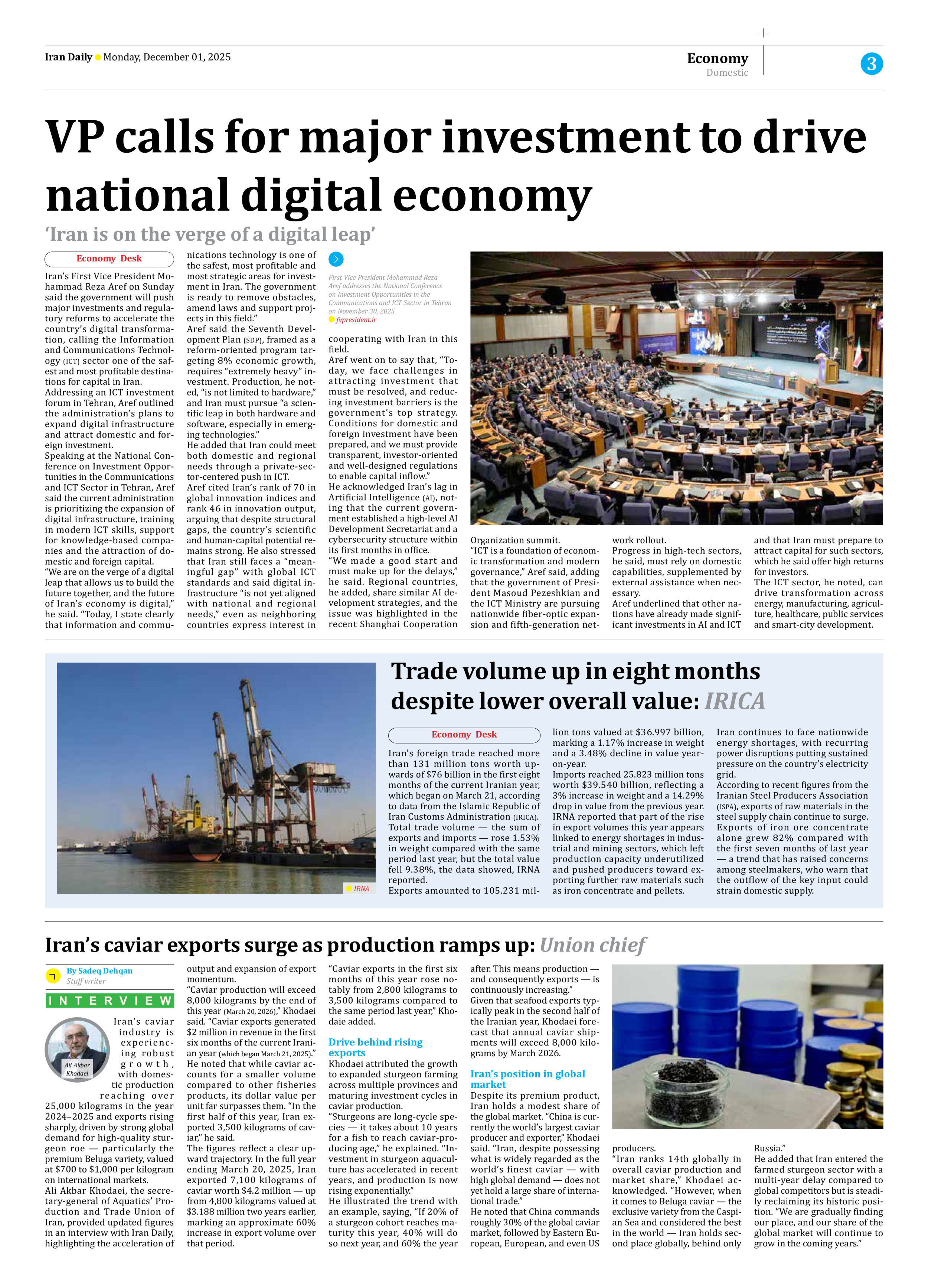
Addressing an ICT investment forum in Tehran, Aref outlined the administration’s plans to expand digital infrastructure and attract domestic and foreign investment.
Speaking at the National Conference on Investment Opportunities in the Communications and ICT Sector in Tehran, Aref said the current administration is prioritizing the expansion of digital infrastructure, training in modern ICT skills, support for knowledge-based companies and the attraction of domestic and foreign capital.
“We are on the verge of a digital leap that allows us to build the future together, and the future of Iran’s economy is digital,” he said. “Today, I state clearly that information and communications technology is one of the safest, most profitable and most strategic areas for investment in Iran. The government is ready to remove obstacles, amend laws and support projects in this field.”
Aref said the Seventh Development Plan (SDP), framed as a reform-oriented program targeting 8% economic growth, requires “extremely heavy” investment. Production, he noted, “is not limited to hardware,” and Iran must pursue “a scientific leap in both hardware and software, especially in emerging technologies.”
He added that Iran could meet both domestic and regional needs through a private-sector-centered push in ICT.
Aref cited Iran’s rank of 70 in global innovation indices and rank 46 in innovation output, arguing that despite structural gaps, the country’s scientific and human-capital potential remains strong. He also stressed that Iran still faces a “meaningful gap” with global ICT standards and said digital infrastructure “is not yet aligned with national and regional needs,” even as neighboring countries express interest in cooperating with Iran in this field.
Aref went on to say that, “Today, we face challenges in attracting investment that must be resolved, and reducing investment barriers is the government’s top strategy. Conditions for domestic and foreign investment have been prepared, and we must provide transparent, investor-oriented and well-designed regulations to enable capital inflow.”
He acknowledged Iran’s lag in Artificial Intelligence (AI), noting that the current government established a high-level AI Development Secretariat and a cybersecurity structure within its first months in office.
“We made a good start and must make up for the delays,” he said. Regional countries, he added, share similar AI development strategies, and the issue was highlighted in the recent Shanghai Cooperation Organization summit.
“ICT is a foundation of economic transformation and modern governance,” Aref said, adding that the government of President Masoud Pezeshkian and the ICT Ministry are pursuing nationwide fiber-optic expansion and fifth-generation network rollout.
Progress in high-tech sectors, he said, must rely on domestic capabilities, supplemented by external assistance when necessary.
Aref underlined that other nations have already made significant investments in AI and ICT and that Iran must prepare to attract capital for such sectors, which he said offer high returns for investors.
The ICT sector, he noted, can drive transformation across energy, manufacturing, agriculture, healthcare, public services and smart-city development.