





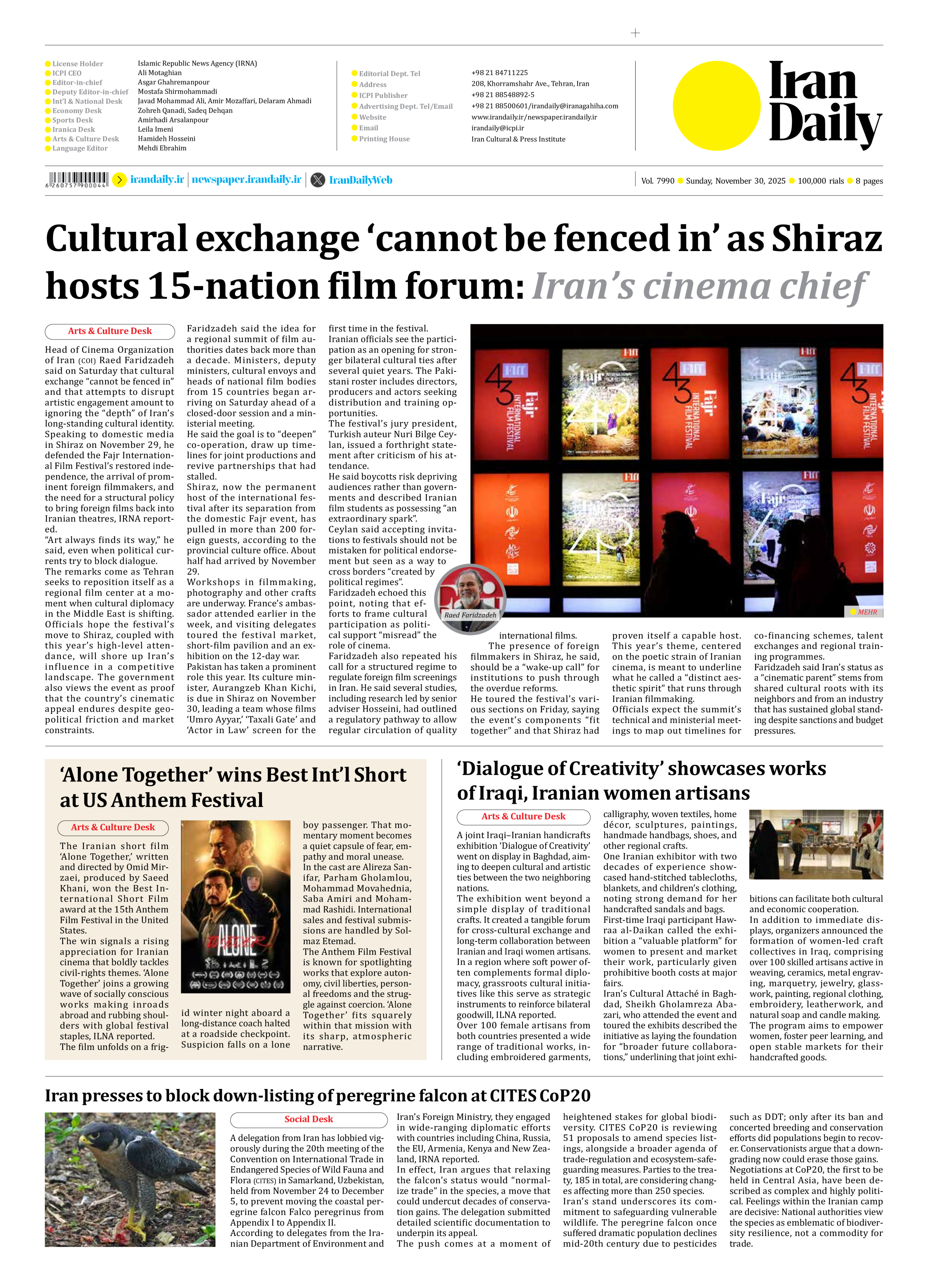


Cultural exchange ‘cannot be fenced in’ as Shiraz hosts 15-nation film forum: Iran’s cinema chief
Head of Cinema Organization of Iran (COI) Raed Faridzadeh said on Saturday that cultural exchange “cannot be fenced in” and that attempts to disrupt artistic engagement amount to ignoring the “depth” of Iran’s long-standing cultural identity.
Speaking to domestic media in Shiraz on November 29, he defended the Fajr International Film Festival’s restored independence, the arrival of prominent foreign filmmakers, and the need for a structural policy to bring foreign films back into Iranian theatres, IRNA reported.
“Art always finds its way,” he said, even when political currents try to block dialogue.
The remarks come as Tehran seeks to reposition itself as a regional film center at a moment when cultural diplomacy in the Middle East is shifting. Officials hope the festival’s move to Shiraz, coupled with this year’s high-level attendance, will shore up Iran’s influence in a competitive landscape. The government also views the event as proof that the country’s cinematic appeal endures despite geopolitical friction and market constraints.
Faridzadeh said the idea for a regional summit of film authorities dates back more than a decade. Ministers, deputy ministers, cultural envoys and heads of national film bodies from 15 countries began arriving on Saturday ahead of a closed-door session and a ministerial meeting.
He said the goal is to “deepen” co-operation, draw up timelines for joint productions and revive partnerships that had stalled.
Shiraz, now the permanent host of the international festival after its separation from the domestic Fajr event, has pulled in more than 200 foreign guests, according to the provincial culture office. About half had arrived by November 29.
Workshops in filmmaking, photography and other crafts are underway. France’s ambassador attended earlier in the week, and visiting delegates toured the festival market, short-film pavilion and an exhibition on the 12-day war.
Pakistan has taken a prominent role this year. Its culture minister, Aurangzeb Khan Kichi, is due in Shiraz on November 30, leading a team whose films ‘Umro Ayyar,’ ‘Taxali Gate’ and ‘Actor in Law’ screen for the first time in the festival.
Iranian officials see the participation as an opening for stronger bilateral cultural ties after several quiet years. The Pakistani roster includes directors, producers and actors seeking distribution and training opportunities.
The festival’s jury president, Turkish auteur Nuri Bilge Ceylan, issued a forthright statement after criticism of his attendance.
He said boycotts risk depriving audiences rather than governments and described Iranian film students as possessing “an extraordinary spark”.
Ceylan said accepting invitations to festivals should not be mistaken for political endorsement but seen as a way to cross borders “created by political regimes”.
Faridzadeh echoed this point, noting that efforts to frame cultural participation as political support “misread” the role of cinema.
Faridzadeh also repeated his call for a structured regime to regulate foreign film screenings in Iran. He said several studies, including research led by senior adviser Hosseini, had outlined a regulatory pathway to allow regular circulation of quality international films.
The presence of foreign filmmakers in Shiraz, he said, should be a “wake-up call” for institutions to push through the overdue reforms.
He toured the festival’s various sections on Friday, saying the event’s components “fit together” and that Shiraz had proven itself a capable host. This year’s theme, centered on the poetic strain of Iranian cinema, is meant to underline what he called a “distinct aesthetic spirit” that runs through Iranian filmmaking.
Officials expect the summit’s technical and ministerial meetings to map out timelines for co-financing schemes, talent exchanges and regional training programmes.
Faridzadeh said Iran’s status as a “cinematic parent” stems from shared cultural roots with its neighbors and from an industry that has sustained global standing despite sanctions and budget pressures.