







Destroyer, floating base join Navy
Iran ready to deliver ‘decisive response’ to threats anywhere: Army chief
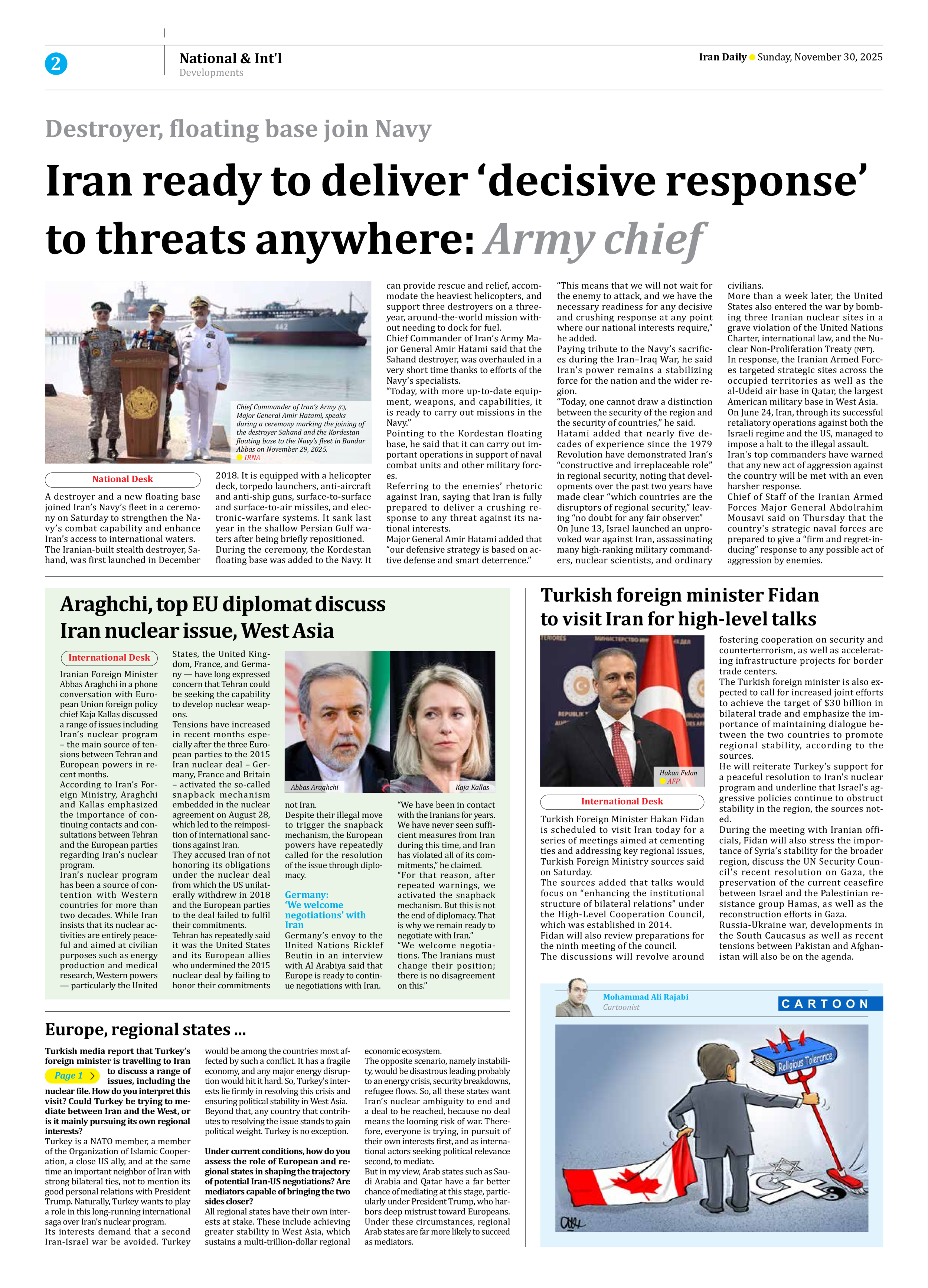
A destroyer and a new floating base joined Iran’s Navy’s fleet in a ceremony on Saturday to strengthen the Navy’s combat capability and enhance Iran’s access to international waters.
The Iranian-built stealth destroyer, Sahand, was first launched in December 2018. It is equipped with a helicopter deck, torpedo launchers, anti-aircraft and anti-ship guns, surface-to-surface and surface-to-air missiles, and electronic-warfare systems. It sank last year in the shallow Persian Gulf waters after being briefly repositioned.
During the ceremony, the Kordestan floating base was added to the Navy. It can provide rescue and relief, accommodate the heaviest helicopters, and support three destroyers on a three-year, around-the-world mission without needing to dock for fuel.
Chief Commander of Iran’s Army Major General Amir Hatami said that the Sahand destroyer, was overhauled in a very short time thanks to efforts of the Navy’s specialists.
“Today, with more up-to-date equipment, weapons, and capabilities, it is ready to carry out missions in the Navy.”
Pointing to the Kordestan floating base, he said that it can carry out important operations in support of naval combat units and other military forces.
Referring to the enemies’ rhetoric against Iran, saying that Iran is fully prepared to deliver a crushing response to any threat against its national interests.
Major General Amir Hatami added that “our defensive strategy is based on active defense and smart deterrence.”
“This means that we will not wait for the enemy to attack, and we have the necessary readiness for any decisive and crushing response at any point where our national interests require,” he added.
Paying tribute to the Navy’s sacrifices during the Iran–Iraq War, he said Iran’s power remains a stabilizing force for the nation and the wider region.
“Today, one cannot draw a distinction between the security of the region and the security of countries,” he said.
Hatami added that nearly five decades of experience since the 1979 Revolution have demonstrated Iran’s “constructive and irreplaceable role” in regional security, noting that developments over the past two years have made clear “which countries are the disruptors of regional security,” leaving “no doubt for any fair observer.”
On June 13, Israel launched an unprovoked war against Iran, assassinating many high-ranking military commanders, nuclear scientists, and ordinary civilians.
More than a week later, the United States also entered the war by bombing three Iranian nuclear sites in a grave violation of the United Nations Charter, international law, and the Nuclear Non-Proliferation Treaty (NPT).
In response, the Iranian Armed Forces targeted strategic sites across the occupied territories as well as the al-Udeid air base in Qatar, the largest American military base in West Asia.
On June 24, Iran, through its successful retaliatory operations against both the Israeli regime and the US, managed to impose a halt to the illegal assault.
Iran's top commanders have warned that any new act of aggression against the country will be met with an even harsher response.
Chief of Staff of the Iranian Armed Forces Major General Abdolrahim Mousavi said on Thursday that the country's strategic naval forces are prepared to give a “firm and regret-inducing” response to any possible act of aggression by enemies.