







ACHA General Assembly
Iran pushes China for new cultural, tourism, heritage pact
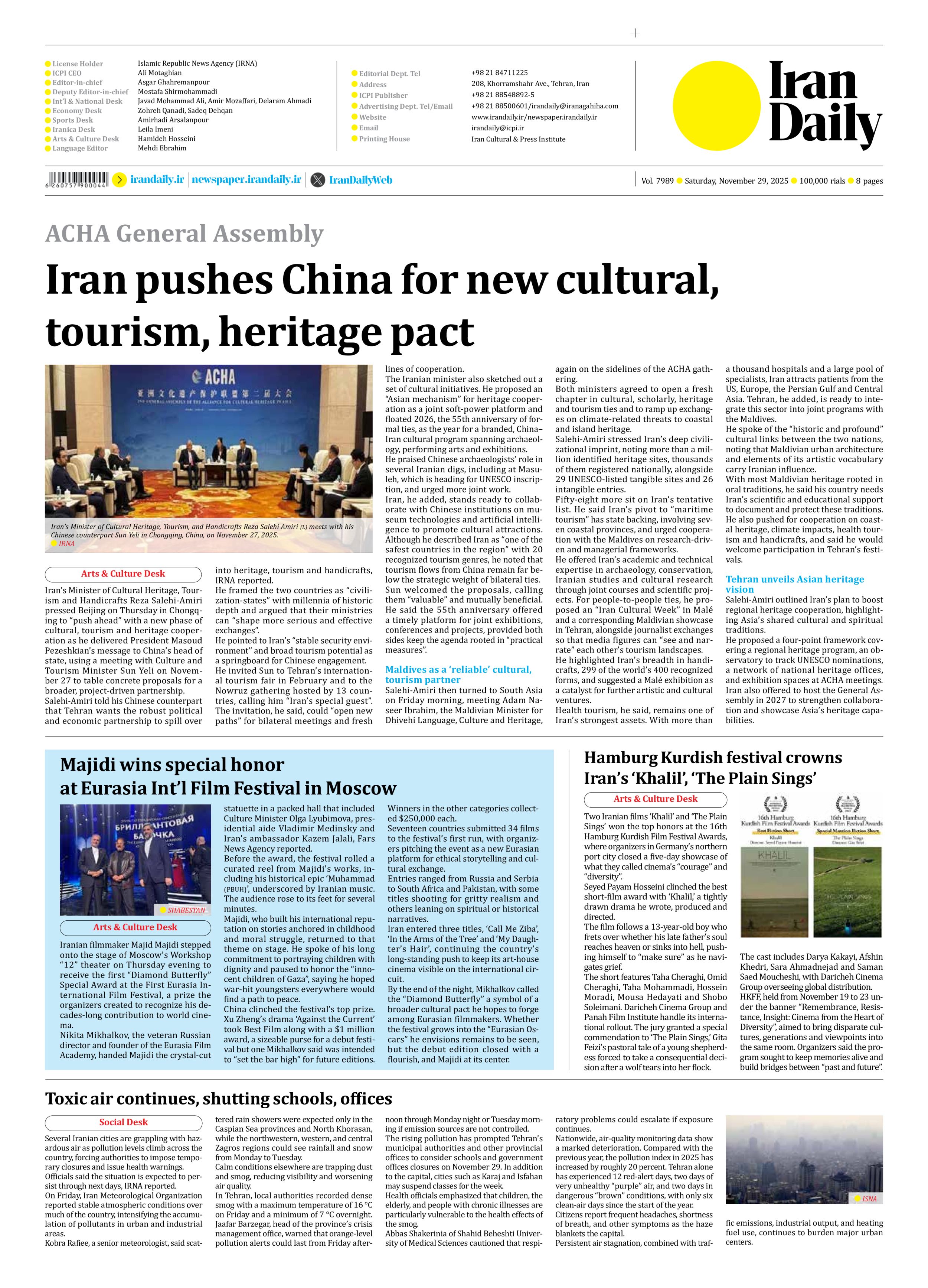
Iran’s Minister of Cultural Heritage, Tourism and Handicrafts Reza Salehi-Amiri pressed Beijing on Thursday in Chongqing to “push ahead” with a new phase of cultural, tourism and heritage cooperation as he delivered President Masoud Pezeshkian’s message to China’s head of state, using a meeting with Culture and Tourism Minister Sun Yeli on November 27 to table concrete proposals for a broader, project-driven partnership.
Salehi-Amiri told his Chinese counterpart that Tehran wants the robust political and economic partnership to spill over into heritage, tourism and handicrafts, IRNA reported.
He framed the two countries as “civilization-states” with millennia of historic depth and argued that their ministries can “shape more serious and effective exchanges”.
He pointed to Iran’s “stable security environment” and broad tourism potential as a springboard for Chinese engagement.
He invited Sun to Tehran’s international tourism fair in February and to the Nowruz gathering hosted by 13 countries, calling him “Iran’s special guest”. The invitation, he said, could “open new paths” for bilateral meetings and fresh lines of cooperation.
The Iranian minister also sketched out a set of cultural initiatives. He proposed an “Asian mechanism” for heritage cooperation as a joint soft-power platform and floated 2026, the 55th anniversary of formal ties, as the year for a branded, China–Iran cultural program spanning archaeology, performing arts and exhibitions.
He praised Chinese archaeologists’ role in several Iranian digs, including at Masuleh, which is heading for UNESCO inscription, and urged more joint work.
Iran, he added, stands ready to collaborate with Chinese institutions on museum technologies and artificial intelligence to promote cultural attractions. Although he described Iran as “one of the safest countries in the region” with 20 recognized tourism genres, he noted that tourism flows from China remain far below the strategic weight of bilateral ties.
Sun welcomed the proposals, calling them “valuable” and mutually beneficial. He said the 55th anniversary offered a timely platform for joint exhibitions, conferences and projects, provided both sides keep the agenda rooted in “practical measures”.
Maldives as a ‘reliable’ cultural, tourism partner
Salehi-Amiri then turned to South Asia on Friday morning, meeting Adam Naseer Ibrahim, the Maldivian Minister for Dhivehi Language, Culture and Heritage, again on the sidelines of the ACHA gathering.
Both ministers agreed to open a fresh chapter in cultural, scholarly, heritage and tourism ties and to ramp up exchanges on climate-related threats to coastal and island heritage.
Salehi-Amiri stressed Iran’s deep civilizational imprint, noting more than a million identified heritage sites, thousands of them registered nationally, alongside 29 UNESCO-listed tangible sites and 26 intangible entries.
Fifty-eight more sit on Iran’s tentative list. He said Iran’s pivot to “maritime tourism” has state backing, involving seven coastal provinces, and urged cooperation with the Maldives on research-driven and managerial frameworks.
He offered Iran’s academic and technical expertise in archaeology, conservation, Iranian studies and cultural research through joint courses and scientific projects. For people-to-people ties, he proposed an “Iran Cultural Week” in Malé and a corresponding Maldivian showcase in Tehran, alongside journalist exchanges so that media figures can “see and narrate” each other’s tourism landscapes.
He highlighted Iran’s breadth in handicrafts, 299 of the world’s 400 recognized forms, and suggested a Malé exhibition as a catalyst for further artistic and cultural ventures.
Health tourism, he said, remains one of Iran’s strongest assets. With more than a thousand hospitals and a large pool of specialists, Iran attracts patients from the US, Europe, the Persian Gulf and Central Asia. Tehran, he added, is ready to integrate this sector into joint programs with the Maldives.
He spoke of the “historic and profound” cultural links between the two nations, noting that Maldivian urban architecture and elements of its artistic vocabulary carry Iranian influence.
With most Maldivian heritage rooted in oral traditions, he said his country needs Iran’s scientific and educational support to document and protect these traditions.
He also pushed for cooperation on coastal heritage, climate impacts, health tourism and handicrafts, and said he would welcome participation in Tehran’s festivals.
Tehran unveils Asian heritage vision
Salehi-Amiri outlined Iran’s plan to boost regional heritage cooperation, highlighting Asia’s shared cultural and spiritual traditions.
He proposed a four-point framework covering a regional heritage program, an observatory to track UNESCO nominations, a network of national heritage offices, and exhibition spaces at ACHA meetings.
Iran also offered to host the General Assembly in 2027 to strengthen collaboration and showcase Asia’s heritage capabilities.