





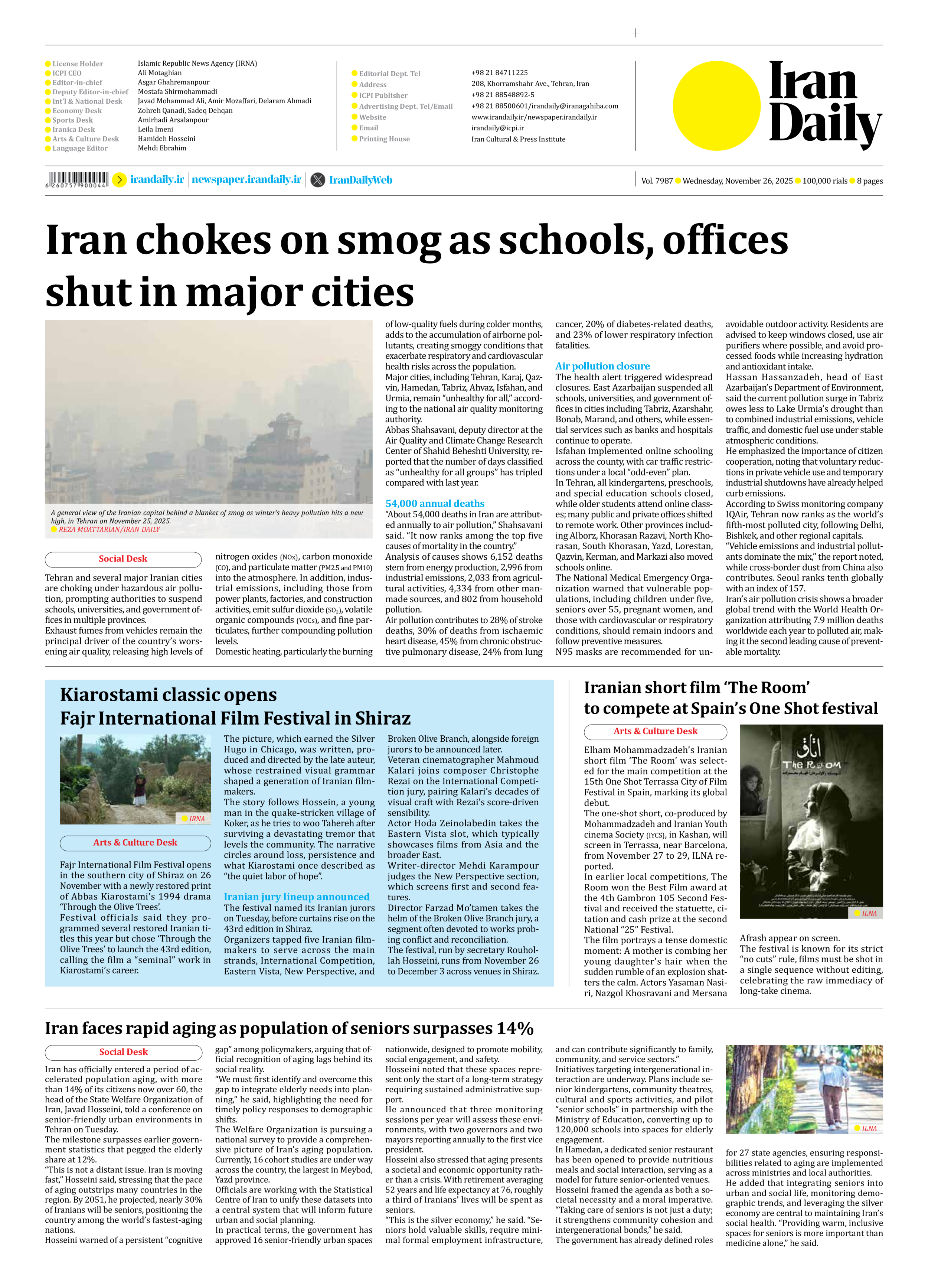


Iran faces rapid aging as population of seniors surpasses 14%
Iran has officially entered a period of accelerated population aging, with more than 14% of its citizens now over 60, the head of the State Welfare Organization of Iran, Javad Hosseini, told a conference on senior-friendly urban environments in Tehran on Tuesday.
The milestone surpasses earlier government statistics that pegged the elderly share at 12%.
“This is not a distant issue. Iran is moving fast,” Hosseini said, stressing that the pace of aging outstrips many countries in the region. By 2051, he projected, nearly 30% of Iranians will be seniors, positioning the country among the world’s fastest-aging nations.
Hosseini warned of a persistent “cognitive gap” among policymakers, arguing that official recognition of aging lags behind its social reality.
“We must first identify and overcome this gap to integrate elderly needs into planning,” he said, highlighting the need for timely policy responses to demographic shifts.
The Welfare Organization is pursuing a national survey to provide a comprehensive picture of Iran’s aging population. Currently, 16 cohort studies are under way across the country, the largest in Meybod, Yazd province.
Officials are working with the Statistical Centre of Iran to unify these datasets into a central system that will inform future urban and social planning.
In practical terms, the government has approved 16 senior-friendly urban spaces nationwide, designed to promote mobility, social engagement, and safety.
Hosseini noted that these spaces represent only the start of a long-term strategy requiring sustained administrative support.
He announced that three monitoring sessions per year will assess these environments, with two governors and two mayors reporting annually to the first vice president.
Hosseini also stressed that aging presents a societal and economic opportunity rather than a crisis. With retirement averaging 52 years and life expectancy at 76, roughly a third of Iranians’ lives will be spent as seniors.
“This is the silver economy,” he said. “Seniors hold valuable skills, require minimal formal employment infrastructure, and can contribute significantly to family, community, and service sectors.”
Initiatives targeting intergenerational interaction are underway. Plans include senior kindergartens, community theatres, cultural and sports activities, and pilot “senior schools” in partnership with the Ministry of Education, converting up to 120,000 schools into spaces for elderly engagement.
In Hamedan, a dedicated senior restaurant has been opened to provide nutritious meals and social interaction, serving as a model for future senior-oriented venues.
Hosseini framed the agenda as both a societal necessity and a moral imperative. “Taking care of seniors is not just a duty; it strengthens community cohesion and intergenerational bonds,” he said.
The government has already defined roles for 27 state agencies, ensuring responsibilities related to aging are implemented across ministries and local authorities.
He added that integrating seniors into urban and social life, monitoring demographic trends, and leveraging the silver economy are central to maintaining Iran’s social health. “Providing warm, inclusive spaces for seniors is more important than medicine alone,” he said.