





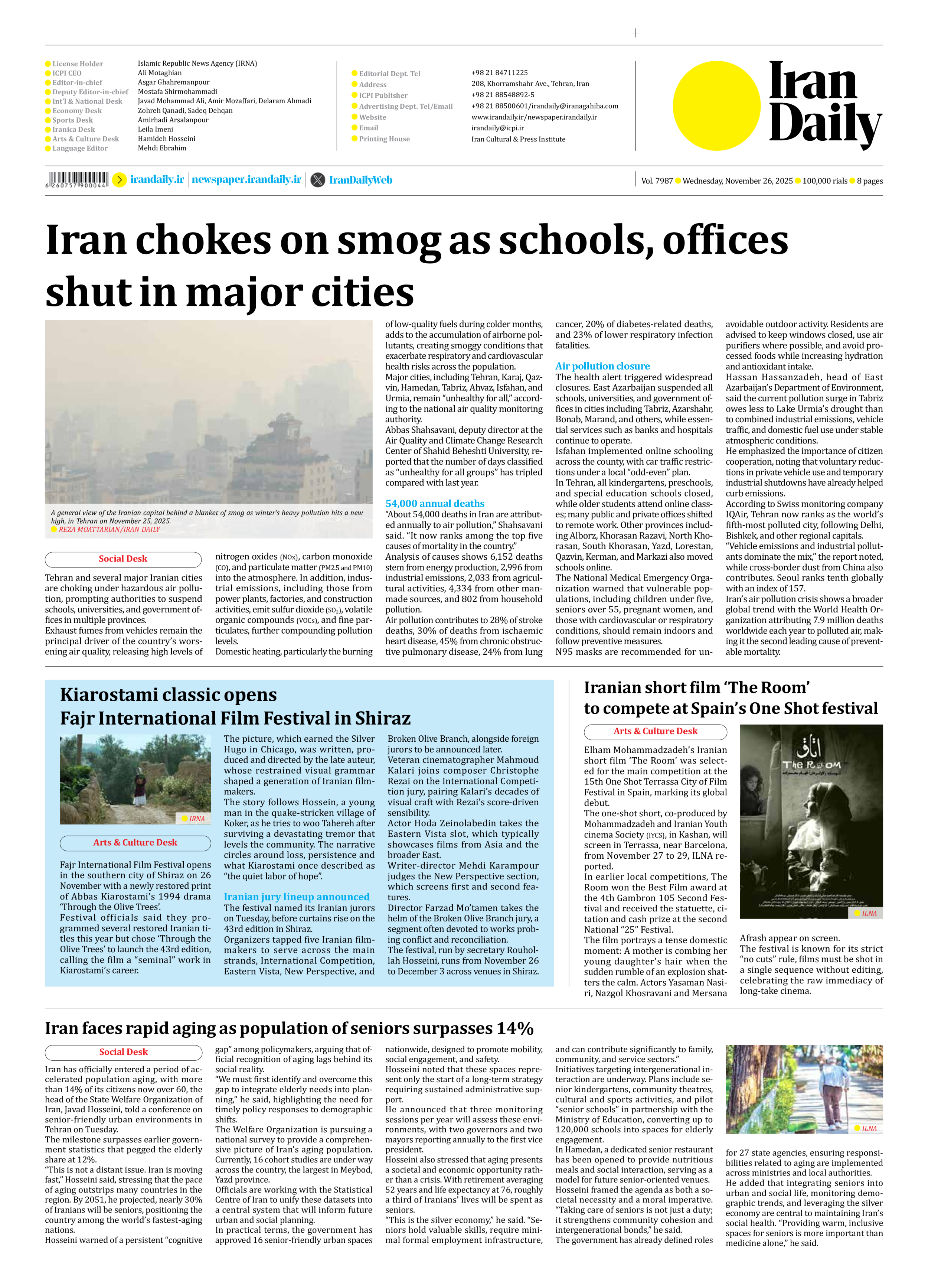


Iran chokes on smog as schools, offices shut in major cities
Tehran and several major Iranian cities are choking under hazardous air pollution, prompting authorities to suspend schools, universities, and government offices in multiple provinces.
Exhaust fumes from vehicles remain the principal driver of the country’s worsening air quality, releasing high levels of nitrogen oxides (NOx), carbon monoxide (CO), and particulate matter (PM2.5 and PM10) into the atmosphere. In addition, industrial emissions, including those from power plants, factories, and construction activities, emit sulfur dioxide (SO₂), volatile organic compounds (VOCs), and fine particulates, further compounding pollution levels.
Domestic heating, particularly the burning of low-quality fuels during colder months, adds to the accumulation of airborne pollutants, creating smoggy conditions that exacerbate respiratory and cardiovascular health risks across the population.
Major cities, including Tehran, Karaj, Qazvin, Hamedan, Tabriz, Ahvaz, Isfahan, and Urmia, remain “unhealthy for all,” according to the national air quality monitoring authority.
Abbas Shahsavani, deputy director at the Air Quality and Climate Change Research Center of Shahid Beheshti University, reported that the number of days classified as “unhealthy for all groups” has tripled compared with last year.
54,000 annual deaths
“About 54,000 deaths in Iran are attributed annually to air pollution,” Shahsavani said. “It now ranks among the top five causes of mortality in the country.”
Analysis of causes shows 6,152 deaths stem from energy production, 2,996 from industrial emissions, 2,033 from agricultural activities, 4,334 from other man-made sources, and 802 from household pollution.
Air pollution contributes to 28% of stroke deaths, 30% of deaths from ischaemic heart disease, 45% from chronic obstructive pulmonary disease, 24% from lung cancer, 20% of diabetes-related deaths, and 23% of lower respiratory infection fatalities.
Air pollution closure
The health alert triggered widespread closures. East Azarbaijan suspended all schools, universities, and government offices in cities including Tabriz, Azarshahr, Bonab, Marand, and others, while essential services such as banks and hospitals continue to operate.
Isfahan implemented online schooling across the county, with car traffic restrictions under a local “odd-even” plan.
In Tehran, all kindergartens, preschools, and special education schools closed, while older students attend online classes; many public and private offices shifted to remote work. Other provinces including Alborz, Khorasan Razavi, North Khorasan, South Khorasan, Yazd, Lorestan, Qazvin, Kerman, and Markazi also moved schools online.
The National Medical Emergency Organization warned that vulnerable populations, including children under five, seniors over 55, pregnant women, and those with cardiovascular or respiratory conditions, should remain indoors and follow preventive measures.
N95 masks are recommended for unavoidable outdoor activity. Residents are advised to keep windows closed, use air purifiers where possible, and avoid processed foods while increasing hydration and antioxidant intake.
Hassan Hassanzadeh, head of East Azarbaijan’s Department of Environment, said the current pollution surge in Tabriz owes less to Lake Urmia’s drought than to combined industrial emissions, vehicle traffic, and domestic fuel use under stable atmospheric conditions.
He emphasized the importance of citizen cooperation, noting that voluntary reductions in private vehicle use and temporary industrial shutdowns have already helped curb emissions.
According to Swiss monitoring company IQAir, Tehran now ranks as the world’s fifth-most polluted city, following Delhi, Bishkek, and other regional capitals.
“Vehicle emissions and industrial pollutants dominate the mix,” the report noted, while cross-border dust from China also contributes. Seoul ranks tenth globally with an index of 157.
Iran’s air pollution crisis shows a broader global trend with the World Health Organization attributing 7.9 million deaths worldwide each year to polluted air, making it the second leading cause of preventable mortality.