







Enduring tradition of Giveh making in Chaharmahal and Bakhtiari
Giveh is a traditional type of footwear among the people of Iran, particularly in Chaharmahal and Bakhtiari Province. Unlike ordinary shoes, it has no distinct left or right side — what locals describe as “not made in pairs.” Remarkably, Giveh never truly wears out and can be easily repaired.
The absence of a left or right in Giveh symbolizes uniformity, integrity, honesty, and purity among the people of Iran and Chaharmahal and Bakhtiari Province, reflecting a cultural heritage where deceit, duplicity, and hypocrisy have no place, chtn.ir wrote.
Step by step, Giveh has walked alongside humans — from the early days when footwear held immense practical importance, to the present day when it is regarded as a valuable and prestigious item. It is said that the foot is the “second heart” of a human being, and perhaps for this reason, people have always sought to invest in their “second heart” by choosing the best and most comfortable footwear.
The art of Giveh making is one of the cherished handicrafts of Chaharmahal and Bakhtiari Province, with a long-standing tradition in cities such as Shahr-e Kord, Borujen, and Farskhur. Yet today, fewer people practice weaving or wearing Giveh.
This decline persists even as mass-produced products have lost some popularity; according to enthusiasts of traditional arts, public interest in handcrafted items — particularly Giveh — has waned, and younger generations show little inclination to continue this cultural practice.
In both modern and traditional markets, not a single Giveh is displayed in shoe store windows. Shopkeepers rarely hang a pair for display, leaving younger generations unaware of this cultural treasure.
Economic fluctuations, market instability, rising costs of raw materials, reduced purchasing power, and low demand for handicrafts have all contributed to the decline of many traditional crafts, including Giveh-making.
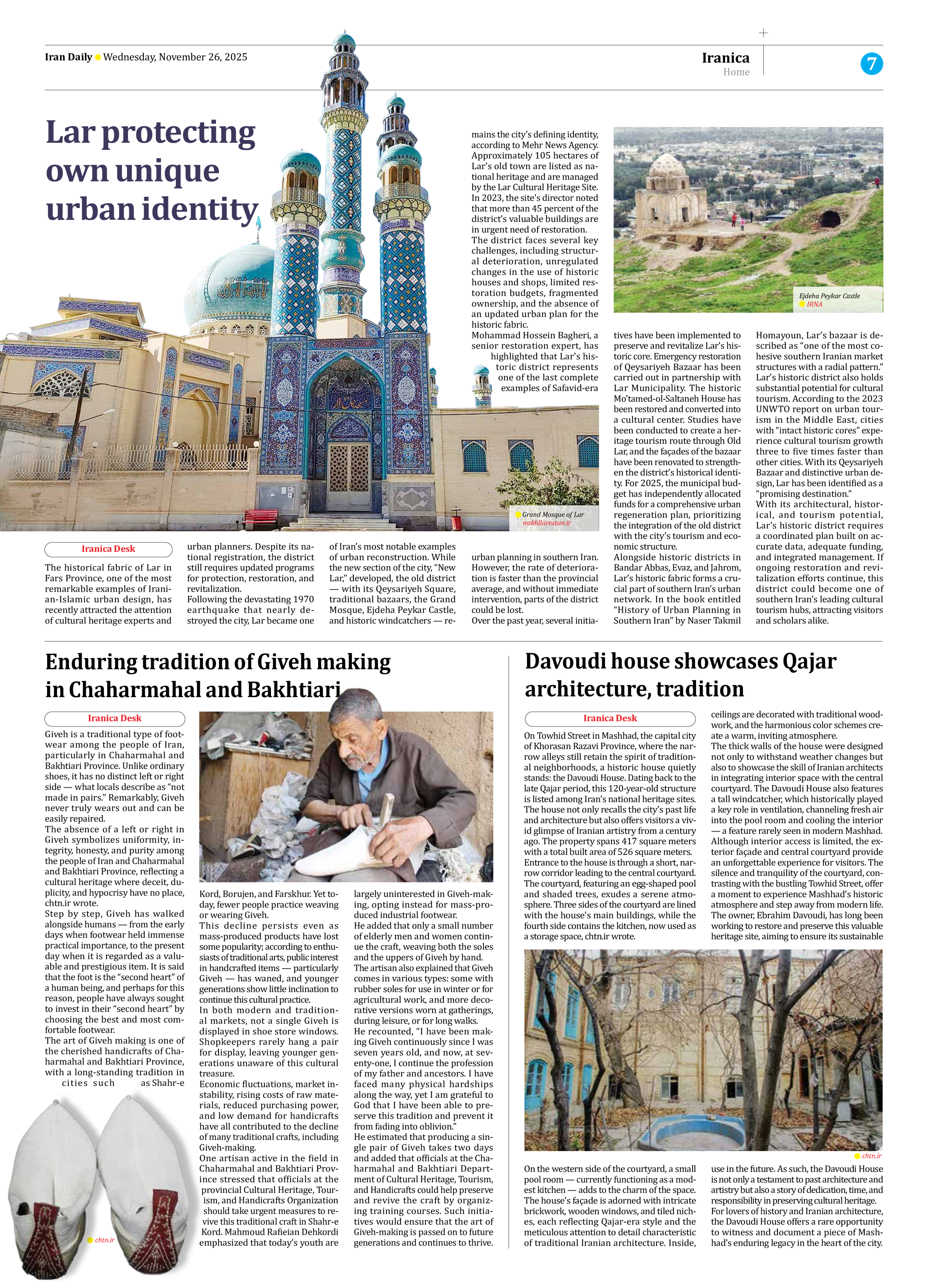
One artisan active in the field in Chaharmahal and Bakhtiari Province stressed that officials at the provincial Cultural Heritage, Tourism, and Handicrafts Organization should take urgent measures to revive this traditional craft in Shahr-e Kord. Mahmoud Rafieian Dehkordi emphasized that today’s youth are largely uninterested in Giveh-making, opting instead for mass-produced industrial footwear.
He added that only a small number of elderly men and women continue the craft, weaving both the soles and the uppers of Giveh by hand.
The artisan also explained that Giveh comes in various types: some with rubber soles for use in winter or for agricultural work, and more decorative versions worn at gatherings, during leisure, or for long walks.
He recounted, “I have been making Giveh continuously since I was seven years old, and now, at seventy-one, I continue the profession of my father and ancestors. I have faced many physical hardships along the way, yet I am grateful to God that I have been able to preserve this tradition and prevent it from fading into oblivion.”
He estimated that producing a single pair of Giveh takes two days and added that officials at the Chaharmahal and Bakhtiari Department of Cultural Heritage, Tourism, and Handicrafts could help preserve and revive the craft by organizing training courses. Such initiatives would ensure that the art of Giveh-making is passed on to future generations and continues to thrive.