





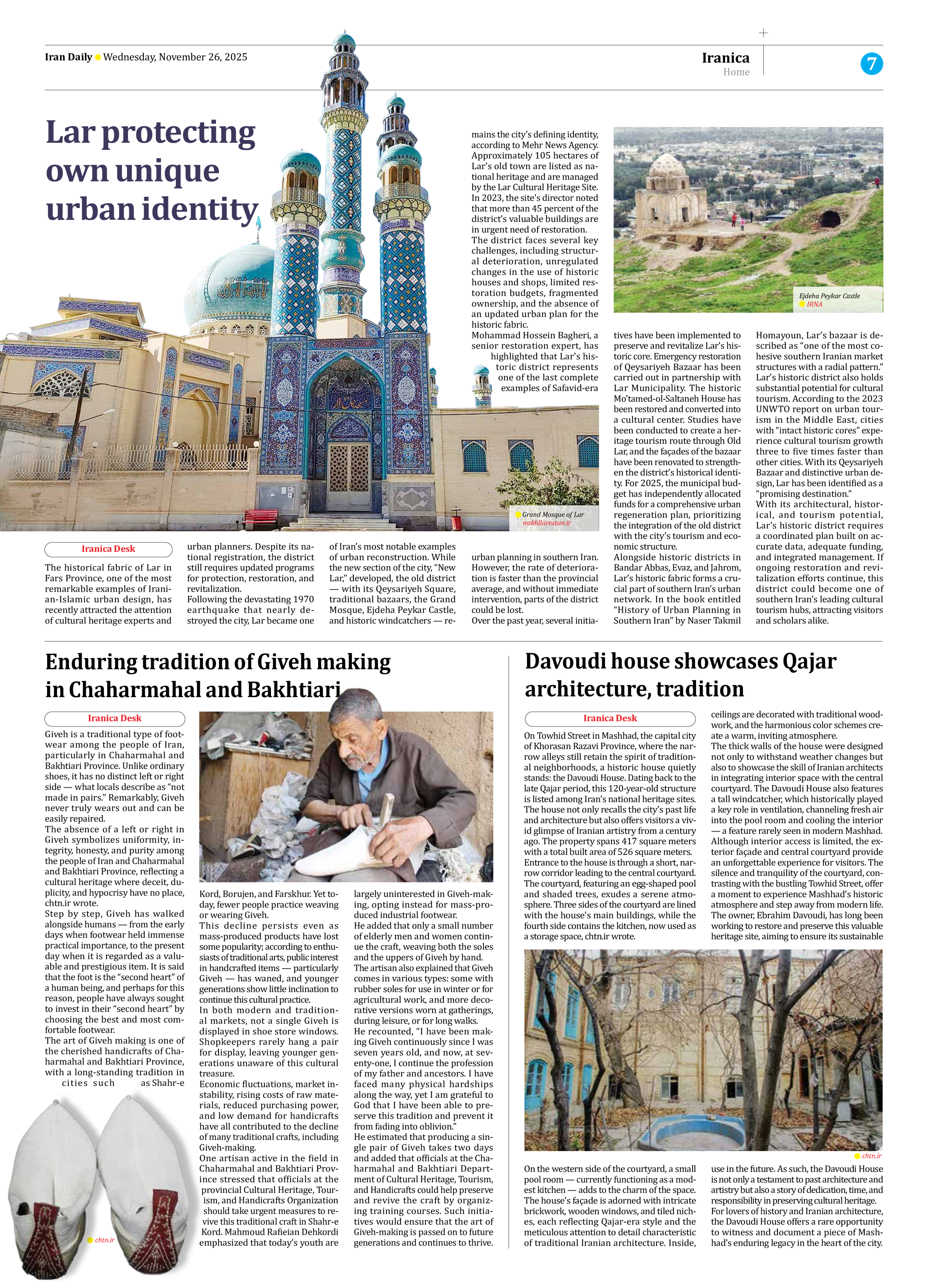


Lar protecting own unique urban identity
The historical fabric of Lar in Fars Province, one of the most remarkable examples of Iranian-Islamic urban design, has recently attracted the attention of cultural heritage experts and urban planners. Despite its national registration, the district still requires updated programs for protection, restoration, and revitalization.
Following the devastating 1970 earthquake that nearly destroyed the city, Lar became one of Iran’s most notable examples of urban reconstruction. While the new section of the city, “New Lar,” developed, the old district — with its Qeysariyeh Square, traditional bazaars, the Grand Mosque, Ejdeha Peykar Castle, and historic windcatchers — remains the city’s defining identity, according to Mehr News Agency.
Approximately 105 hectares of Lar’s old town are listed as national heritage and are managed by the Lar Cultural Heritage Site. In 2023, the site’s director noted that more than 45 percent of the district’s valuable buildings are in urgent need of restoration.
The district faces several key challenges, including structural deterioration, unregulated changes in the use of historic houses and shops, limited restoration budgets, fragmented ownership, and the absence of an updated urban plan for the historic fabric.
Mohammad Hossein Bagheri, a senior restoration expert, has highlighted that Lar’s historic district represents one of the last complete examples of Safavid-era urban planning in southern Iran. However, the rate of deterioration is faster than the provincial average, and without immediate intervention, parts of the district could be lost.
Over the past year, several initiatives have been implemented to preserve and revitalize Lar’s historic core. Emergency restoration of Qeysariyeh Bazaar has been carried out in partnership with Lar Municipality. The historic Mo’tamed-ol-Saltaneh House has been restored and converted into a cultural center. Studies have been conducted to create a heritage tourism route through Old Lar, and the façades of the bazaar have been renovated to strengthen the district’s historical identity. For 2025, the municipal budget has independently allocated funds for a comprehensive urban regeneration plan, prioritizing the integration of the old district with the city’s tourism and economic structure.
Alongside historic districts in Bandar Abbas, Evaz, and Jahrom, Lar’s historic fabric forms a crucial part of southern Iran’s urban network. In the book entitled “History of Urban Planning in Southern Iran” by Naser Takmil Homayoun, Lar’s bazaar is described as “one of the most cohesive southern Iranian market structures with a radial pattern.”
Lar’s historic district also holds substantial potential for cultural tourism. According to the 2023 UNWTO report on urban tourism in the Middle East, cities with “intact historic cores” experience cultural tourism growth three to five times faster than other cities. With its Qeysariyeh Bazaar and distinctive urban design, Lar has been identified as a “promising destination.”
With its architectural, historical, and tourism potential, Lar’s historic district requires a coordinated plan built on accurate data, adequate funding, and integrated management. If ongoing restoration and revitalization efforts continue, this district could become one of southern Iran’s leading cultural tourism hubs, attracting visitors and scholars alike.