







Poetry, architecture shape Tekyieh Valeh’s fame
Isfahan, with its ancient history and rich culture, has always been the cradle of Iran’s art, literature, and philosophy. Within this historic city, the Takht-e Foulad Cemetery is not only the resting place of religious and mystical figures but also a guardian of cultural and artistic heritage. The tomb of Aqa Mohammad Kazem Valeh, also known as Tekyieh Valeh, with its unique architecture and artistic value, presents a special fusion of poetry, calligraphy, and Qajar-era architectural design.
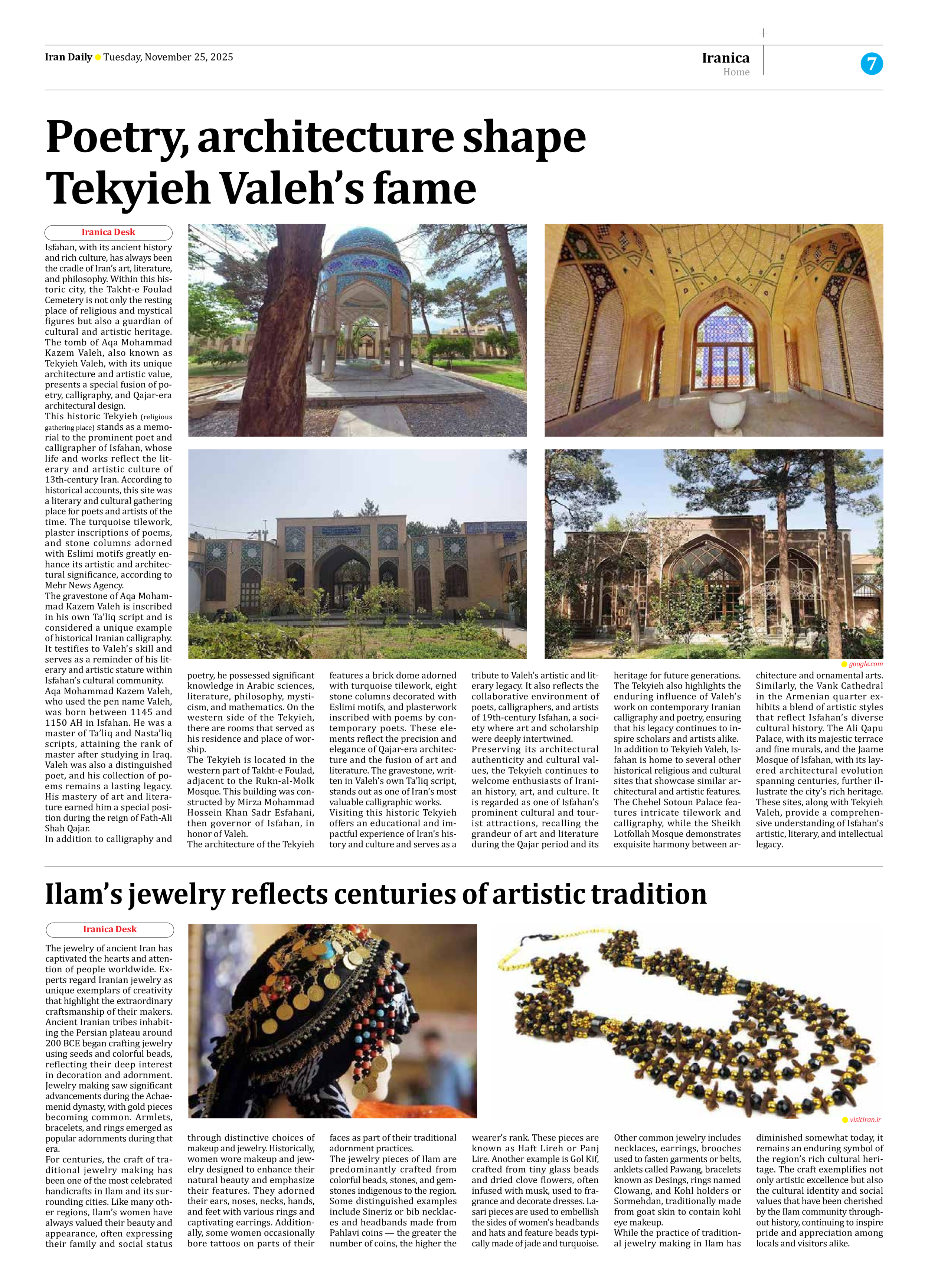
This historic Tekyieh (religious gathering place) stands as a memorial to the prominent poet and calligrapher of Isfahan, whose life and works reflect the literary and artistic culture of 13th-century Iran. According to historical accounts, this site was a literary and cultural gathering place for poets and artists of the time. The turquoise tilework, plaster inscriptions of poems, and stone columns adorned with Eslimi motifs greatly enhance its artistic and architectural significance, according to Mehr News Agency.
The gravestone of Aqa Mohammad Kazem Valeh is inscribed in his own Ta’liq script and is considered a unique example of historical Iranian calligraphy. It testifies to Valeh’s skill and serves as a reminder of his literary and artistic stature within Isfahan’s cultural community.
Aqa Mohammad Kazem Valeh, who used the pen name Valeh, was born between 1145 and 1150 AH in Isfahan. He was a master of Ta’liq and Nasta’liq scripts, attaining the rank of master after studying in Iraq. Valeh was also a distinguished poet, and his collection of poems remains a lasting legacy. His mastery of art and literature earned him a special position during the reign of Fath-Ali Shah Qajar.
In addition to calligraphy and poetry, he possessed significant knowledge in Arabic sciences, literature, philosophy, mysticism, and mathematics. On the western side of the Tekyieh, there are rooms that served as his residence and place of worship.
The Tekyieh is located in the western part of Takht-e Foulad, adjacent to the Rukn-al-Molk Mosque. This building was constructed by Mirza Mohammad Hossein Khan Sadr Esfahani, then governor of Isfahan, in honor of Valeh.
The architecture of the Tekyieh features a brick dome adorned with turquoise tilework, eight stone columns decorated with Eslimi motifs, and plasterwork inscribed with poems by contemporary poets. These elements reflect the precision and elegance of Qajar-era architecture and the fusion of art and literature. The gravestone, written in Valeh’s own Ta’liq script, stands out as one of Iran’s most valuable calligraphic works.
Visiting this historic Tekyieh offers an educational and impactful experience of Iran’s history and culture and serves as a tribute to Valeh’s artistic and literary legacy. It also reflects the collaborative environment of poets, calligraphers, and artists of 19th-century Isfahan, a society where art and scholarship were deeply intertwined.
Preserving its architectural authenticity and cultural values, the Tekyieh continues to welcome enthusiasts of Iranian history, art, and culture. It is regarded as one of Isfahan’s prominent cultural and tourist attractions, recalling the grandeur of art and literature during the Qajar period and its heritage for future generations. The Tekyieh also highlights the enduring influence of Valeh’s work on contemporary Iranian calligraphy and poetry, ensuring that his legacy continues to inspire scholars and artists alike.
In addition to Tekyieh Valeh, Isfahan is home to several other historical religious and cultural sites that showcase similar architectural and artistic features. The Chehel Sotoun Palace features intricate tilework and calligraphy, while the Sheikh Lotfollah Mosque demonstrates exquisite harmony between architecture and ornamental arts. Similarly, the Vank Cathedral in the Armenian quarter exhibits a blend of artistic styles that reflect Isfahan’s diverse cultural history. The Ali Qapu Palace, with its majestic terrace and fine murals, and the Jaame Mosque of Isfahan, with its layered architectural evolution spanning centuries, further illustrate the city’s rich heritage. These sites, along with Tekyieh Valeh, provide a comprehensive understanding of Isfahan’s artistic, literary, and intellectual legacy.