





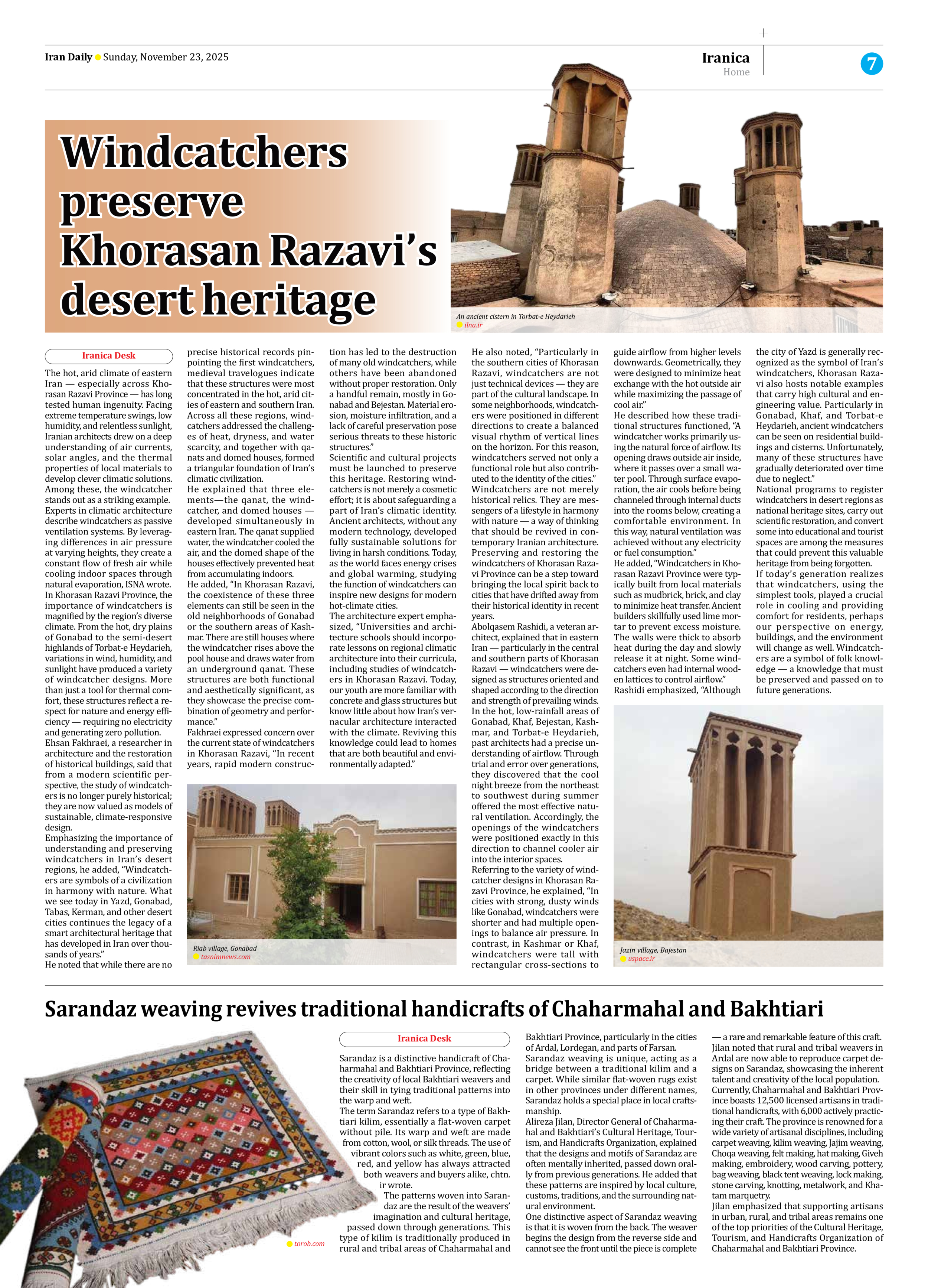


Sarandaz weaving revives traditional handicrafts of Chaharmahal and Bakhtiari
Sarandaz is a distinctive handicraft of Chaharmahal and Bakhtiari Province, reflecting the creativity of local Bakhtiari weavers and their skill in tying traditional patterns into the warp and weft.
The term Sarandaz refers to a type of Bakhtiari kilim, essentially a flat-woven carpet without pile. Its warp and weft are made from cotton, wool, or silk threads. The use of vibrant colors such as white, green, blue, red, and yellow has always attracted both weavers and buyers alike, chtn.ir wrote.
The patterns woven into Sarandaz are the result of the weavers’ imagination and cultural heritage, passed down through generations. This type of kilim is traditionally produced in rural and tribal areas of Chaharmahal and Bakhtiari Province, particularly in the cities of Ardal, Lordegan, and parts of Farsan.
Sarandaz weaving is unique, acting as a bridge between a traditional kilim and a carpet. While similar flat-woven rugs exist in other provinces under different names, Sarandaz holds a special place in local craftsmanship.
Alireza Jilan, Director General of Chaharmahal and Bakhtiari’s Cultural Heritage, Tourism, and Handicrafts Organization, explained that the designs and motifs of Sarandaz are often mentally inherited, passed down orally from previous generations. He added that these patterns are inspired by local culture, customs, traditions, and the surrounding natural environment.
One distinctive aspect of Sarandaz weaving is that it is woven from the back. The weaver begins the design from the reverse side and cannot see the front until the piece is complete — a rare and remarkable feature of this craft.
Jilan noted that rural and tribal weavers in Ardal are now able to reproduce carpet designs on Sarandaz, showcasing the inherent talent and creativity of the local population.
Currently, Chaharmahal and Bakhtiari Province boasts 12,500 licensed artisans in traditional handicrafts, with 6,000 actively practicing their craft. The province is renowned for a wide variety of artisanal disciplines, including carpet weaving, kilim weaving, Jajim weaving, Choqa weaving, felt making, hat making, Giveh making, embroidery, wood carving, pottery, bag weaving, black tent weaving, lock making, stone carving, knotting, metalwork, and Khatam marquetry.
Jilan emphasized that supporting artisans in urban, rural, and tribal areas remains one of the top priorities of the Cultural Heritage, Tourism, and Handicrafts Organization of Chaharmahal and Bakhtiari Province.