





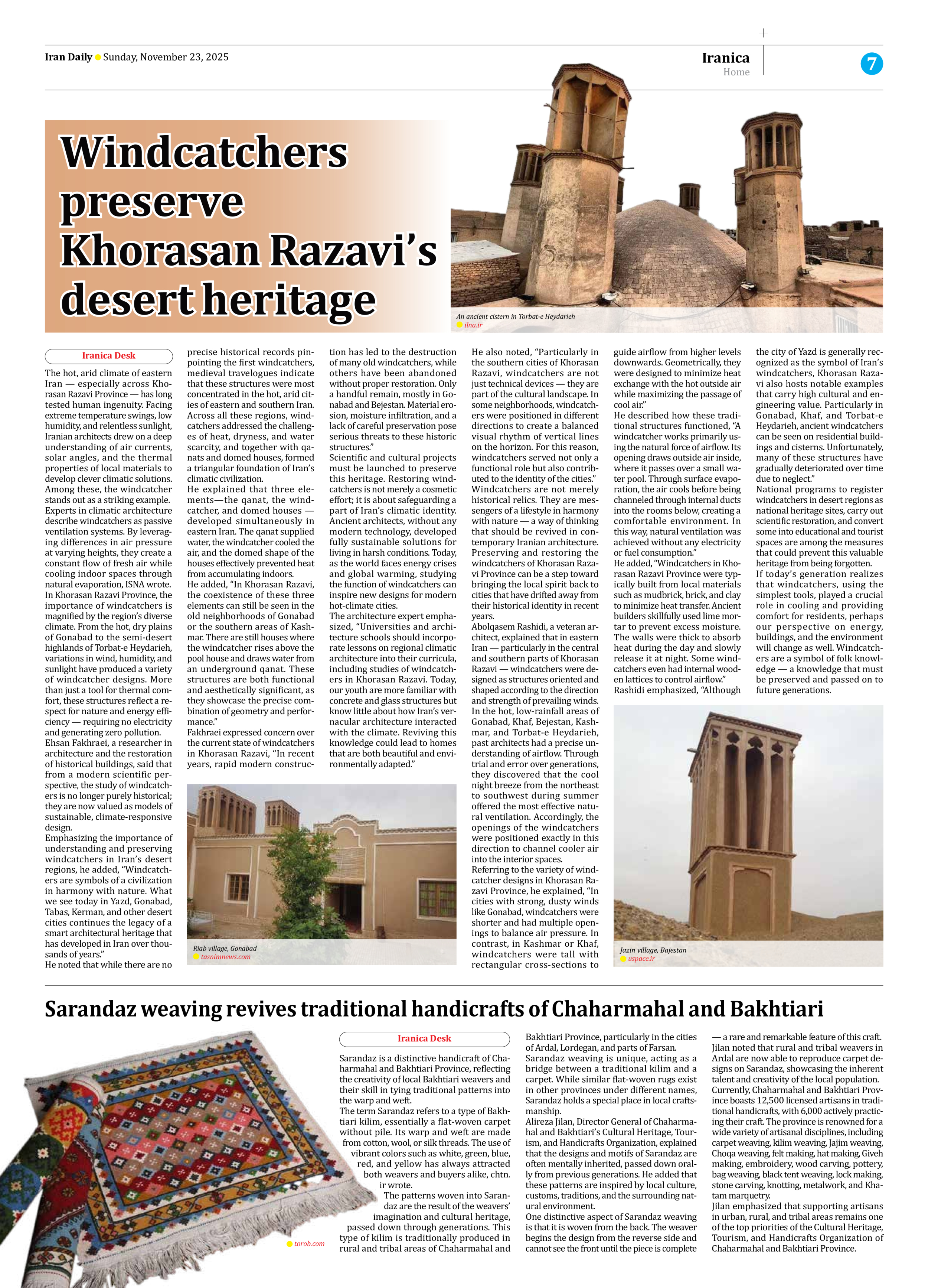


Windcatchers preserve Khorasan Razavi’s desert heritage
The hot, arid climate of eastern Iran — especially across Khorasan Razavi Province — has long tested human ingenuity. Facing extreme temperature swings, low humidity, and relentless sunlight, Iranian architects drew on a deep understanding of air currents, solar angles, and the thermal properties of local materials to develop clever climatic solutions. Among these, the windcatcher stands out as a striking example.
Experts in climatic architecture describe windcatchers as passive ventilation systems. By leveraging differences in air pressure at varying heights, they create a constant flow of fresh air while cooling indoor spaces through natural evaporation, ISNA wrote.
In Khorasan Razavi Province, the importance of windcatchers is magnified by the region’s diverse climate. From the hot, dry plains of Gonabad to the semi-desert highlands of Torbat-e Heydarieh, variations in wind, humidity, and sunlight have produced a variety of windcatcher designs. More than just a tool for thermal comfort, these structures reflect a respect for nature and energy efficiency — requiring no electricity and generating zero pollution.
Ehsan Fakhraei, a researcher in architecture and the restoration of historical buildings, said that from a modern scientific perspective, the study of windcatchers is no longer purely historical; they are now valued as models of sustainable, climate-responsive design.
Emphasizing the importance of understanding and preserving windcatchers in Iran’s desert regions, he added, “Windcatchers are symbols of a civilization in harmony with nature. What we see today in Yazd, Gonabad, Tabas, Kerman, and other desert cities continues the legacy of a smart architectural heritage that has developed in Iran over thousands of years.”
He noted that while there are no precise historical records pinpointing the first windcatchers, medieval travelogues indicate that these structures were most concentrated in the hot, arid cities of eastern and southern Iran. Across all these regions, windcatchers addressed the challenges of heat, dryness, and water scarcity, and together with qanats and domed houses, formed a triangular foundation of Iran’s climatic civilization.
He explained that three elements—the qanat, the windcatcher, and domed houses — developed simultaneously in eastern Iran. The qanat supplied water, the windcatcher cooled the air, and the domed shape of the houses effectively prevented heat from accumulating indoors.
He added, “In Khorasan Razavi, the coexistence of these three elements can still be seen in the old neighborhoods of Gonabad or the southern areas of Kashmar. There are still houses where the windcatcher rises above the pool house and draws water from an underground qanat. These structures are both functional and aesthetically significant, as they showcase the precise combination of geometry and performance.”
Fakhraei expressed concern over the current state of windcatchers in Khorasan Razavi, “In recent years, rapid modern construction has led to the destruction of many old windcatchers, while others have been abandoned without proper restoration. Only a handful remain, mostly in Gonabad and Bejestan. Material erosion, moisture infiltration, and a lack of careful preservation pose serious threats to these historic structures.”
Scientific and cultural projects must be launched to preserve this heritage. Restoring windcatchers is not merely a cosmetic effort; it is about safeguarding a part of Iran’s climatic identity. Ancient architects, without any modern technology, developed fully sustainable solutions for living in harsh conditions. Today, as the world faces energy crises and global warming, studying the function of windcatchers can inspire new designs for modern hot-climate cities.
The architecture expert emphasized, “Universities and architecture schools should incorporate lessons on regional climatic architecture into their curricula, including studies of windcatchers in Khorasan Razavi. Today, our youth are more familiar with concrete and glass structures but know little about how Iran’s vernacular architecture interacted with the climate. Reviving this knowledge could lead to homes that are both beautiful and environmentally adapted.”
He also noted, “Particularly in the southern cities of Khorasan Razavi, windcatchers are not just technical devices — they are part of the cultural landscape. In some neighborhoods, windcatchers were positioned in different directions to create a balanced visual rhythm of vertical lines on the horizon. For this reason, windcatchers served not only a functional role but also contributed to the identity of the cities.”
Windcatchers are not merely historical relics. They are messengers of a lifestyle in harmony with nature — a way of thinking that should be revived in contemporary Iranian architecture. Preserving and restoring the windcatchers of Khorasan Razavi Province can be a step toward bringing the local spirit back to cities that have drifted away from their historical identity in recent years.
Abolqasem Rashidi, a veteran architect, explained that in eastern Iran — particularly in the central and southern parts of Khorasan Razavi — windcatchers were designed as structures oriented and shaped according to the direction and strength of prevailing winds. In the hot, low-rainfall areas of Gonabad, Khaf, Bejestan, Kashmar, and Torbat-e Heydarieh, past architects had a precise understanding of airflow. Through trial and error over generations, they discovered that the cool night breeze from the northeast to southwest during summer offered the most effective natural ventilation. Accordingly, the openings of the windcatchers were positioned exactly in this direction to channel cooler air into the interior spaces.
Referring to the variety of windcatcher designs in Khorasan Razavi Province, he explained, “In cities with strong, dusty winds like Gonabad, windcatchers were shorter and had multiple openings to balance air pressure. In contrast, in Kashmar or Khaf, windcatchers were tall with rectangular cross-sections to guide airflow from higher levels downwards. Geometrically, they were designed to minimize heat exchange with the hot outside air while maximizing the passage of cool air.”
He described how these traditional structures functioned, “A windcatcher works primarily using the natural force of airflow. Its opening draws outside air inside, where it passes over a small water pool. Through surface evaporation, the air cools before being channeled through internal ducts into the rooms below, creating a comfortable environment. In this way, natural ventilation was achieved without any electricity or fuel consumption.”
He added, “Windcatchers in Khorasan Razavi Province were typically built from local materials such as mudbrick, brick, and clay to minimize heat transfer. Ancient builders skillfully used lime mortar to prevent excess moisture. The walls were thick to absorb heat during the day and slowly release it at night. Some windcatchers even had internal wooden lattices to control airflow.”
Rashidi emphasized, “Although the city of Yazd is generally recognized as the symbol of Iran’s windcatchers, Khorasan Razavi also hosts notable examples that carry high cultural and engineering value. Particularly in Gonabad, Khaf, and Torbat-e Heydarieh, ancient windcatchers can be seen on residential buildings and cisterns. Unfortunately, many of these structures have gradually deteriorated over time due to neglect.”
National programs to register windcatchers in desert regions as national heritage sites, carry out scientific restoration, and convert some into educational and tourist spaces are among the measures that could prevent this valuable heritage from being forgotten.
If today’s generation realizes that windcatchers, using the simplest tools, played a crucial role in cooling and providing comfort for residents, perhaps our perspective on energy, buildings, and the environment will change as well. Windcatchers are a symbol of folk knowledge — a knowledge that must be preserved and passed on to future generations.