







Isfahan prepares to mark its national day
In 2005, the Islamic City Council of Isfahan designated the first day the first day of Iranian month of Azar (Nov. 22) as Isfahan National Day, a date that has since become an occasion for celebrating the city’s cultural, artistic, and historical heritage. The day also serves as a platform for examining Isfahan’s opportunities and challenges — an invitation to shared reflection and dialogue aimed at advancing sustainable development.
Although never institutionalized through official channels, Isfahan National Day holds a deep and enduring place in the collective memory of the city’s residents. Its grassroots and community-driven character has ensured its continuity and popularity, particularly among cultural, academic, and intellectual circles. Chosen through strong public support, the day has long been honored independently of government directives. Instead, it has been kept alive through spontaneous civic initiatives — cultural, artistic, and environmental gatherings, traditional ceremonies, storytelling tours, and even small neighborhood events, according to IRNA.
The day provides an opportunity to highlight the many factors that have shaped Isfahan’s growth and reputation while also bringing attention to the challenges affecting its long-term sustainability. By presenting these varied dimensions of the city’s past and present, the observance aims to broaden the conversation — extending from experts to officials — toward practical and thoughtful solutions. Its significance today lies less in the city’s distant history and more in the contemporary civic engagement of its citizens.
This year, as in years past, a series of events is scheduled across the city from Nov. 22–28 to mark Isfahan National Day and the Week of Isfahan Appreciation. The Isfahan Day Conference, a longstanding centerpiece of the celebrations, will be held on the evening of Nov. 27 with the participation of NGOs active in cultural heritage, the environment, and architecture, alongside several universities.
Other programs include the unveiling of the Encyclopedia of Isfahan, compiled by researchers in the cultural, historical, and social fields. The continually expanding reference work will be introduced on Nov. 26 at Isfahan Central Library. A gathering at the Isfahan University of Art will also take place during the week, hosted in the historic Tohid Khaneh building, with discussions focused on urban planning and the future of the Zayandeh Rud River.
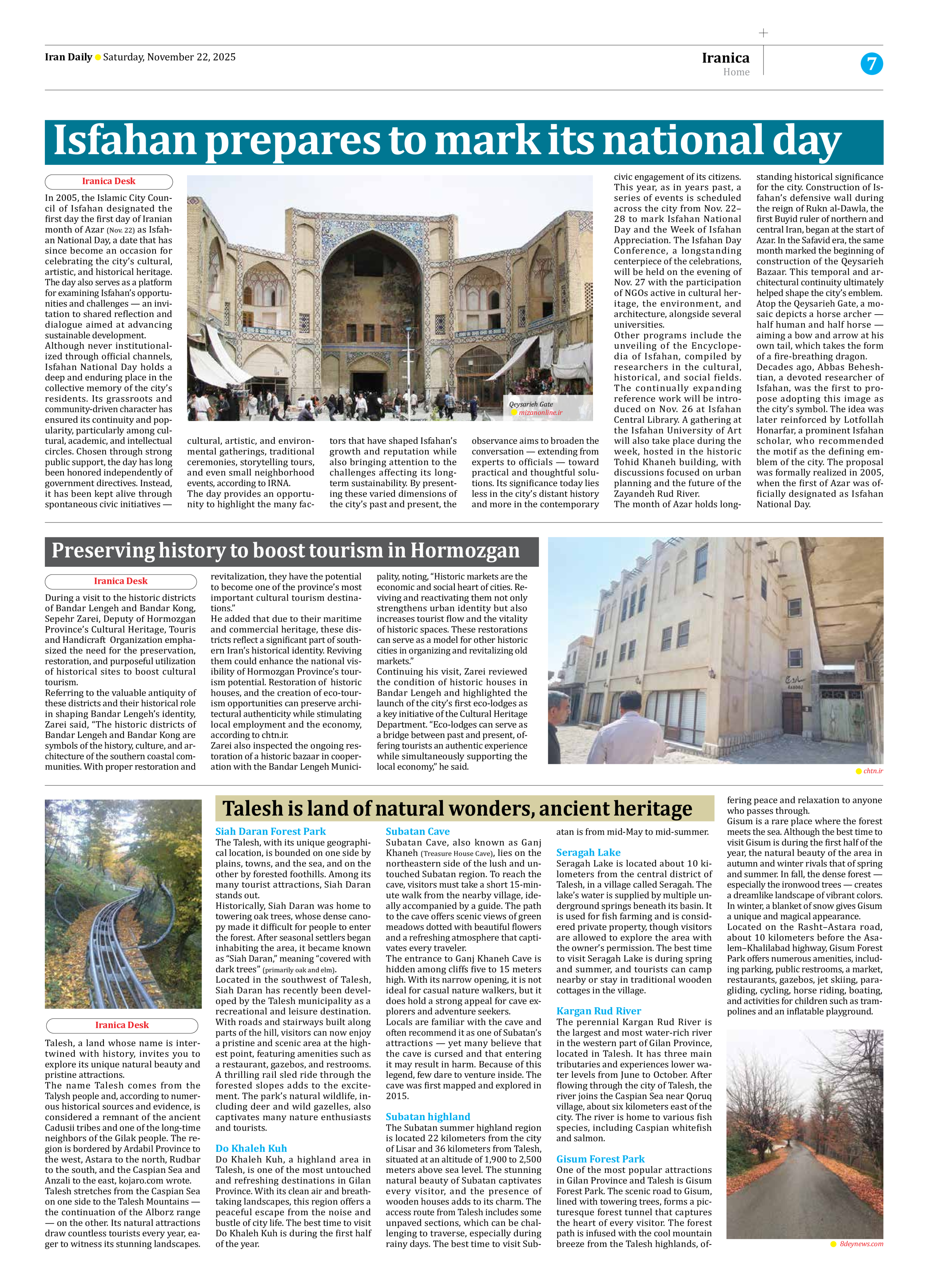
The month of Azar holds longstanding historical significance for the city. Construction of Isfahan’s defensive wall during the reign of Rukn al-Dawla, the first Buyid ruler of northern and central Iran, began at the start of Azar. In the Safavid era, the same month marked the beginning of construction of the Qeysarieh Bazaar. This temporal and architectural continuity ultimately helped shape the city’s emblem.
Atop the Qeysarieh Gate, a mosaic depicts a horse archer — half human and half horse — aiming a bow and arrow at his own tail, which takes the form of a fire-breathing dragon.
Decades ago, Abbas Beheshtian, a devoted researcher of Isfahan, was the first to propose adopting this image as the city’s symbol. The idea was later reinforced by Lotfollah Honarfar, a prominent Isfahan scholar, who recommended the motif as the defining emblem of the city. The proposal was formally realized in 2005, when the first of Azar was officially designated as Isfahan National Day.