







West Azarbaijan Province welcoming tourists with history, nature
West Azarbaijan Province can rightly be called the “Rainbow of Tourism.” Its breathtaking blend of historical and natural attractions, combined with a remarkable diversity of ethnicities and religions, has turned the province into a vibrant symbol of freedom, dignity, and respect.
According to IRNA, the rich variety of ethnic groups and faiths in the region has given rise to unique historical and natural landmarks, as well as diverse customs and cultural traditions — each serving as a distinct ambassador of West Azarbaijan’s beauty and a magnet for visitors.
Here, mosques and churches stand side by side; the call to prayer from minarets harmonizes with the ringing of church bells. Local dialects, historical sites, diverse cuisines, unparalleled folklore and literature, and traditional dances reflecting unity and solidarity — all together tell the story of this land’s deep-rooted culture and history. Each aspect paints a vivid portrait of the province’s unmatched heritage, captivating visitors with its authenticity and charm.
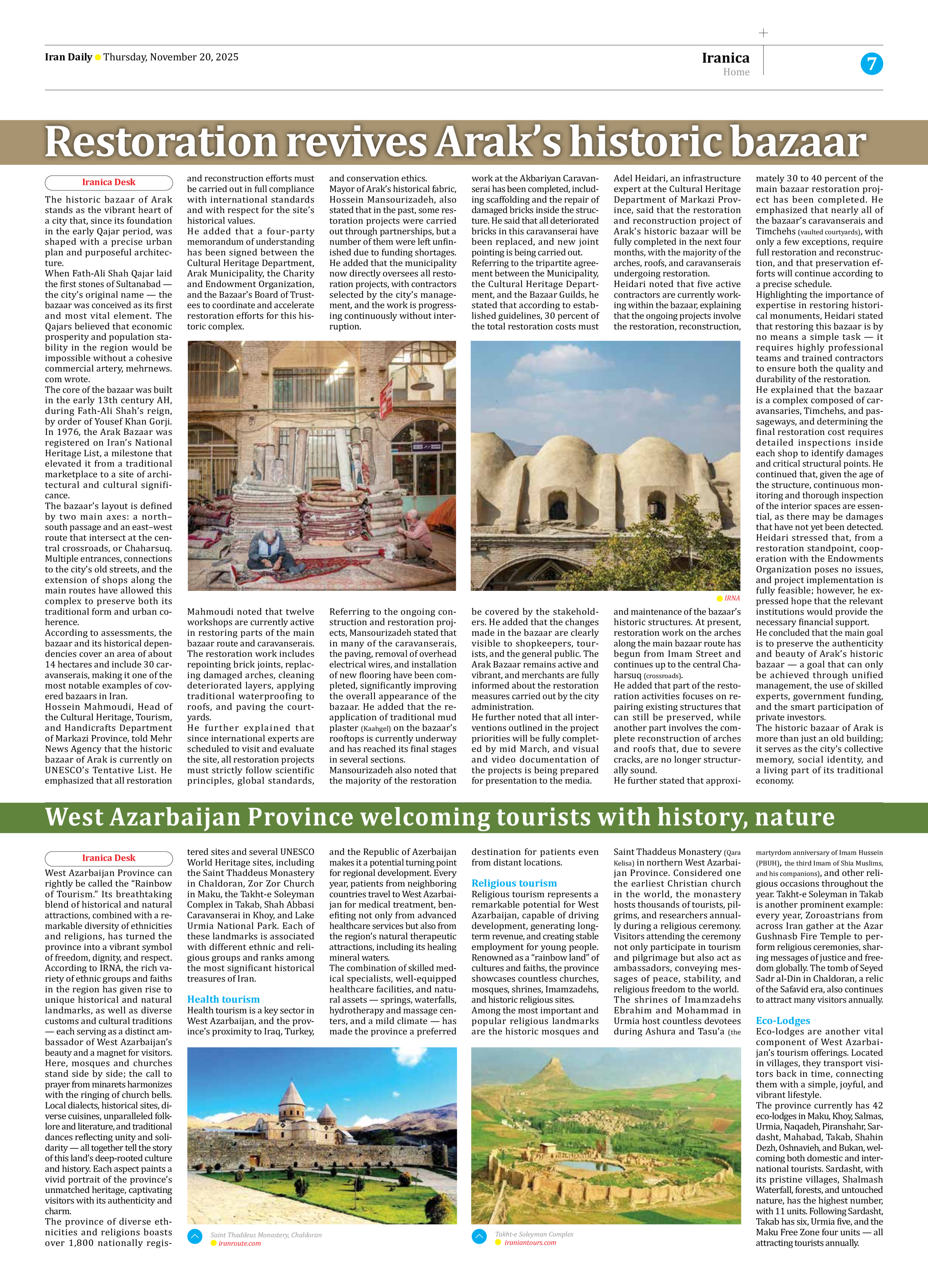
The province of diverse ethnicities and religions boasts over 1,800 nationally registered sites and several UNESCO World Heritage sites, including the Saint Thaddeus Monastery in Chaldoran, Zor Zor Church in Maku, the Takht-e Soleyman Complex in Takab, Shah Abbasi Caravanserai in Khoy, and Lake Urmia National Park. Each of these landmarks is associated with different ethnic and religious groups and ranks among the most significant historical treasures of Iran.
Health tourism
Health tourism is a key sector in West Azarbaijan, and the province’s proximity to Iraq, Turkey, and the Republic of Azerbaijan makes it a potential turning point for regional development. Every year, patients from neighboring countries travel to West Azarbaijan for medical treatment, benefiting not only from advanced healthcare services but also from the region’s natural therapeutic attractions, including its healing mineral waters.
The combination of skilled medical specialists, well-equipped healthcare facilities, and natural assets — springs, waterfalls, hydrotherapy and massage centers, and a mild climate — has made the province a preferred destination for patients even from distant locations.
Religious tourism
Religious tourism represents a remarkable potential for West Azarbaijan, capable of driving development, generating long-term revenue, and creating stable employment for young people. Renowned as a “rainbow land” of cultures and faiths, the province showcases countless churches, mosques, shrines, Imamzadehs, and historic religious sites.
Among the most important and popular religious landmarks are the historic mosques and Saint Thaddeus Monastery (Qara Kelisa) in northern West Azarbaijan Province. Considered one the earliest Christian church in the world, the monastery hosts thousands of tourists, pilgrims, and researchers annually during a religious ceremony. Visitors attending the ceremony not only participate in tourism and pilgrimage but also act as ambassadors, conveying messages of peace, stability, and religious freedom to the world.
The shrines of Imamzadehs Ebrahim and Mohammad in Urmia host countless devotees during Ashura and Tasu’a (the martyrdom anniversary of Imam Hussein (PBUH),(the third Imam of Shia Muslims, and his companions), and other religious occasions throughout the year. Takht-e Soleyman in Takab is another prominent example: every year, Zoroastrians from across Iran gather at the Azar Gushnasb Fire Temple to perform religious ceremonies, sharing messages of justice and freedom globally. The tomb of Seyed Sadr al-Din in Chaldoran, a relic of the Safavid era, also continues to attract many visitors annually.
Eco-Lodges
Eco-lodges are another vital component of West Azarbaijan’s tourism offerings. Located in villages, they transport visitors back in time, connecting them with a simple, joyful, and vibrant lifestyle.
The province currently has 42 eco-lodges in Maku, Khoy, Salmas, Urmia, Naqadeh, Piranshahr, Sardasht, Mahabad, Takab, Shahin Dezh, Oshnavieh, and Bukan, welcoming both domestic and international tourists. Sardasht, with its pristine villages, Shalmash Waterfall, forests, and untouched nature, has the highest number, with 11 units. Following Sardasht, Takab has six, Urmia five, and the Maku Free Zone four units — all attracting tourists annually.