







Restoration revives Arak’s historic bazaar
The historic bazaar of Arak stands as the vibrant heart of a city that, since its foundation in the early Qajar period, was shaped with a precise urban plan and purposeful architecture.
When Fath-Ali Shah Qajar laid the first stones of Sultanabad — the city’s original name — the bazaar was conceived as its first and most vital element. The Qajars believed that economic prosperity and population stability in the region would be impossible without a cohesive commercial artery, mehrnews.com wrote.
The core of the bazaar was built in the early 13th century AH, during Fath-Ali Shah’s reign, by order of Yousef Khan Gorji. In 1976, the Arak Bazaar was registered on Iran’s National Heritage List, a milestone that elevated it from a traditional marketplace to a site of architectural and cultural significance.
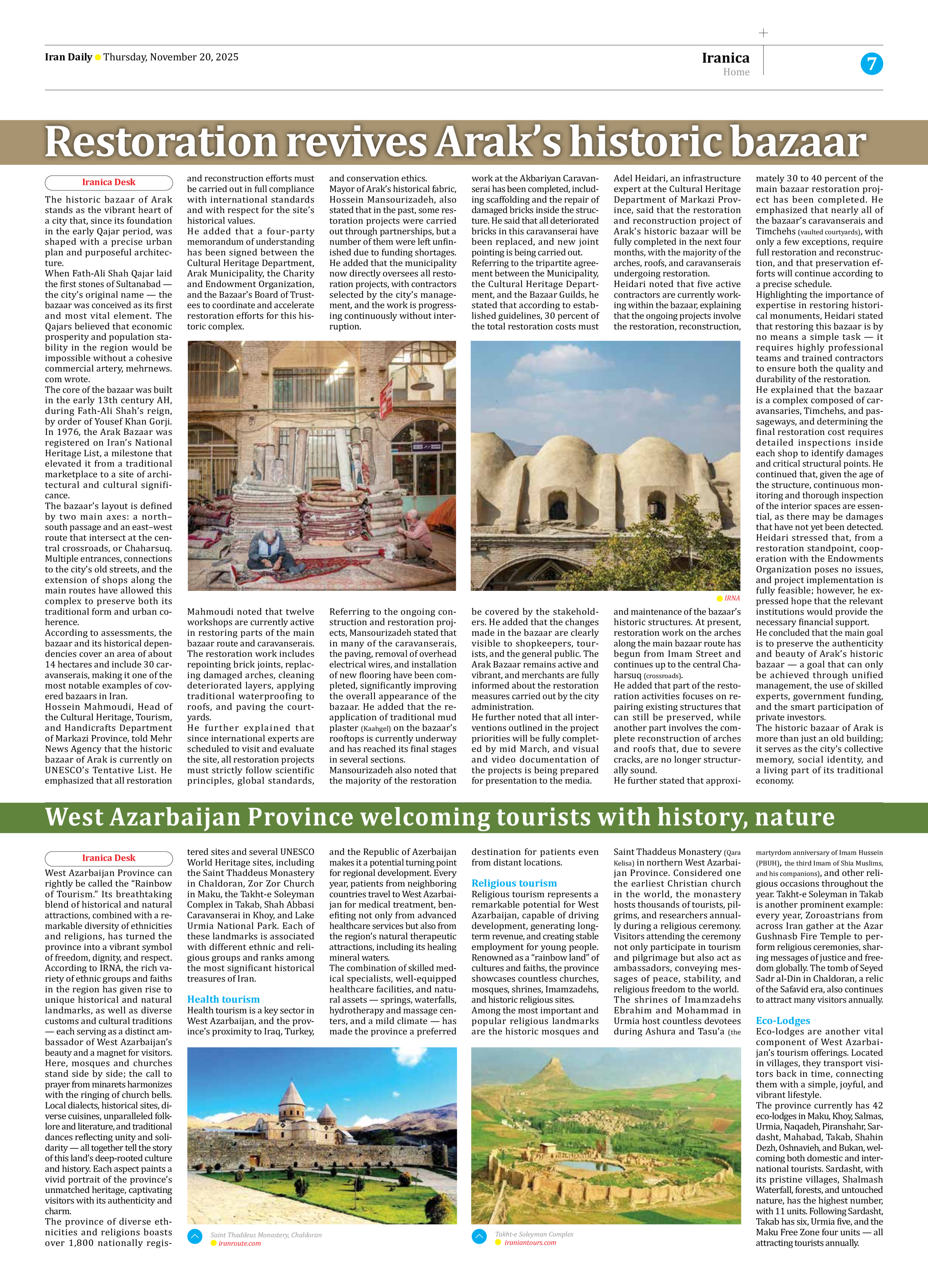
The bazaar’s layout is defined by two main axes: a north–south passage and an east–west route that intersect at the central crossroads, or Chaharsuq. Multiple entrances, connections to the city’s old streets, and the extension of shops along the main routes have allowed this complex to preserve both its traditional form and urban coherence.
According to assessments, the bazaar and its historical dependencies cover an area of about 14 hectares and include 30 caravanserais, making it one of the most notable examples of covered bazaars in Iran.
Hossein Mahmoudi, Head of the Cultural Heritage, Tourism, and Handicrafts Department of Markazi Province, told Mehr News Agency that the historic bazaar of Arak is currently on UNESCO’s Tentative List. He emphasized that all restoration and reconstruction efforts must be carried out in full compliance with international standards and with respect for the site’s historical values.
He added that a four-party memorandum of understanding has been signed between the Cultural Heritage Department, Arak Municipality, the Charity and Endowment Organization, and the Bazaar’s Board of Trustees to coordinate and accelerate restoration efforts for this historic complex.
Mahmoudi noted that twelve workshops are currently active in restoring parts of the main bazaar route and caravanserais. The restoration work includes repointing brick joints, replacing damaged arches, cleaning deteriorated layers, applying traditional waterproofing to roofs, and paving the courtyards.
He further explained that since international experts are scheduled to visit and evaluate the site, all restoration projects must strictly follow scientific principles, global standards, and conservation ethics.
Mayor of Arak’s historical fabric, Hossein Mansourizadeh, also stated that in the past, some restoration projects were carried out through partnerships, but a number of them were left unfinished due to funding shortages. He added that the municipality now directly oversees all restoration projects, with contractors selected by the city’s management, and the work is progressing continuously without interruption.
Referring to the ongoing construction and restoration projects, Mansourizadeh stated that in many of the caravanserais, the paving, removal of overhead electrical wires, and installation of new flooring have been completed, significantly improving the overall appearance of the bazaar. He added that the reapplication of traditional mud plaster (Kaahgel) on the bazaar’s rooftops is currently underway and has reached its final stages in several sections.
Mansourizadeh also noted that the majority of the restoration work at the Akbariyan Caravanserai has been completed, including scaffolding and the repair of damaged bricks inside the structure. He said that all deteriorated bricks in this caravanserai have been replaced, and new joint pointing is being carried out.
Referring to the tripartite agreement between the Municipality, the Cultural Heritage Department, and the Bazaar Guilds, he stated that according to established guidelines, 30 percent of the total restoration costs must be covered by the stakeholders. He added that the changes made in the bazaar are clearly visible to shopkeepers, tourists, and the general public. The Arak Bazaar remains active and vibrant, and merchants are fully informed about the restoration measures carried out by the city administration.
He further noted that all interventions outlined in the project priorities will be fully completed by mid March, and visual and video documentation of the projects is being prepared for presentation to the media.
Adel Heidari, an infrastructure expert at the Cultural Heritage Department of Markazi Province, said that the restoration and reconstruction project of Arak’s historic bazaar will be fully completed in the next four months, with the majority of the arches, roofs, and caravanserais undergoing restoration.
Heidari noted that five active contractors are currently working within the bazaar, explaining that the ongoing projects involve the restoration, reconstruction, and maintenance of the bazaar’s historic structures. At present, restoration work on the arches along the main bazaar route has begun from Imam Street and continues up to the central Chaharsuq (crossroads).
He added that part of the restoration activities focuses on repairing existing structures that can still be preserved, while another part involves the complete reconstruction of arches and roofs that, due to severe cracks, are no longer structurally sound.
He further stated that approximately 30 to 40 percent of the main bazaar restoration project has been completed. He emphasized that nearly all of the bazaar’s caravanserais and Timchehs (vaulted courtyards), with only a few exceptions, require full restoration and reconstruction, and that preservation efforts will continue according to a precise schedule.
Highlighting the importance of expertise in restoring historical monuments, Heidari stated that restoring this bazaar is by no means a simple task — it requires highly professional teams and trained contractors to ensure both the quality and durability of the restoration.
He explained that the bazaar is a complex composed of caravansaries, Timchehs, and passageways, and determining the final restoration cost requires detailed inspections inside each shop to identify damages and critical structural points. He continued that, given the age of the structure, continuous monitoring and thorough inspection of the interior spaces are essential, as there may be damages that have not yet been detected.
Heidari stressed that, from a restoration standpoint, cooperation with the Endowments Organization poses no issues, and project implementation is fully feasible; however, he expressed hope that the relevant institutions would provide the necessary financial support.
He concluded that the main goal is to preserve the authenticity and beauty of Arak’s historic bazaar — a goal that can only be achieved through unified management, the use of skilled experts, government funding, and the smart participation of private investors.
The historic bazaar of Arak is more than just an old building; it serves as the city’s collective memory, social identity, and a living part of its traditional economy.