







Ista village resists flow of time
Among the towering peaks of Taleqan, Alborz Province, where the morning mist settles on the tree branches like a heavy blanket and the cool breeze carries the scent of damp soil through the valleys, lies a small, hidden village. As you step into this secluded place, it feels as though you’ve crossed a threshold into another world — one where time has turned back two centuries. The honking of car horns, the chaos of city streets, and the glare of neon lights have no meaning here. Only the sound of footsteps on cobblestones, the whisper of wind through the trees, and the murmur of a small river fill the air.
Ista is a place untouched by the haste of modern life. Every movement, decision, and gesture unfolds with calm deliberation, as though every moment carries weight and every breath tells a story. The residents of this quiet settlement have chosen a life that is simple, unadorned, and deeply meaningful — a conscious return to the way their ancestors lived some 200 years ago.
The name Ista itself is a recent one. Officially, the area is not even classified as a village. Its lands were once purchased by families from Tabriz. Later, when Alborz researcher and author Hossein Askari visited the area to study the local way of life, he suggested the name “Ista,” a word that perfectly captures the spirit of the place — a life that stands firm against the rush of modernity, quietly removed from the flow of time, chtn.ir wrote.
Here, life follows the rhythm of nature. The villagers cook with organic ingredients, heat their homes and bake bread using wood-fired stoves, and light their nights with lanterns instead of electricity. The moon and the sun serve as their natural clocks; each activity is planned in harmony with the rhythms of the earth.
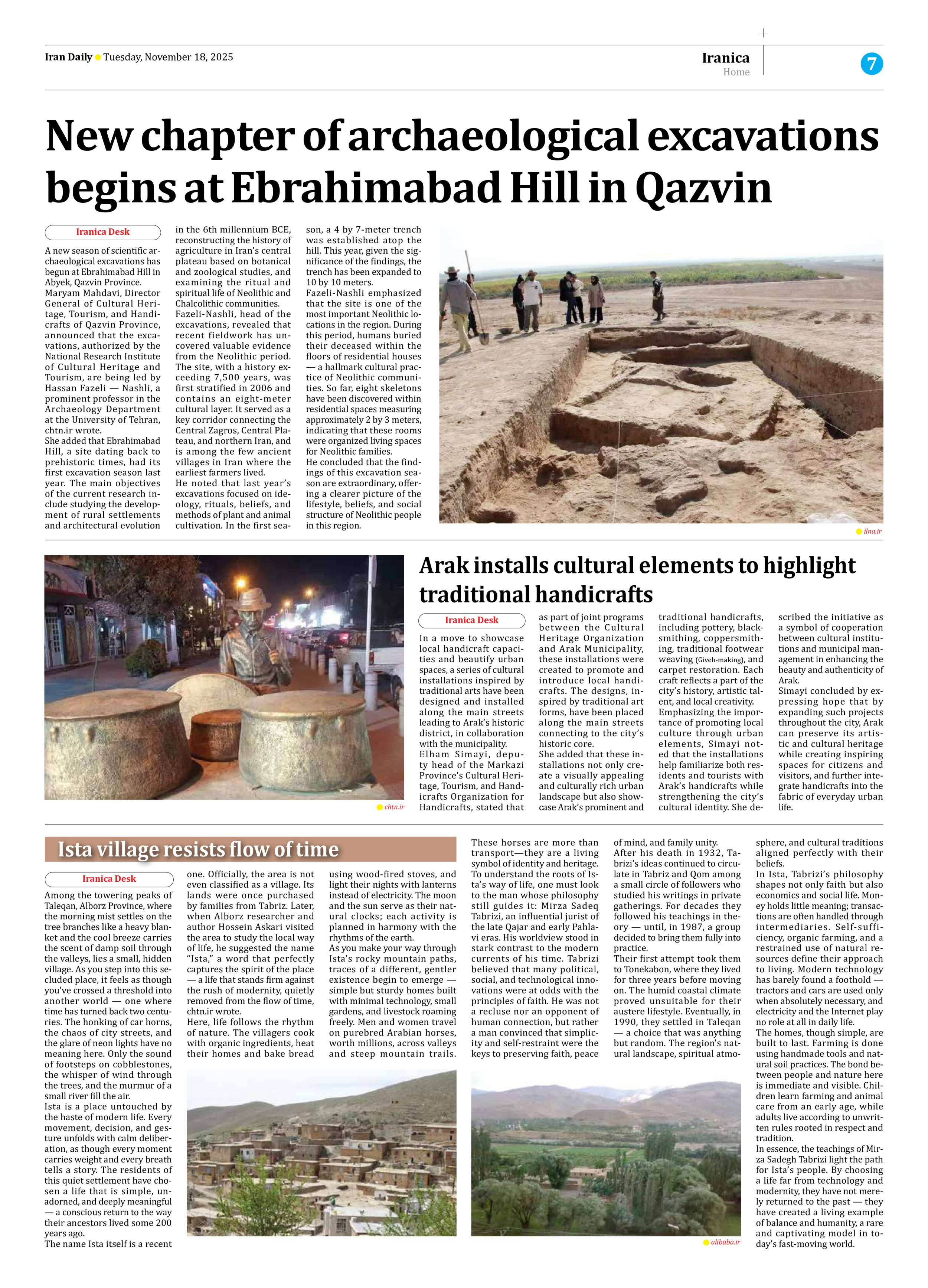
As you make your way through Ista’s rocky mountain paths, traces of a different, gentler existence begin to emerge — simple but sturdy homes built with minimal technology, small gardens, and livestock roaming freely. Men and women travel on purebred Arabian horses, worth millions, across valleys and steep mountain trails. These horses are more than transport—they are a living symbol of identity and heritage.
To understand the roots of Ista’s way of life, one must look to the man whose philosophy still guides it: Mirza Sadeq Tabrizi, an influential jurist of the late Qajar and early Pahlavi eras. His worldview stood in stark contrast to the modern currents of his time. Tabrizi believed that many political, social, and technological innovations were at odds with the principles of faith. He was not a recluse nor an opponent of human connection, but rather a man convinced that simplicity and self-restraint were the keys to preserving faith, peace of mind, and family unity.
After his death in 1932, Tabrizi’s ideas continued to circulate in Tabriz and Qom among a small circle of followers who studied his writings in private gatherings. For decades they followed his teachings in theory — until, in 1987, a group decided to bring them fully into practice.
Their first attempt took them to Tonekabon, where they lived for three years before moving on. The humid coastal climate proved unsuitable for their austere lifestyle. Eventually, in 1990, they settled in Taleqan — a choice that was anything but random. The region’s natural landscape, spiritual atmosphere, and cultural traditions aligned perfectly with their beliefs.
In Ista, Tabrizi’s philosophy shapes not only faith but also economics and social life. Money holds little meaning; transactions are often handled through intermediaries. Self-sufficiency, organic farming, and a restrained use of natural resources define their approach to living. Modern technology has barely found a foothold — tractors and cars are used only when absolutely necessary, and electricity and the Internet play no role at all in daily life.
The homes, though simple, are built to last. Farming is done using handmade tools and natural soil practices. The bond between people and nature here is immediate and visible. Children learn farming and animal care from an early age, while adults live according to unwritten rules rooted in respect and tradition.
In essence, the teachings of Mirza Sadegh Tabrizi light the path for Ista’s people. By choosing a life far from technology and modernity, they have not merely returned to the past — they have created a living example of balance and humanity, a rare and captivating model in today’s fast-moving world.