







New chapter of archaeological excavations begins at Ebrahimabad Hill in Qazvin
A new season of scientific archaeological excavations has begun at Ebrahimabad Hill in Abyek, Qazvin Province.
Maryam Mahdavi, Director General of Cultural Heritage, Tourism, and Handicrafts of Qazvin Province, announced that the excavations, authorized by the National Research Institute of Cultural Heritage and Tourism, are being led by Hassan Fazeli — Nashli, a prominent professor in the Archaeology Department at the University of Tehran, chtn.ir wrote.
She added that Ebrahimabad Hill, a site dating back to prehistoric times, had its first excavation season last year. The main objectives of the current research include studying the development of rural settlements and architectural evolution in the 6th millennium BCE, reconstructing the history of agriculture in Iran’s central plateau based on botanical and zoological studies, and examining the ritual and spiritual life of Neolithic and Chalcolithic communities.
Fazeli-Nashli, head of the excavations, revealed that recent fieldwork has uncovered valuable evidence from the Neolithic period. The site, with a history exceeding 7,500 years, was first stratified in 2006 and contains an eight-meter cultural layer. It served as a key corridor connecting the Central Zagros, Central Plateau, and northern Iran, and is among the few ancient villages in Iran where the earliest farmers lived.
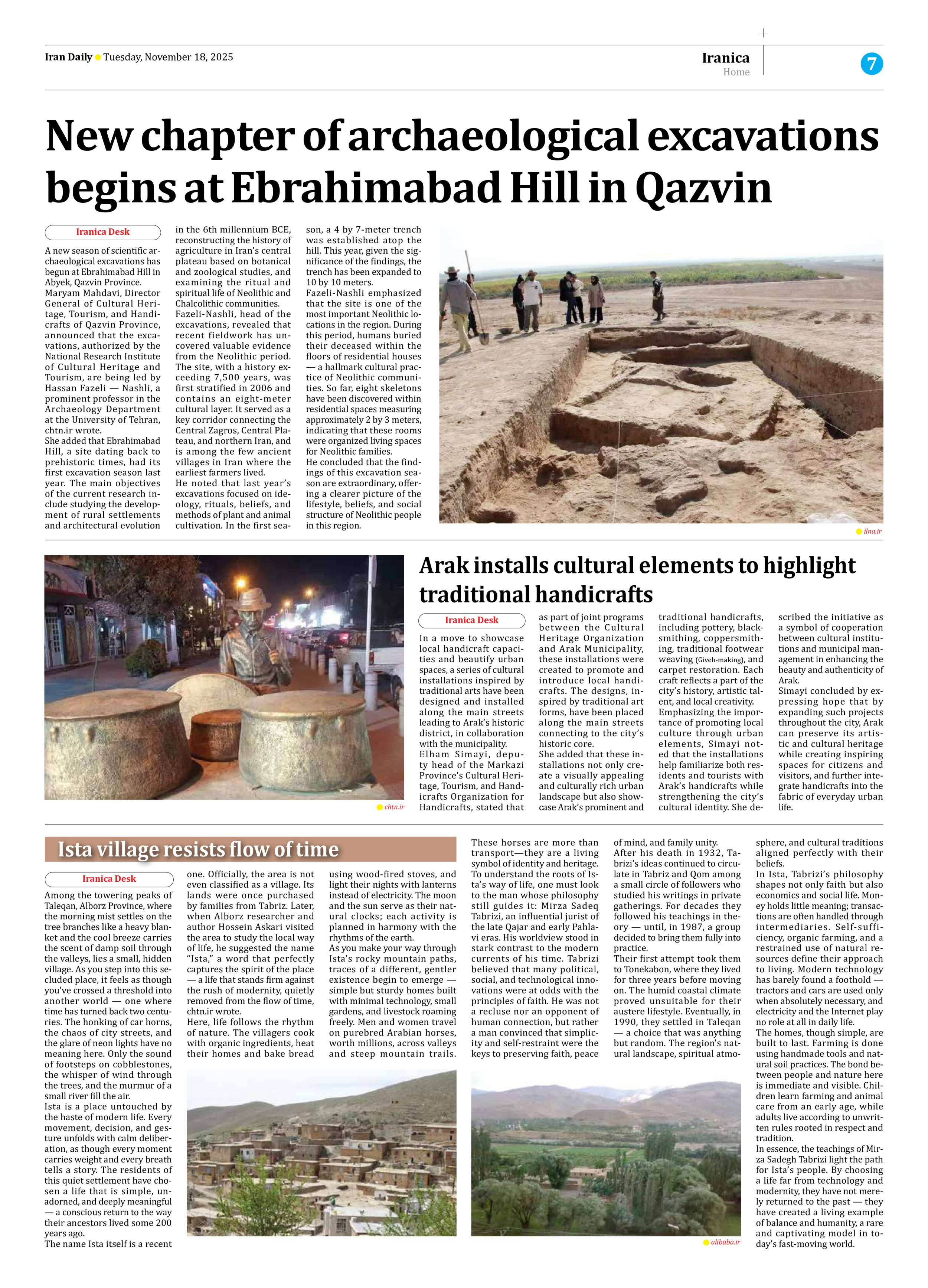
He noted that last year’s excavations focused on ideology, rituals, beliefs, and methods of plant and animal cultivation. In the first season, a 4 by 7-meter trench was established atop the hill. This year, given the significance of the findings, the trench has been expanded to 10 by 10 meters.
Fazeli-Nashli emphasized that the site is one of the most important Neolithic locations in the region. During this period, humans buried their deceased within the floors of residential houses — a hallmark cultural practice of Neolithic communities. So far, eight skeletons have been discovered within residential spaces measuring approximately 2 by 3 meters, indicating that these rooms were organized living spaces for Neolithic families.
He concluded that the findings of this excavation season are extraordinary, offering a clearer picture of the lifestyle, beliefs, and social structure of Neolithic people in this region.