





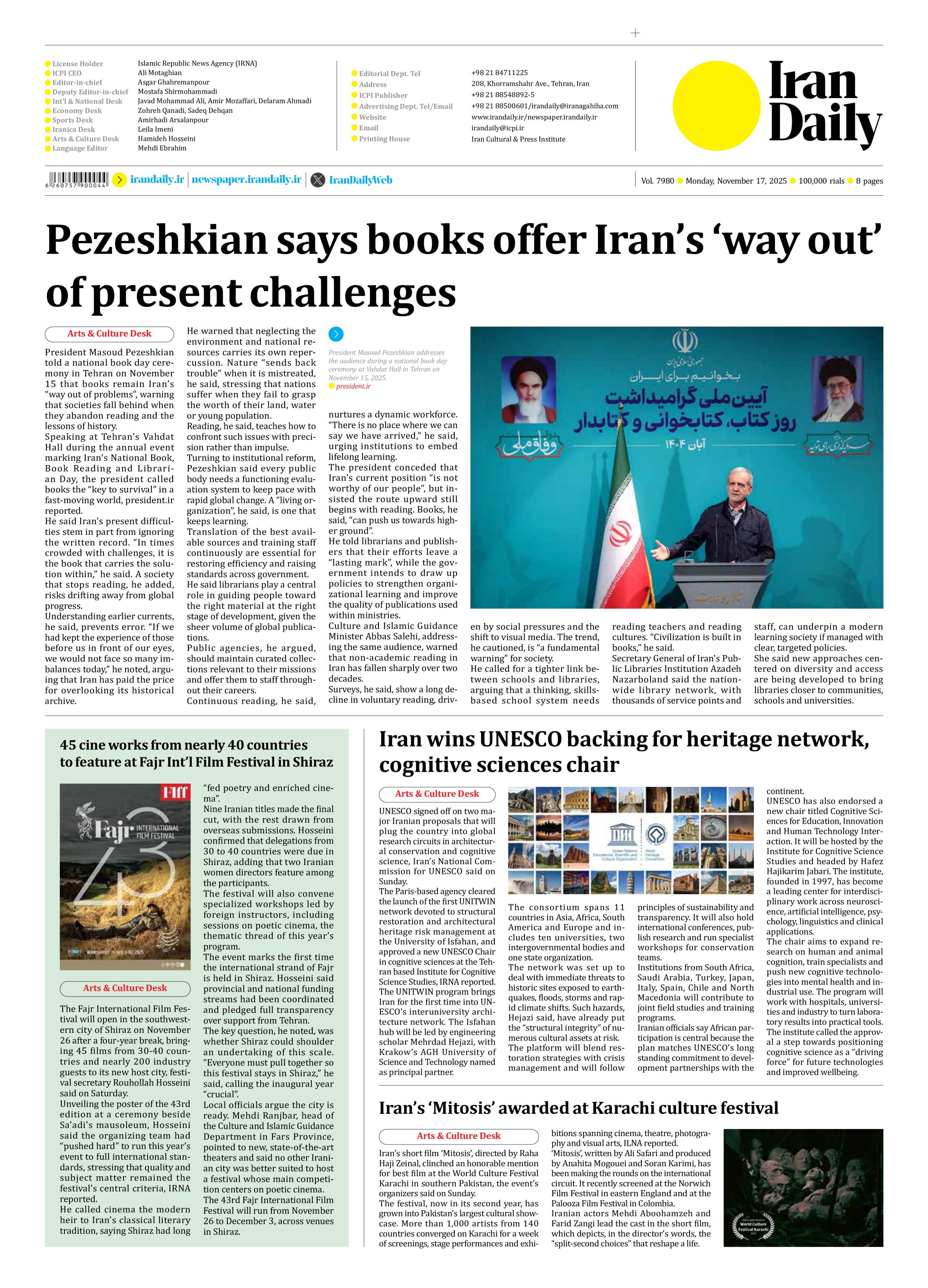


Iran wins UNESCO backing for heritage network, cognitive sciences chair
UNESCO signed off on two major Iranian proposals that will plug the country into global research circuits in architectural conservation and cognitive science, Iran’s National Commission for UNESCO said on Sunday.
The Paris-based agency cleared the launch of the first UNITWIN network devoted to structural restoration and architectural heritage risk management at the University of Isfahan, and approved a new UNESCO Chair in cognitive sciences at the Tehran based Institute for Cognitive Science Studies, IRNA reported.
The UNITWIN program brings Iran for the first time into UNESCO’s interuniversity architecture network. The Isfahan hub will be led by engineering scholar Mehrdad Hejazi, with Krakow’s AGH University of Science and Technology named as principal partner.
The consortium spans 11 countries in Asia, Africa, South America and Europe and includes ten universities, two intergovernmental bodies and one state organization.
The network was set up to deal with immediate threats to historic sites exposed to earthquakes, floods, storms and rapid climate shifts. Such hazards, Hejazi said, have already put the “structural integrity” of numerous cultural assets at risk.
The platform will blend restoration strategies with crisis management and will follow principles of sustainability and transparency. It will also hold international conferences, publish research and run specialist workshops for conservation teams.
Institutions from South Africa, Saudi Arabia, Turkey, Japan, Italy, Spain, Chile and North Macedonia will contribute to joint field studies and training programs.
Iranian officials say African participation is central because the plan matches UNESCO’s long standing commitment to development partnerships with the continent.
UNESCO has also endorsed a new chair titled Cognitive Sciences for Education, Innovation and Human Technology Interaction. It will be hosted by the Institute for Cognitive Science Studies and headed by Hafez Hajikarim Jabari. The institute, founded in 1997, has become a leading center for interdisciplinary work across neuroscience, artificial intelligence, psychology, linguistics and clinical applications.
The chair aims to expand research on human and animal cognition, train specialists and push new cognitive technologies into mental health and industrial use. The program will work with hospitals, universities and industry to turn laboratory results into practical tools. The institute called the approval a step towards positioning cognitive science as a “driving force” for future technologies and improved wellbeing.