







Pezeshkian says books offer Iran’s ‘way out’ of present challenges
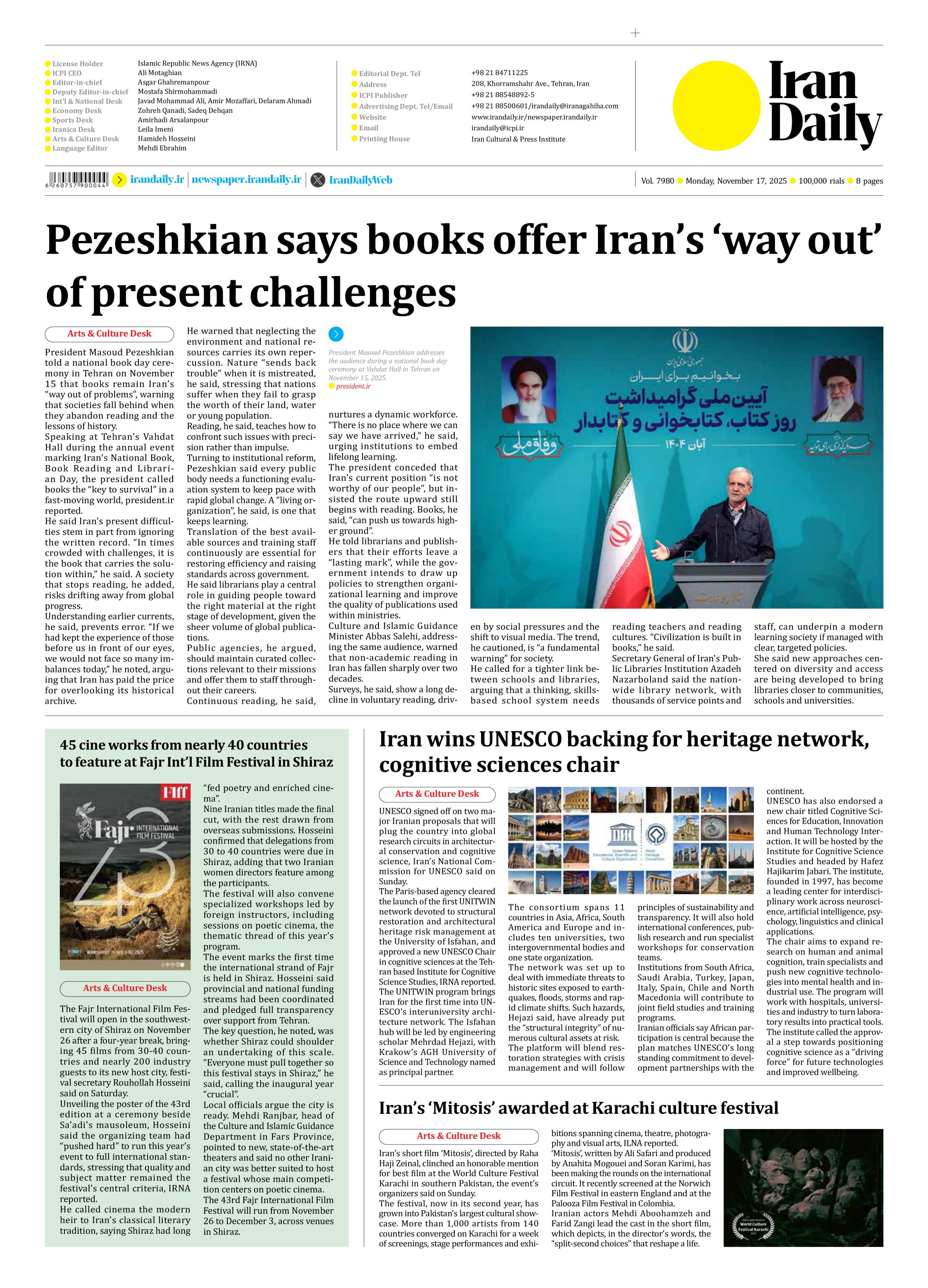
President Masoud Pezeshkian told a national book day ceremony in Tehran on November 15 that books remain Iran’s “way out of problems”, warning that societies fall behind when they abandon reading and the lessons of history.
Speaking at Tehran’s Vahdat Hall during the annual event marking Iran's National Book, Book Reading and Librarian Day, the president called books the “key to survival” in a fast-moving world, president.ir reported.
He said Iran’s present difficulties stem in part from ignoring the written record. “In times crowded with challenges, it is the book that carries the solution within,” he said. A society that stops reading, he added, risks drifting away from global progress.
Understanding earlier currents, he said, prevents error. “If we had kept the experience of those before us in front of our eyes, we would not face so many imbalances today,” he noted, arguing that Iran has paid the price for overlooking its historical archive.
He warned that neglecting the environment and national resources carries its own repercussion. Nature “sends back trouble” when it is mistreated, he said, stressing that nations suffer when they fail to grasp the worth of their land, water or young population.
Reading, he said, teaches how to confront such issues with precision rather than impulse.
Turning to institutional reform, Pezeshkian said every public body needs a functioning evaluation system to keep pace with rapid global change. A “living organization”, he said, is one that keeps learning.
Translation of the best available sources and training staff continuously are essential for restoring efficiency and raising standards across government.
He said librarians play a central role in guiding people toward the right material at the right stage of development, given the sheer volume of global publications.
Public agencies, he argued, should maintain curated collections relevant to their missions and offer them to staff throughout their careers.
Continuous reading, he said, nurtures a dynamic workforce. “There is no place where we can say we have arrived,” he said, urging institutions to embed lifelong learning.
The president conceded that Iran’s current position “is not worthy of our people”, but insisted the route upward still begins with reading. Books, he said, “can push us towards higher ground”.
He told librarians and publishers that their efforts leave a “lasting mark”, while the government intends to draw up policies to strengthen organizational learning and improve the quality of publications used within ministries.
Culture and Islamic Guidance Minister Abbas Salehi, addressing the same audience, warned that non-academic reading in Iran has fallen sharply over two decades.
Surveys, he said, show a long decline in voluntary reading, driven by social pressures and the shift to visual media. The trend, he cautioned, is “a fundamental warning” for society.
He called for a tighter link between schools and libraries, arguing that a thinking, skills-based school system needs reading teachers and reading cultures. “Civilization is built in books,” he said.
Secretary General of Iran's Public Libraries Institution Azadeh Nazarboland said the nationwide library network, with thousands of service points and staff, can underpin a modern learning society if managed with clear, targeted policies.
She said new approaches centered on diversity and access are being developed to bring libraries closer to communities, schools and universities.