







Copy in clipboard...
Iran launches first cloud seeding in water year amid record low precipitation
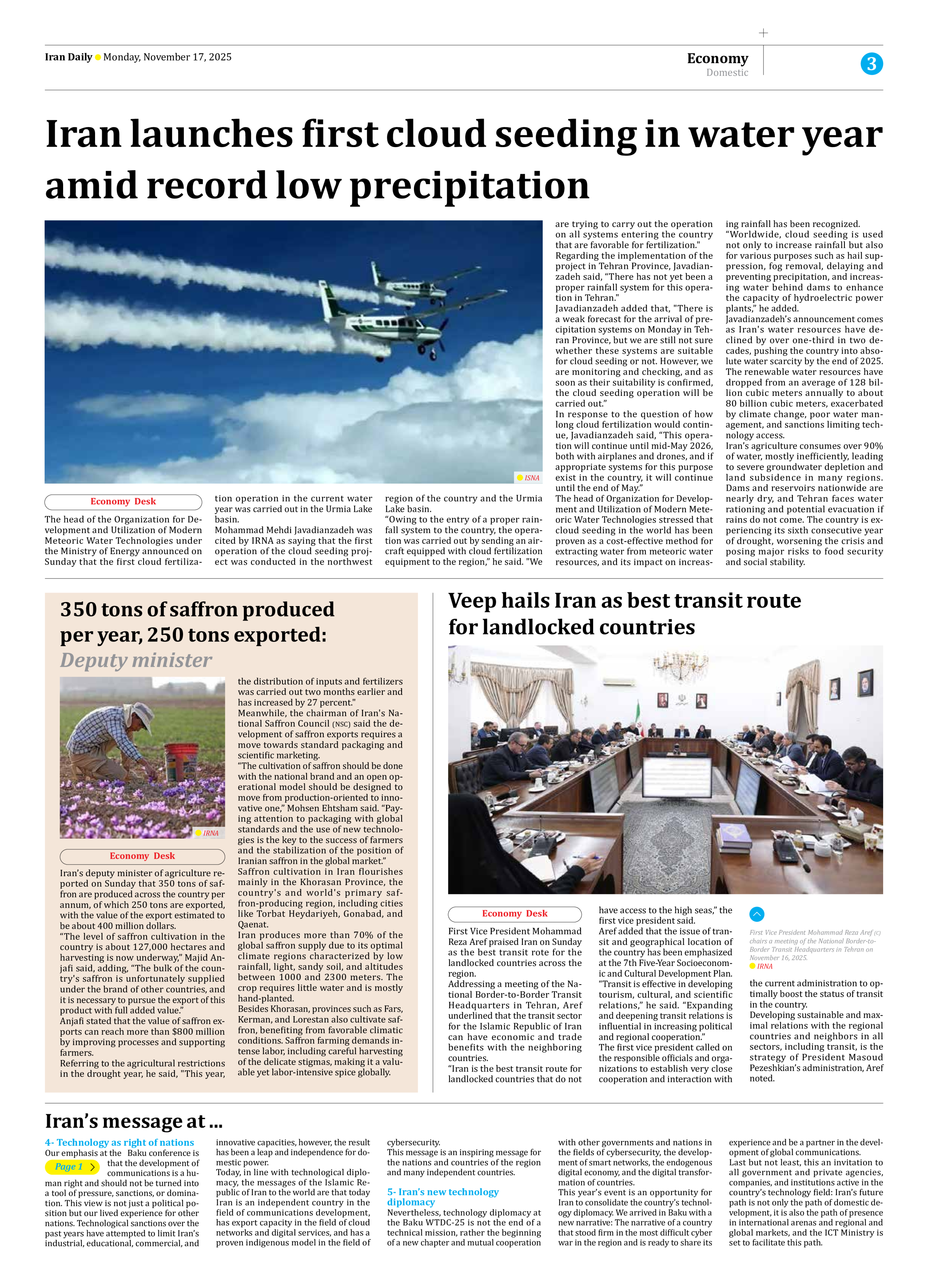
The head of the Organization for Development and Utilization of Modern Meteoric Water Technologies under the Ministry of Energy announced on Sunday that the first cloud fertilization operation in the current water year was carried out in the Urmia Lake basin.
Mohammad Mehdi Javadianzadeh was cited by IRNA as saying that the first operation of the cloud seeding project was conducted in the northwest region of the country and the Urmia Lake basin.
“Owing to the entry of a proper rainfall system to the country, the operation was carried out by sending an aircraft equipped with cloud fertilization equipment to the region,” he said. "We are trying to carry out the operation on all systems entering the country that are favorable for fertilization."
Regarding the implementation of the project in Tehran Province, Javadianzadeh said, “There has not yet been a proper rainfall system for this operation in Tehran."
Javadianzadeh added that, "There is a weak forecast for the arrival of precipitation systems on Monday in Tehran Province, but we are still not sure whether these systems are suitable for cloud seeding or not. However, we are monitoring and checking, and as soon as their suitability is confirmed, the cloud seeding operation will be carried out.”
In response to the question of how long cloud fertilization would continue, Javadianzadeh said, “This operation will continue until mid-May 2026, both with airplanes and drones, and if appropriate systems for this purpose exist in the country, it will continue until the end of May.”
The head of Organization for Development and Utilization of Modern Meteoric Water Technologies stressed that cloud seeding in the world has been proven as a cost-effective method for extracting water from meteoric water resources, and its impact on increasing rainfall has been recognized.
“Worldwide, cloud seeding is used not only to increase rainfall but also for various purposes such as hail suppression, fog removal, delaying and preventing precipitation, and increasing water behind dams to enhance the capacity of hydroelectric power plants,” he added.
Javadianzadeh’s announcement comes as Iran's water resources have declined by over one-third in two decades, pushing the country into absolute water scarcity by the end of 2025.
The renewable water resources have dropped from an average of 128 billion cubic meters annually to about 80 billion cubic meters, exacerbated by climate change, poor water management, and sanctions limiting technology access.
Iran’s agriculture consumes over 90% of water, mostly inefficiently, leading to severe groundwater depletion and land subsidence in many regions. Dams and reservoirs nationwide are nearly dry, and Tehran faces water rationing and potential evacuation if rains do not come. The country is experiencing its sixth consecutive year of drought, worsening the crisis and posing major risks to food security and social stability.