







Lawmaker urges action to develope infrastructure in Lut Desert
Tourism development in the Lut Desert, registered on UNESCO’s List, will be achieved only when integrated tourism routes are established across the provinces of South Khorasan, Kerman, and Sistan and Baluchestan, enabling visitors to experience the diverse attractions of eastern Iran in a single trip, said Mostafa Nakhai, Parliament representative for Nehbandan and Sarbisheh.
Speaking at the Fourth International Conference on Lut Desert hosted in Nehbandan, South Khorasan Province, on Thursday, he stated, “If we want the Lut Desert to be properly introduced and developed, we must adopt creative planning and take initiative. Holding conferences alone is not enough; a clear route must be designed for tourists that passes through key attractions in all three provinces.”
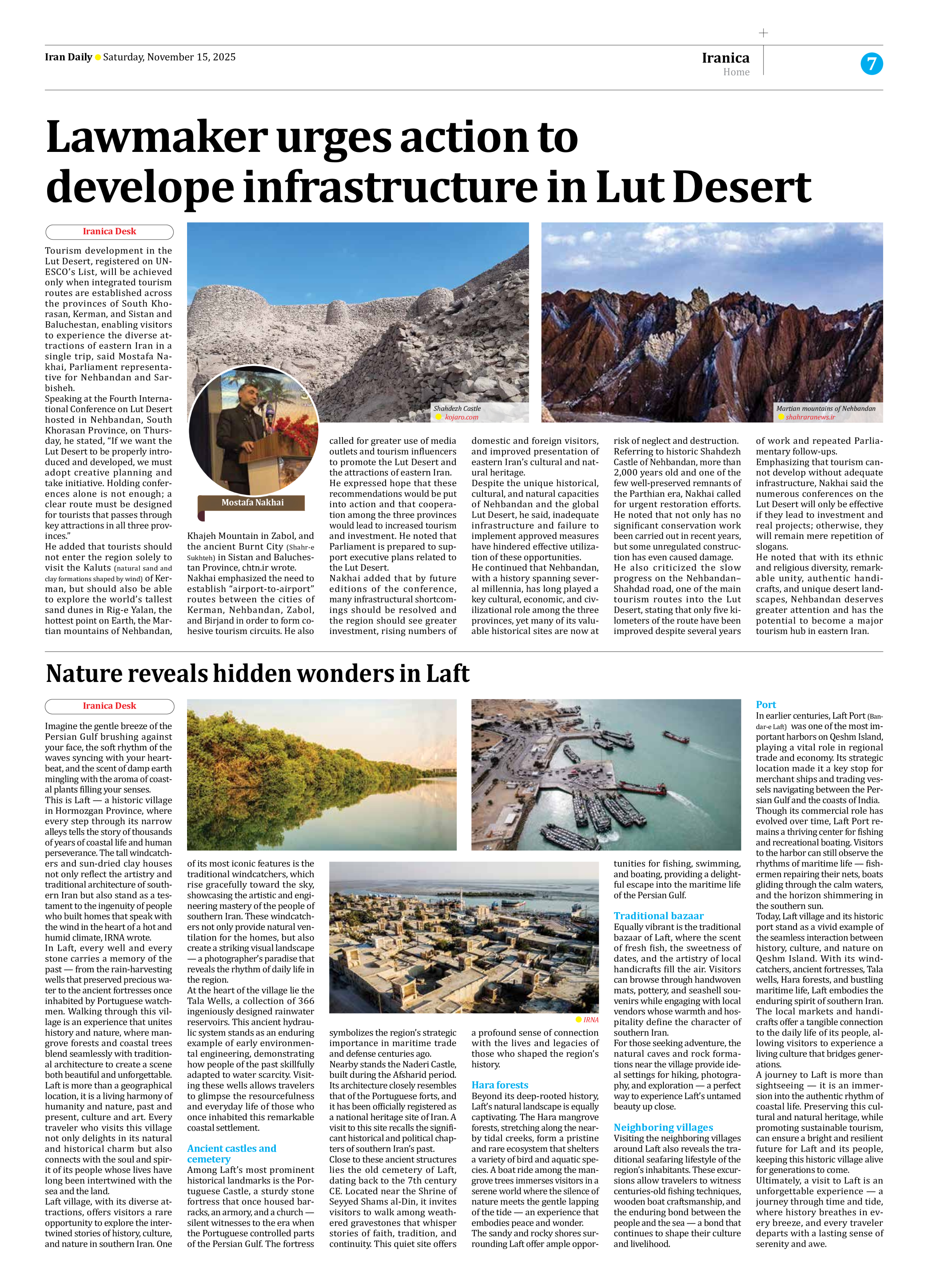
He added that tourists should not enter the region solely to visit the Kaluts (natural sand and clay formations shaped by wind) of Kerman, but should also be able to explore the world’s tallest sand dunes in Rig-e Yalan, the hottest point on Earth, the Martian mountains of Nehbandan, Khajeh Mountain in Zabol, and the ancient Burnt City (Shahr-e Sukhteh) in Sistan and Baluchestan Province, chtn.ir wrote.
Nakhai emphasized the need to establish “airport-to-airport” routes between the cities of Kerman, Nehbandan, Zabol, and Birjand in order to form cohesive tourism circuits. He also called for greater use of media outlets and tourism influencers to promote the Lut Desert and the attractions of eastern Iran.
He expressed hope that these recommendations would be put into action and that cooperation among the three provinces would lead to increased tourism and investment. He noted that Parliament is prepared to support executive plans related to the Lut Desert.
Nakhai added that by future editions of the conference, many infrastructural shortcomings should be resolved and the region should see greater investment, rising numbers of domestic and foreign visitors, and improved presentation of eastern Iran’s cultural and natural heritage.
Despite the unique historical, cultural, and natural capacities of Nehbandan and the global Lut Desert, he said, inadequate infrastructure and failure to implement approved measures have hindered effective utilization of these opportunities.
He continued that Nehbandan, with a history spanning several millennia, has long played a key cultural, economic, and civilizational role among the three provinces, yet many of its valuable historical sites are now at risk of neglect and destruction.
Referring to historic Shahdezh Castle of Nehbandan, more than 2,000 years old and one of the few well-preserved remnants of the Parthian era, Nakhai called for urgent restoration efforts. He noted that not only has no significant conservation work been carried out in recent years, but some unregulated construction has even caused damage.
He also criticized the slow progress on the Nehbandan–Shahdad road, one of the main tourism routes into the Lut Desert, stating that only five kilometers of the route have been improved despite several years of work and repeated Parliamentary follow-ups.
Emphasizing that tourism cannot develop without adequate infrastructure, Nakhai said the numerous conferences on the Lut Desert will only be effective if they lead to investment and real projects; otherwise, they will remain mere repetition of slogans.
He noted that with its ethnic and religious diversity, remarkable unity, authentic handicrafts, and unique desert landscapes, Nehbandan deserves greater attention and has the potential to become a major tourism hub in eastern Iran.