







JCPOA withdrawn from IAEA BoG’s agenda; Iran’s case limited to safeguards
According to a memo published by the Secretariat of the International Atomic Energy Agency (IAEA) on Friday, with the end of the period of Resolution 2231, the issue of Iran has been withdrawn from agenda under the 2015 nuclear deal — known as the Joint Comprehensive Plan of Action (JCPOA) — in the upcoming meeting of the Board of Governors and it will only be pursued within the framework of the Safeguards Agreement.
The IAEA Secretariat said in the memo that the meeting of the Board of Governors will be held in Vienna on Wednesday (November 19), and its topics will include issues such as the membership of countries, the report of technical cooperation, safety and transportation of radioactive materials, the verification status in North Korea and Syria, the nuclear propulsion case in Australia and Brazil, as well as the implementation of the safeguards agreements of the member states, including Iran.
In the agenda, as reported by IRNA, there is no mention of resolution 2231 and the JCPOA commitments, and the name of Iran is only mentioned in the Safeguards Agreement, an issue that shows that the pursuit of issues related to the JCPOA has been removed from the agenda of the Board of Governors.
With the end of the 10-year term of Resolution 2231 on October 18, the task of reporting the Director General on the implementation of Iran's JCPOA commitments has ended, and for this reason, Iran's case in the field of non-proliferation is no longer on the agenda of the Board of Governors.
Mikhail Ulyanov, Russia’s envoy to Vienna, said earlier that the IAEA would consider Iran’s nuclear activities only within the framework of the Comprehensive Safeguards Agreement. “We are witnessing new conditions surrounding Iran’s nuclear program.”
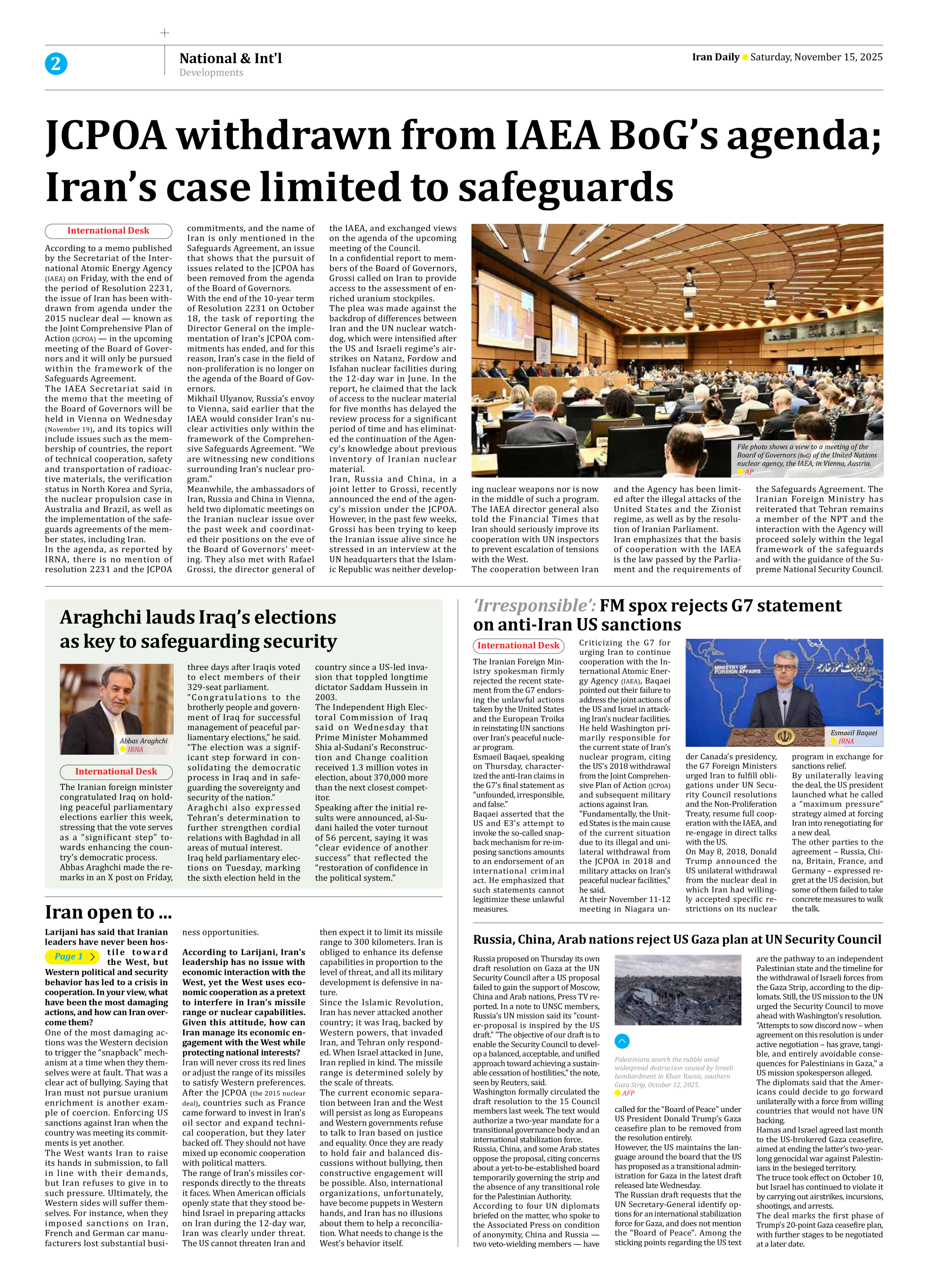
Meanwhile, the ambassadors of Iran, Russia and China in Vienna, held two diplomatic meetings on the Iranian nuclear issue over the past week and coordinated their positions on the eve of the Board of Governors' meeting. They also met with Rafael Grossi, the director general of the IAEA, and exchanged views on the agenda of the upcoming meeting of the Council.
In a confidential report to members of the Board of Governors, Grossi called on Iran to provide access to the assessment of enriched uranium stockpiles.
The plea was made against the backdrop of differences between Iran and the UN nuclear watchdog, which were intensified after the US and Israeli regime’s airstrikes on Natanz, Fordow and Isfahan nuclear facilities during the 12-day war in June. In the report, he claimed that the lack of access to the nuclear material for five months has delayed the review process for a significant period of time and has eliminated the continuation of the Agency's knowledge about previous inventory of Iranian nuclear material.
Iran, Russia and China, in a joint letter to Grossi, recently announced the end of the agency's mission under the JCPOA. However, in the past few weeks, Grossi has been trying to keep the Iranian issue alive since he stressed in an interview at the UN headquarters that the Islamic Republic was neither developing nuclear weapons nor is now in the middle of such a program.
The IAEA director general also told the Financial Times that Iran should seriously improve its cooperation with UN inspectors to prevent escalation of tensions with the West.
The cooperation between Iran and the Agency has been limited after the illegal attacks of the United States and the Zionist regime, as well as by the resolution of Iranian Parliament.
Iran emphasizes that the basis of cooperation with the IAEA is the law passed by the Parliament and the requirements of the Safeguards Agreement. The Iranian Foreign Ministry has reiterated that Tehran remains a member of the NPT and the interaction with the Agency will proceed solely within the legal framework of the safeguards and with the guidance of the Supreme National Security Council.