





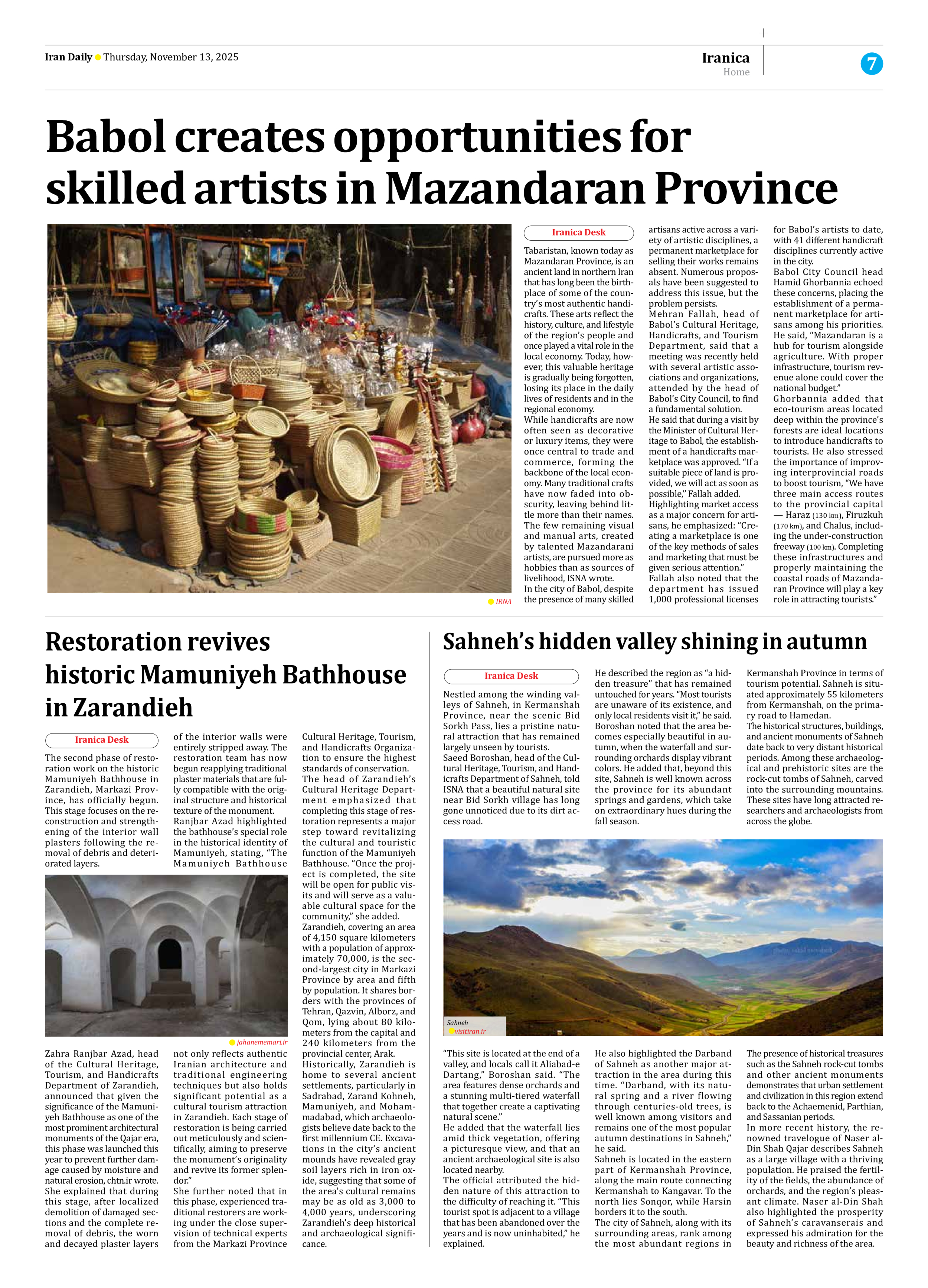


Restoration revives historic Mamuniyeh Bathhouse in Zarandieh
The second phase of restoration work on the historic Mamuniyeh Bathhouse in Zarandieh, Markazi Province, has officially begun. This stage focuses on the reconstruction and strengthening of the interior wall plasters following the removal of debris and deteriorated layers.
Zahra Ranjbar Azad, head of the Cultural Heritage, Tourism, and Handicrafts Department of Zarandieh, announced that given the significance of the Mamuniyeh Bathhouse as one of the most prominent architectural monuments of the Qajar era, this phase was launched this year to prevent further damage caused by moisture and natural erosion, chtn.ir wrote.
She explained that during this stage, after localized demolition of damaged sections and the complete removal of debris, the worn and decayed plaster layers of the interior walls were entirely stripped away. The restoration team has now begun reapplying traditional plaster materials that are fully compatible with the original structure and historical texture of the monument.
Ranjbar Azad highlighted the bathhouse’s special role in the historical identity of Mamuniyeh, stating, “The Mamuniyeh Bathhouse not only reflects authentic Iranian architecture and traditional engineering techniques but also holds significant potential as a cultural tourism attraction in Zarandieh. Each stage of restoration is being carried out meticulously and scientifically, aiming to preserve the monument’s originality and revive its former splendor.”
She further noted that in this phase, experienced traditional restorers are working under the close supervision of technical experts from the Markazi Province Cultural Heritage, Tourism, and Handicrafts Organization to ensure the highest standards of conservation.
The head of Zarandieh’s Cultural Heritage Department emphasized that completing this stage of restoration represents a major step toward revitalizing the cultural and touristic function of the Mamuniyeh Bathhouse. “Once the project is completed, the site will be open for public visits and will serve as a valuable cultural space for the community,” she added.
Zarandieh, covering an area of 4,150 square kilometers with a population of approximately 70,000, is the second-largest city in Markazi Province by area and fifth by population. It shares borders with the provinces of Tehran, Qazvin, Alborz, and Qom, lying about 80 kilometers from the capital and 240 kilometers from the provincial center, Arak.
Historically, Zarandieh is home to several ancient settlements, particularly in Sadrabad, Zarand Kohneh, Mamuniyeh, and Mohammadabad, which archaeologists believe date back to the first millennium CE. Excavations in the city’s ancient mounds have revealed gray soil layers rich in iron oxide, suggesting that some of the area’s cultural remains may be as old as 3,000 to 4,000 years, underscoring Zarandieh’s deep historical and archaeological significance.