







Babol creates opportunities for skilled artists in Mazandaran Province
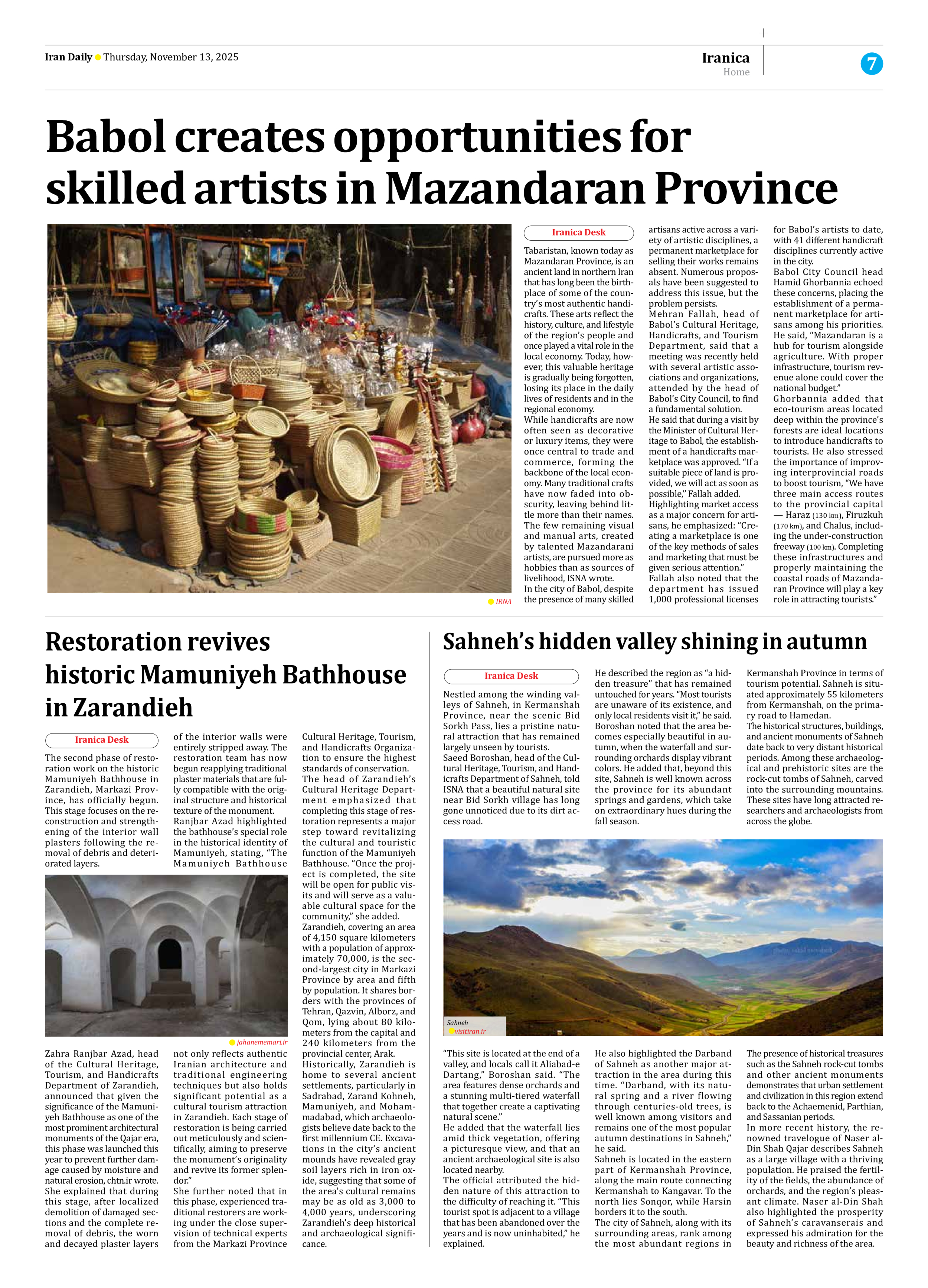
Tabaristan, known today as Mazandaran Province, is an ancient land in northern Iran that has long been the birthplace of some of the country’s most authentic handicrafts. These arts reflect the history, culture, and lifestyle of the region’s people and once played a vital role in the local economy. Today, however, this valuable heritage is gradually being forgotten, losing its place in the daily lives of residents and in the regional economy.
While handicrafts are now often seen as decorative or luxury items, they were once central to trade and commerce, forming the backbone of the local economy. Many traditional crafts have now faded into obscurity, leaving behind little more than their names. The few remaining visual and manual arts, created by talented Mazandarani artists, are pursued more as hobbies than as sources of livelihood, ISNA wrote.
In the city of Babol, despite the presence of many skilled artisans active across a variety of artistic disciplines, a permanent marketplace for selling their works remains absent. Numerous proposals have been suggested to address this issue, but the problem persists.
Mehran Fallah, head of Babol’s Cultural Heritage, Handicrafts, and Tourism Department, said that a meeting was recently held with several artistic associations and organizations, attended by the head of Babol’s City Council, to find a fundamental solution.
He said that during a visit by the Minister of Cultural Heritage to Babol, the establishment of a handicrafts marketplace was approved. “If a suitable piece of land is provided, we will act as soon as possible,” Fallah added.
Highlighting market access as a major concern for artisans, he emphasized: “Creating a marketplace is one of the key methods of sales and marketing that must be given serious attention.”
Fallah also noted that the department has issued 1,000 professional licenses for Babol’s artists to date, with 41 different handicraft disciplines currently active in the city.
Babol City Council head Hamid Ghorbannia echoed these concerns, placing the establishment of a permanent marketplace for artisans among his priorities. He said, “Mazandaran is a hub for tourism alongside agriculture. With proper infrastructure, tourism revenue alone could cover the national budget.”
Ghorbannia added that eco-tourism areas located deep within the province’s forests are ideal locations to introduce handicrafts to tourists. He also stressed the importance of improving interprovincial roads to boost tourism, “We have three main access routes to the provincial capital — Haraz (130 km), Firuzkuh (170 km), and Chalus, including the under-construction freeway (100 km). Completing these infrastructures and properly maintaining the coastal roads of Mazandaran Province will play a key role in attracting tourists.”