







Moscow says doubts E3’s ability to play ‘positive role’ in Iran nuclear issue
Iranian, Russian FMs discuss upcoming IAEA meeting
Russia's Permanent Representative to International Organizations in Vienna, Mikhail Ulyanov, on Wednesday expressed doubt about the European powers’ ability to play a positive role concerning Iran's nuclear program.
“Russia, China and Iran are major players in what regards the nuclear program of Iran. They decide to a significant extent how the situation will develop. The so-called E3 (UK, Germany and France) also has the right to express its viewpoint. But their ability to play a positive role is highly questionable,” Ulyanov said in a post on X.
His comments came nearly a week before a session of the International Atomic Energy Agency’s Board of Governors.
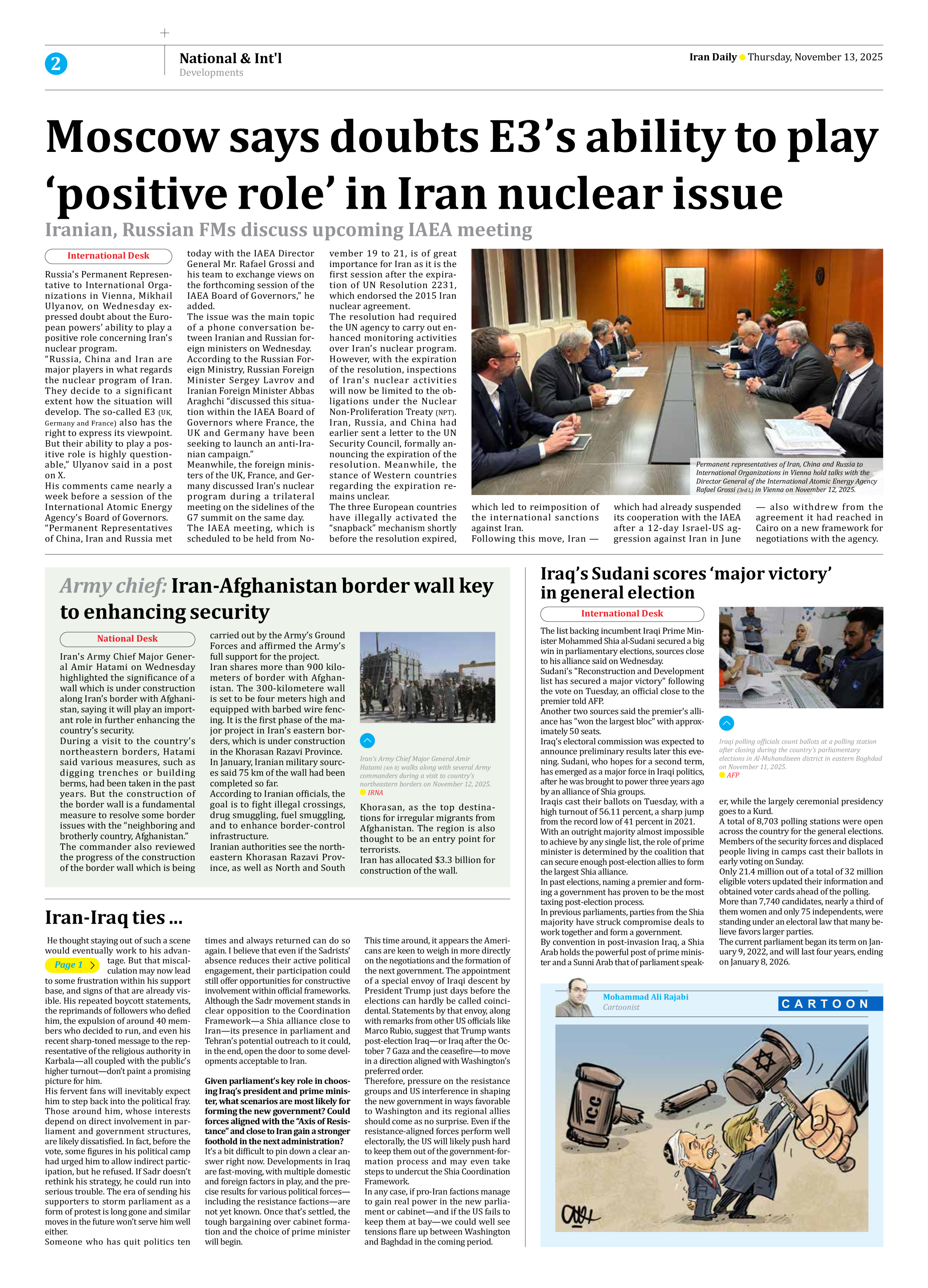
“Permanent Representatives of China, Iran and Russia met today with the IAEA Director General Mr. Rafael Grossi and his team to exchange views on the forthcoming session of the IAEA Board of Governors,” he added.
The issue was the main topic of a phone conversation between Iranian and Russian foreign ministers on Wednesday.
According to the Russian Foreign Ministry, Russian Foreign Minister Sergey Lavrov and Iranian Foreign Minister Abbas Araghchi “discussed this situation within the IAEA Board of Governors where France, the UK and Germany have been seeking to launch an anti-Iranian campaign.”
Meanwhile, the foreign ministers of the UK, France, and Germany discussed Iran's nuclear program during a trilateral meeting on the sidelines of the G7 summit on the same day.
The IAEA meeting, which is scheduled to be held from November 19 to 21, is of great importance for Iran as it is the first session after the expiration of UN Resolution 2231, which endorsed the 2015 Iran nuclear agreement.
The resolution had required the UN agency to carry out enhanced monitoring activities over Iran’s nuclear program. However, with the expiration of the resolution, inspections of Iran’s nuclear activities will now be limited to the obligations under the Nuclear Non-Proliferation Treaty (NPT).
Iran, Russia, and China had earlier sent a letter to the UN Security Council, formally announcing the expiration of the resolution. Meanwhile, the stance of Western countries regarding the expiration remains unclear.
The three European countries have illegally activated the “snapback” mechanism shortly before the resolution expired, which led to reimposition of the international sanctions against Iran.
Following this move, Iran — which had already suspended its cooperation with the IAEA after a 12-day Israel-US aggression against Iran in June — also withdrew from the agreement it had reached in Cairo on a new framework for negotiations with the agency.