





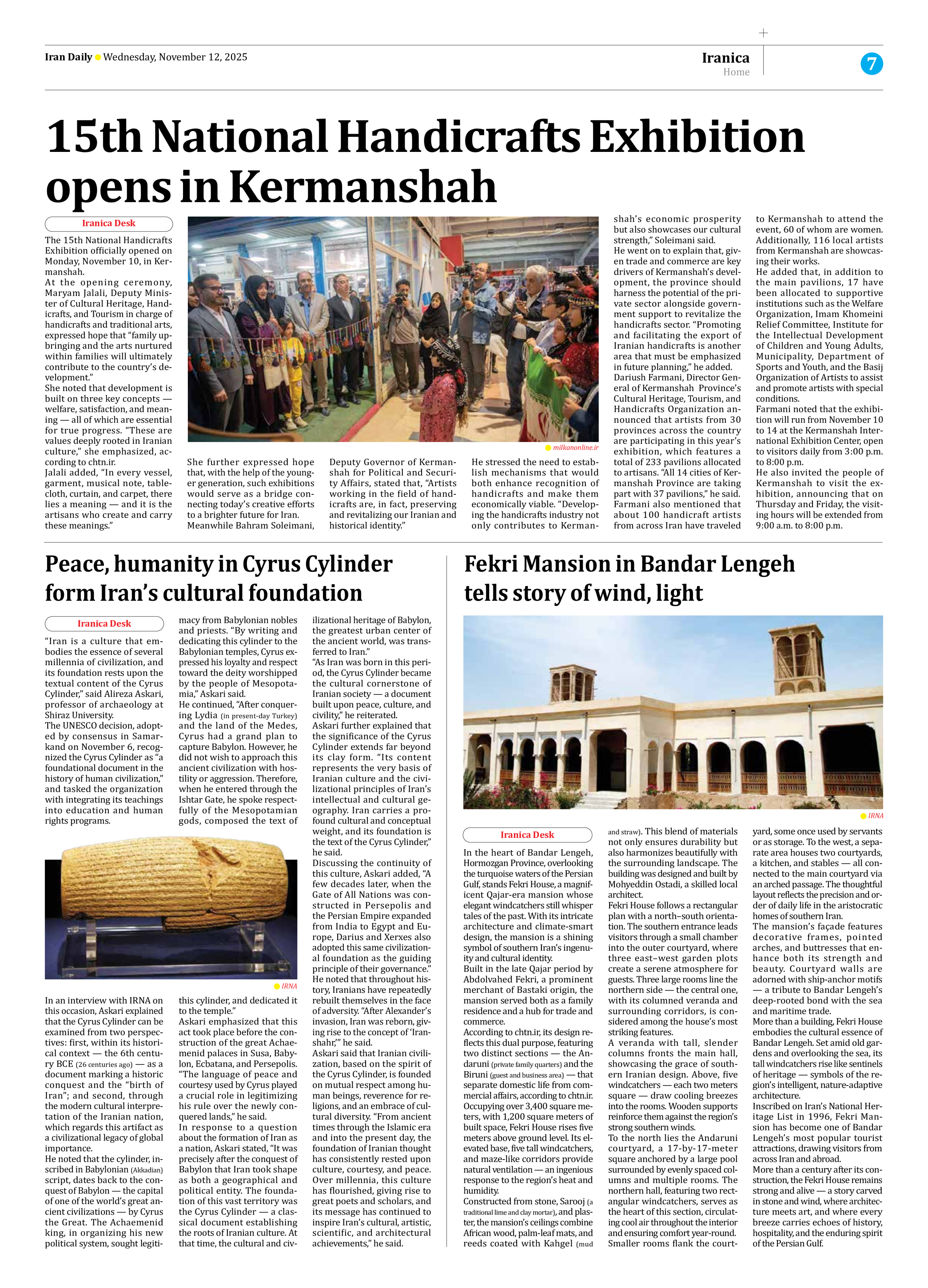


Fekri Mansion in Bandar Lengeh tells story of wind, light
In the heart of Bandar Lengeh, Hormozgan Province, overlooking the turquoise waters of the Persian Gulf, stands Fekri House, a magnificent Qajar-era mansion whose elegant windcatchers still whisper tales of the past. With its intricate architecture and climate-smart design, the mansion is a shining symbol of southern Iran’s ingenuity and cultural identity.
Built in the late Qajar period by Abdolvahed Fekri, a prominent merchant of Bastaki origin, the mansion served both as a family residence and a hub for trade and commerce.
According to chtn.ir, its design reflects this dual purpose, featuring two distinct sections — the Andaruni (private family quarters) and the Biruni (guest and business area) — that separate domestic life from commercial affairs, according to chtn.ir.
Occupying over 3,400 square meters, with 1,200 square meters of built space, Fekri House rises five meters above ground level. Its elevated base, five tall windcatchers, and maze-like corridors provide natural ventilation — an ingenious response to the region’s heat and humidity.
Constructed from stone, Sarooj (a traditional lime and clay mortar), and plaster, the mansion’s ceilings combine African wood, palm-leaf mats, and reeds coated with Kahgel (mud and straw). This blend of materials not only ensures durability but also harmonizes beautifully with the surrounding landscape. The building was designed and built by Mohyeddin Ostadi, a skilled local architect.
Fekri House follows a rectangular plan with a north–south orientation. The southern entrance leads visitors through a small chamber into the outer courtyard, where three east–west garden plots create a serene atmosphere for guests. Three large rooms line the northern side — the central one, with its columned veranda and surrounding corridors, is considered among the house’s most striking features.
A veranda with tall, slender columns fronts the main hall, showcasing the grace of southern Iranian design. Above, five windcatchers — each two meters square — draw cooling breezes into the rooms. Wooden supports reinforce them against the region’s strong southern winds.
To the north lies the Andaruni courtyard, a 17-by-17-meter square anchored by a large pool surrounded by evenly spaced columns and multiple rooms. The northern hall, featuring two rectangular windcatchers, serves as the heart of this section, circulating cool air throughout the interior and ensuring comfort year-round.
Smaller rooms flank the courtyard, some once used by servants or as storage. To the west, a separate area houses two courtyards, a kitchen, and stables — all connected to the main courtyard via an arched passage. The thoughtful layout reflects the precision and order of daily life in the aristocratic homes of southern Iran.
The mansion’s façade features decorative frames, pointed arches, and buttresses that enhance both its strength and beauty. Courtyard walls are adorned with ship-anchor motifs — a tribute to Bandar Lengeh’s deep-rooted bond with the sea and maritime trade.
More than a building, Fekri House embodies the cultural essence of Bandar Lengeh. Set amid old gardens and overlooking the sea, its tall windcatchers rise like sentinels of heritage — symbols of the region’s intelligent, nature-adaptive architecture.
Inscribed on Iran’s National Heritage List in 1996, Fekri Mansion has become one of Bandar Lengeh’s most popular tourist attractions, drawing visitors from across Iran and abroad.
More than a century after its construction, the Fekri House remains strong and alive — a story carved in stone and wind, where architecture meets art, and where every breeze carries echoes of history, hospitality, and the enduring spirit of the Persian Gulf.