





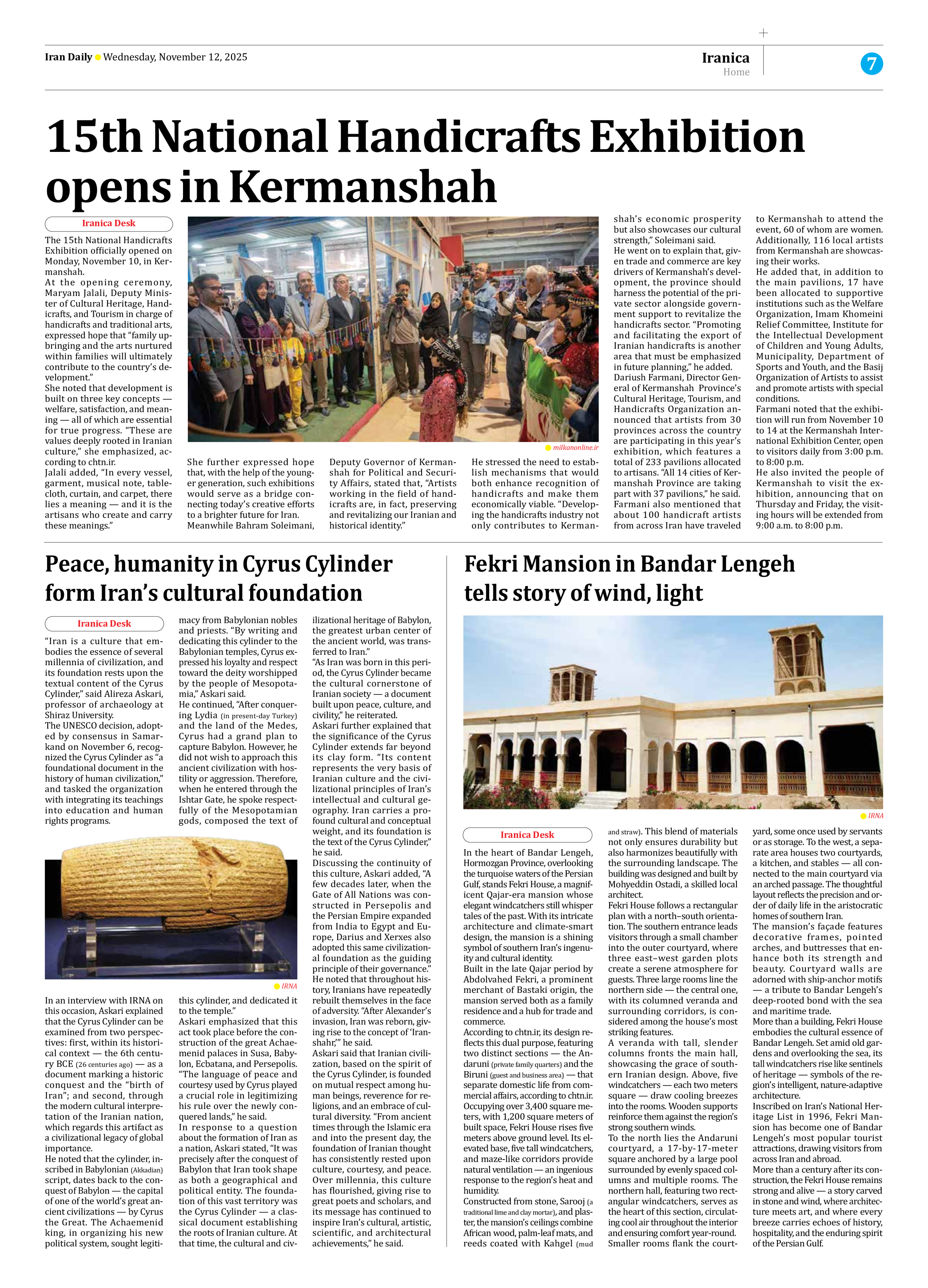


Peace, humanity in Cyrus Cylinder form Iran’s cultural foundation
“Iran is a culture that embodies the essence of several millennia of civilization, and its foundation rests upon the textual content of the Cyrus Cylinder,” said Alireza Askari, professor of archaeology at Shiraz University.
The UNESCO decision, adopted by consensus in Samarkand on November 6, recognized the Cyrus Cylinder as “a foundational document in the history of human civilization,” and tasked the organization with integrating its teachings into education and human rights programs.
In an interview with IRNA on this occasion, Askari explained that the Cyrus Cylinder can be examined from two perspectives: first, within its historical context — the 6th century BCE (26 centuries ago) — as a document marking a historic conquest and the “birth of Iran”; and second, through the modern cultural interpretation of the Iranian nation, which regards this artifact as a civilizational legacy of global importance.
He noted that the cylinder, inscribed in Babylonian (Akkadian) script, dates back to the conquest of Babylon — the capital of one of the world’s great ancient civilizations — by Cyrus the Great. The Achaemenid king, in organizing his new political system, sought legitimacy from Babylonian nobles and priests. “By writing and dedicating this cylinder to the Babylonian temples, Cyrus expressed his loyalty and respect toward the deity worshipped by the people of Mesopotamia,” Askari said.
He continued, “After conquering Lydia (in present-day Turkey) and the land of the Medes, Cyrus had a grand plan to capture Babylon. However, he did not wish to approach this ancient civilization with hostility or aggression. Therefore, when he entered through the Ishtar Gate, he spoke respectfully of the Mesopotamian gods, composed the text of this cylinder, and dedicated it to the temple.”
Askari emphasized that this act took place before the construction of the great Achaemenid palaces in Susa, Babylon, Ecbatana, and Persepolis. “The language of peace and courtesy used by Cyrus played a crucial role in legitimizing his rule over the newly conquered lands,” he said.
In response to a question about the formation of Iran as a nation, Askari stated, “It was precisely after the conquest of Babylon that Iran took shape as both a geographical and political entity. The foundation of this vast territory was the Cyrus Cylinder — a classical document establishing the roots of Iranian culture. At that time, the cultural and civilizational heritage of Babylon, the greatest urban center of the ancient world, was transferred to Iran.”
“As Iran was born in this period, the Cyrus Cylinder became the cultural cornerstone of Iranian society — a document built upon peace, culture, and civility,” he reiterated.
Askari further explained that the significance of the Cyrus Cylinder extends far beyond its clay form. “Its content represents the very basis of Iranian culture and the civilizational principles of Iran’s intellectual and cultural geography. Iran carries a profound cultural and conceptual weight, and its foundation is the text of the Cyrus Cylinder,” he said.
Discussing the continuity of this culture, Askari added, “A few decades later, when the Gate of All Nations was constructed in Persepolis and the Persian Empire expanded from India to Egypt and Europe, Darius and Xerxes also adopted this same civilizational foundation as the guiding principle of their governance.”
He noted that throughout history, Iranians have repeatedly rebuilt themselves in the face of adversity. “After Alexander’s invasion, Iran was reborn, giving rise to the concept of ‘Iranshahr,’” he said.
Askari said that Iranian civilization, based on the spirit of the Cyrus Cylinder, is founded on mutual respect among human beings, reverence for religions, and an embrace of cultural diversity. “From ancient times through the Islamic era and into the present day, the foundation of Iranian thought has consistently rested upon culture, courtesy, and peace. Over millennia, this culture has flourished, giving rise to great poets and scholars, and its message has continued to inspire Iran’s cultural, artistic, scientific, and architectural achievements,” he said.