





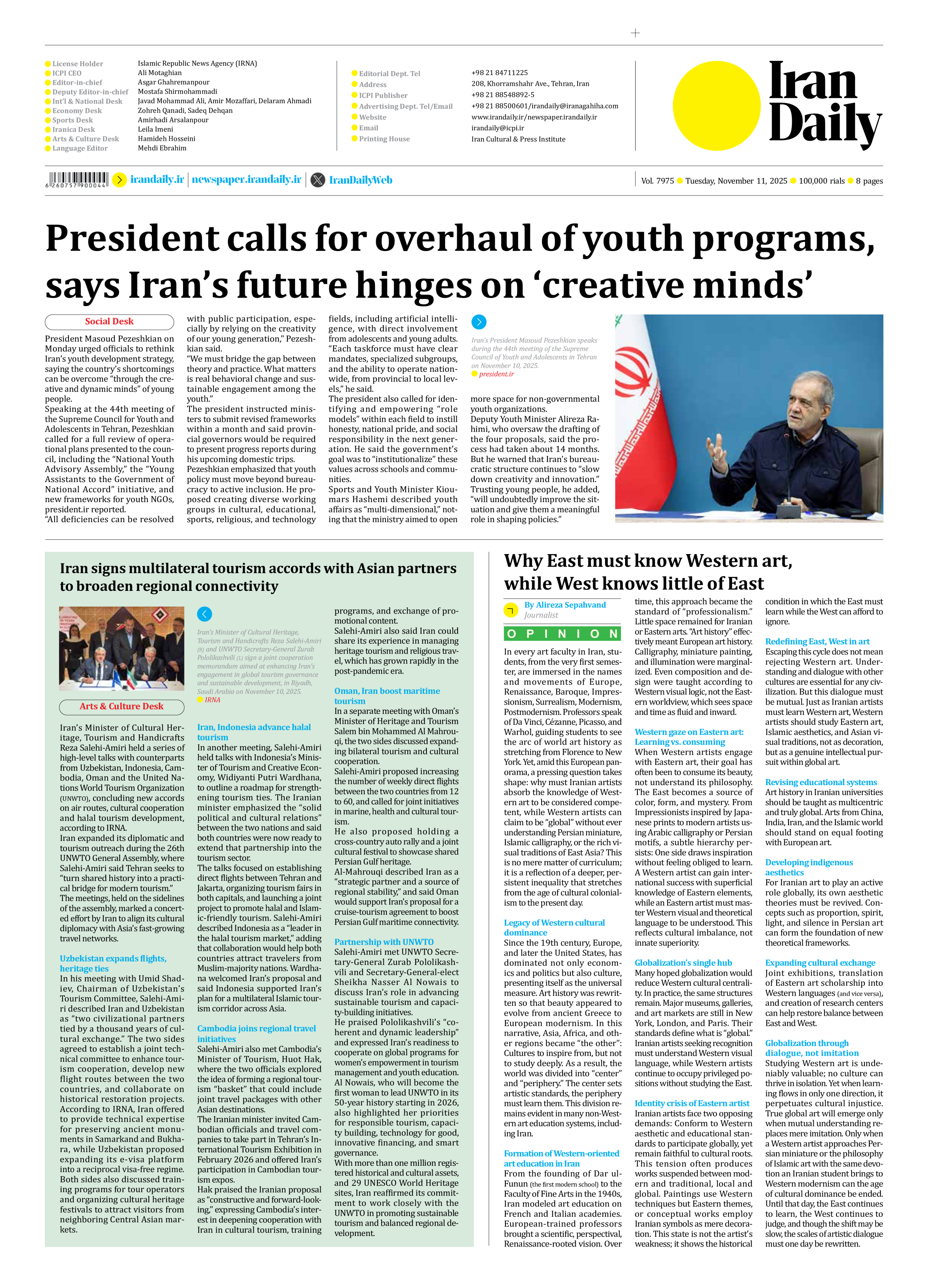


Iran signs multilateral tourism accords with Asian partners to broaden regional connectivity
Iran’s Minister of Cultural Heritage, Tourism and Handicrafts Reza Salehi-Amiri held a series of high-level talks with counterparts from Uzbekistan, Indonesia, Cambodia, Oman and the United Nations World Tourism Organization (UNWTO), concluding new accords on air routes, cultural cooperation and halal tourism development, according to IRNA.
Iran expanded its diplomatic and tourism outreach during the 26th UNWTO General Assembly, where Salehi-Amiri said Tehran seeks to “turn shared history into a practical bridge for modern tourism.”
The meetings, held on the sidelines of the assembly, marked a concerted effort by Iran to align its cultural diplomacy with Asia’s fast-growing travel networks.
Uzbekistan expands flights, heritage ties
In his meeting with Umid Shadiev, Chairman of Uzbekistan’s Tourism Committee, Salehi-Amiri described Iran and Uzbekistan as “two civilizational partners tied by a thousand years of cultural exchange.” The two sides agreed to establish a joint technical committee to enhance tourism cooperation, develop new flight routes between the two countries, and collaborate on historical restoration projects. According to IRNA, Iran offered to provide technical expertise for preserving ancient monuments in Samarkand and Bukhara, while Uzbekistan proposed expanding its e-visa platform into a reciprocal visa-free regime. Both sides also discussed training programs for tour operators and organizing cultural heritage festivals to attract visitors from neighboring Central Asian markets.
Iran, Indonesia advance halal tourism
In another meeting, Salehi-Amiri held talks with Indonesia’s Minister of Tourism and Creative Economy, Widiyanti Putri Wardhana, to outline a roadmap for strengthening tourism ties. The Iranian minister emphasized the “solid political and cultural relations” between the two nations and said both countries were now ready to extend that partnership into the tourism sector.
The talks focused on establishing direct flights between Tehran and Jakarta, organizing tourism fairs in both capitals, and launching a joint project to promote halal and Islamic-friendly tourism. Salehi-Amiri described Indonesia as a “leader in the halal tourism market,” adding that collaboration would help both countries attract travelers from Muslim-majority nations. Wardhana welcomed Iran’s proposal and said Indonesia supported Iran’s plan for a multilateral Islamic tourism corridor across Asia.
Cambodia joins regional travel initiatives
Salehi-Amiri also met Cambodia’s Minister of Tourism, Huot Hak, where the two officials explored the idea of forming a regional tourism “basket” that could include joint travel packages with other Asian destinations.
The Iranian minister invited Cambodian officials and travel companies to take part in Tehran’s International Tourism Exhibition in February 2026 and offered Iran’s participation in Cambodian tourism expos.
Hak praised the Iranian proposal as “constructive and forward-looking,” expressing Cambodia’s interest in deepening cooperation with Iran in cultural tourism, training programs, and exchange of promotional content.
Salehi-Amiri also said Iran could share its experience in managing heritage tourism and religious travel, which has grown rapidly in the post-pandemic era.
Oman, Iran boost maritime tourism
In a separate meeting with Oman’s Minister of Heritage and Tourism Salem bin Mohammed Al Mahrouqi, the two sides discussed expanding bilateral tourism and cultural cooperation.
Salehi-Amiri proposed increasing the number of weekly direct flights between the two countries from 12 to 60, and called for joint initiatives in marine, health and cultural tourism.
He also proposed holding a cross-country auto rally and a joint cultural festival to showcase shared Persian Gulf heritage.
Al-Mahrouqi described Iran as a “strategic partner and a source of regional stability,” and said Oman would support Iran’s proposal for a cruise-tourism agreement to boost Persian Gulf maritime connectivity.
Partnership with UNWTO
Salehi-Amiri met UNWTO Secretary-General Zurab Pololikashvili and Secretary-General-elect Sheikha Nasser Al Nowais to discuss Iran’s role in advancing sustainable tourism and capacity-building initiatives.
He praised Pololikashvili’s “coherent and dynamic leadership” and expressed Iran’s readiness to cooperate on global programs for women’s empowerment in tourism management and youth education. Al Nowais, who will become the first woman to lead UNWTO in its 50-year history starting in 2026, also highlighted her priorities for responsible tourism, capacity building, technology for good, innovative financing, and smart governance.
With more than one million registered historical and cultural assets, and 29 UNESCO World Heritage sites, Iran reaffirmed its commitment to work closely with the UNWTO in promoting sustainable tourism and balanced regional development.