







Gilan hosts IRNA chief on journey through rich tapestry of history, civic life
Gilan Province, a land steeped in history, culture, and the lives of distinguished contemporaries, welcomed Hossein Jaberi Ansari, Managing Director of the Islamic Republic News Agency (IRNA), on November 4, 2025. Jaberi Ansari entered a province whose collective memory is rich with figures whose names shine across the galaxy of Iran’s enduring legacy. In the provincial capital city of Rasht, every street bears the footprints of countless notable history-makers.
During his 29th provincial visit, Jaberi Ansari paid homage to Mirza Kuchak Khan Jangali, the province’s martyrs and prominent personalities. He met with IRNA staff and veterans in Gilan Province, the governor and mayor of Rasht, the head of the Chamber of Commerce, the Commander of the Northern Fleet, and the director general of Gilan Province’s Department of Environment. His brief itinerary included visits to the Anzali Palace Museum, the Anzali International Wetland, and Fashtakeh village, designated as the National Mat-Weaving Village.
In a meeting with the mayor and head of the Rasht City Council, Jaberi Ansari emphasized IRNA’s national stature, stating, “IRNA, now 91 years old, must, based on its national responsibility, serve as a two-way bridge of information between municipal management and citizens. The municipality and the city council shoulder a significant part of the responsibilities that would otherwise fall on the government.”
He added that through its credibility and broad coverage, IRNA could communicate the actions, programs, and challenges of urban management to citizens in a simple, understandable language. Jaberi Ansari further stressed that such two-way communication not only informs citizens about the municipality’s work but also ensures that the voice and needs of the people reach urban officials.
Jaberi Ansari also conducted a joint visit with Director General of Gilan’s Department of Environment, Farhad Hosseini Tayefeh to the Anzali International Wetland. While observing and reviewing the wetland’s challenges, he highlighted IRNA’s official duty to amplify environmental concerns to the authorities.
Covering approximately 20,000 hectares, the Anzali Wetland is among the largest in Iran and the world. Its unique vegetation, wildlife, and morphological connection to the Caspian Sea, along with its intricate river system, render it ecologically invaluable.
Today, however, its vital lifelines — once among the most beautiful and extensive natural habitats for wildlife — are threatened by domestic and industrial wastewater, invasive plants such as water hyacinth and azolla, sediment accumulation, failure to implement integrated watershed management plans, lack of water rights delivery, and declining Caspian Sea levels. Environmental experts warn that the ongoing decline of the Caspian Sea’s water level will accelerate the drying of the Anzali Wetland, which may vanish entirely within 35 years.
Hosseini Tayefeh noted during the visit that the decreasing water levels across the wetland represent a looming disaster for this precious ecosystem.
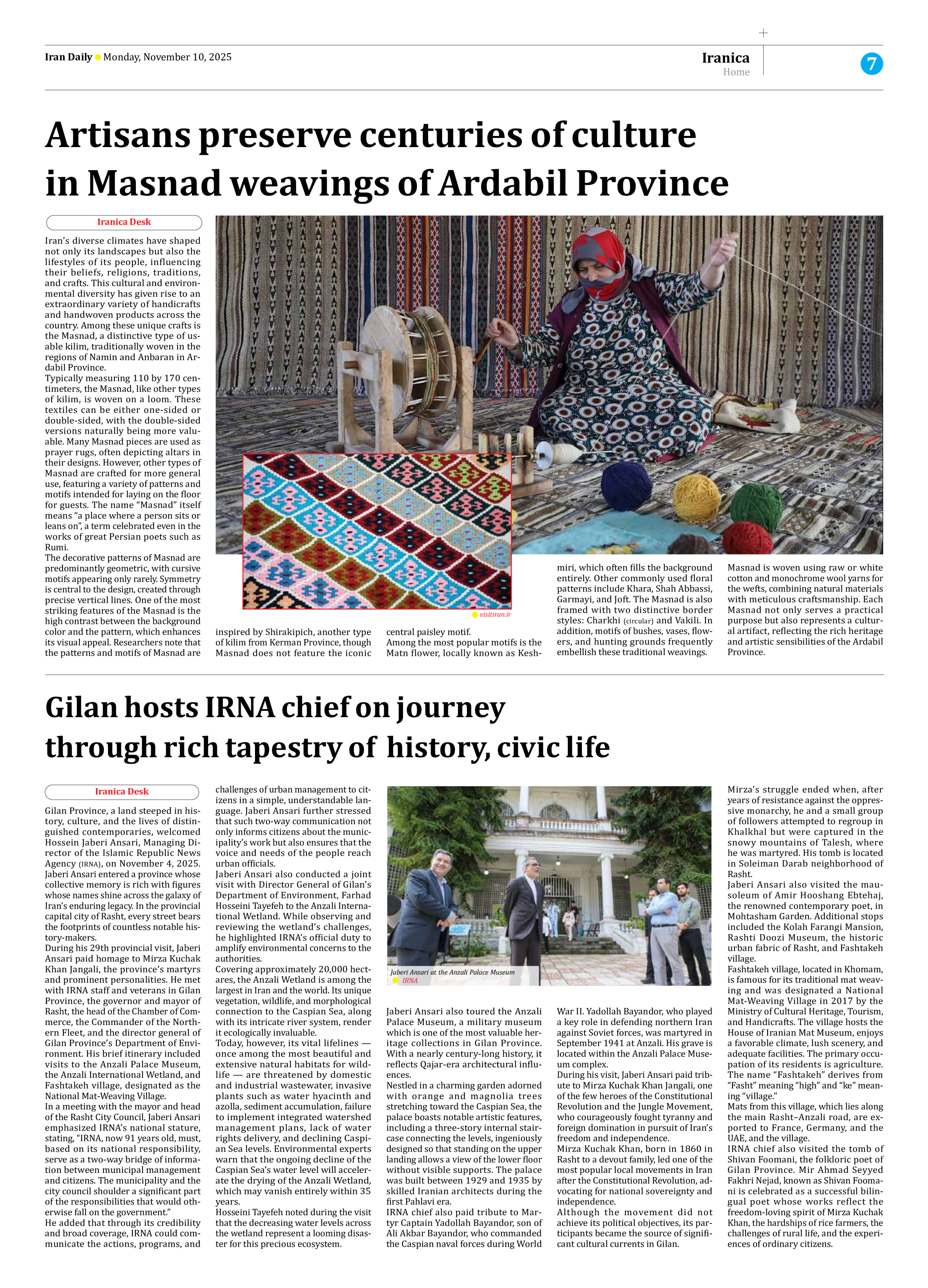
Jaberi Ansari also toured the Anzali Palace Museum, a military museum which is one of the most valuable heritage collections in Gilan Province. With a nearly century-long history, it reflects Qajar-era architectural influences.
Nestled in a charming garden adorned with orange and magnolia trees stretching toward the Caspian Sea, the palace boasts notable artistic features, including a three-story internal staircase connecting the levels, ingeniously designed so that standing on the upper landing allows a view of the lower floor without visible supports. The palace was built between 1929 and 1935 by skilled Iranian architects during the first Pahlavi era.
IRNA chief also paid tribute to Martyr Captain Yadollah Bayandor, son of Ali Akbar Bayandor, who commanded the Caspian naval forces during World War II. Yadollah Bayandor, who played a key role in defending northern Iran against Soviet forces, was martyred in September 1941 at Anzali. His grave is located within the Anzali Palace Museum complex.
During his visit, Jaberi Ansari paid tribute to Mirza Kuchak Khan Jangali, one of the few heroes of the Constitutional Revolution and the Jungle Movement, who courageously fought tyranny and foreign domination in pursuit of Iran’s freedom and independence.
Mirza Kuchak Khan, born in 1860 in Rasht to a devout family, led one of the most popular local movements in Iran after the Constitutional Revolution, advocating for national sovereignty and independence.
Although the movement did not achieve its political objectives, its participants became the source of significant cultural currents in Gilan.
Mirza’s struggle ended when, after years of resistance against the oppressive monarchy, he and a small group of followers attempted to regroup in Khalkhal but were captured in the snowy mountains of Talesh, where he was martyred. His tomb is located in Soleiman Darab neighborhood of Rasht.
Jaberi Ansari also visited the mausoleum of Amir Hooshang Ebtehaj, the renowned contemporary poet, in Mohtasham Garden. Additional stops included the Kolah Farangi Mansion, Rashti Doozi Museum, the historic urban fabric of Rasht, and Fashtakeh village.
Fashtakeh village, located in Khomam, is famous for its traditional mat weaving and was designated a National Mat-Weaving Village in 2017 by the Ministry of Cultural Heritage, Tourism, and Handicrafts. The village hosts the House of Iranian Mat Museum, enjoys a favorable climate, lush scenery, and adequate facilities. The primary occupation of its residents is agriculture. The name “Fashtakeh” derives from “Fasht” meaning “high” and “ke” meaning “village.”
Mats from this village, which lies along the main Rasht–Anzali road, are exported to France, Germany, and the UAE, and the village.
IRNA chief also visited the tomb of Shivan Foomani, the folkloric poet of Gilan Province. Mir Ahmad Seyyed Fakhri Nejad, known as Shivan Foomani is celebrated as a successful bilingual poet whose works reflect the freedom-loving spirit of Mirza Kuchak Khan, the hardships of rice farmers, the challenges of rural life, and the experiences of ordinary citizens.