







Artisans preserve centuries of culture in Masnad weavings of Ardabil Province
Iran’s diverse climates have shaped not only its landscapes but also the lifestyles of its people, influencing their beliefs, religions, traditions, and crafts. This cultural and environmental diversity has given rise to an extraordinary variety of handicrafts and handwoven products across the country. Among these unique crafts is the Masnad, a distinctive type of usable kilim, traditionally woven in the regions of Namin and Anbaran in Ardabil Province.
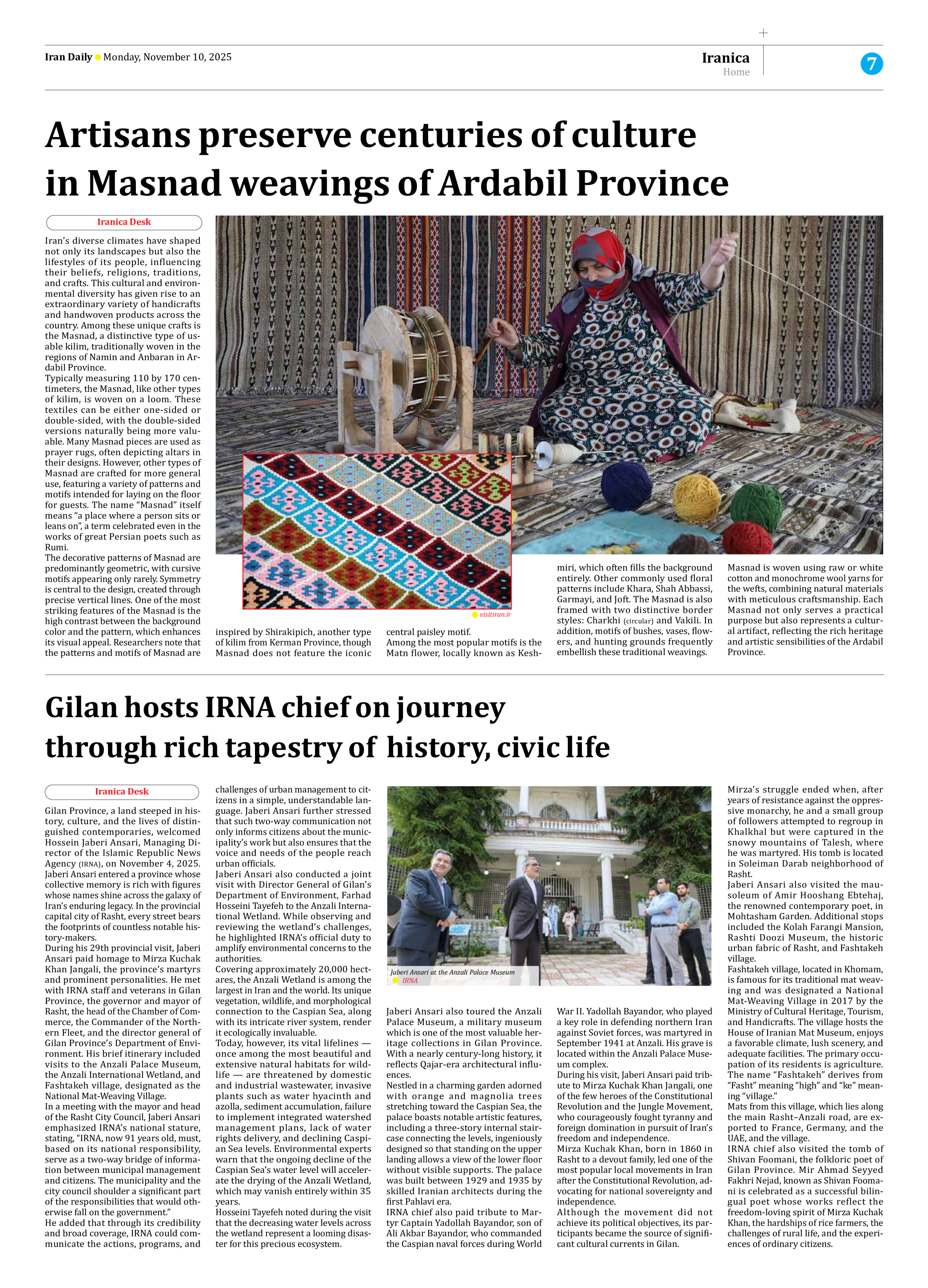
Typically measuring 110 by 170 centimeters, the Masnad, like other types of kilim, is woven on a loom. These textiles can be either one-sided or double-sided, with the double-sided versions naturally being more valuable. Many Masnad pieces are used as prayer rugs, often depicting altars in their designs. However, other types of Masnad are crafted for more general use, featuring a variety of patterns and motifs intended for laying on the floor for guests. The name “Masnad” itself means “a place where a person sits or leans on”, a term celebrated even in the works of great Persian poets such as Rumi.
The decorative patterns of Masnad are predominantly geometric, with cursive motifs appearing only rarely. Symmetry is central to the design, created through precise vertical lines. One of the most striking features of the Masnad is the high contrast between the background color and the pattern, which enhances its visual appeal. Researchers note that the patterns and motifs of Masnad are inspired by Shirakipich, another type of kilim from Kerman Province, though Masnad does not feature the iconic central paisley motif.
Among the most popular motifs is the Matn flower, locally known as Keshmiri, which often fills the background entirely. Other commonly used floral patterns include Khara, Shah Abbassi, Garmayi, and Joft. The Masnad is also framed with two distinctive border styles: Charkhi (circular) and Vakili. In addition, motifs of bushes, vases, flowers, and hunting grounds frequently embellish these traditional weavings.
Masnad is woven using raw or white cotton and monochrome wool yarns for the wefts, combining natural materials with meticulous craftsmanship. Each Masnad not only serves a practical purpose but also represents a cultural artifact, reflecting the rich heritage and artistic sensibilities of the Ardabil Province.