





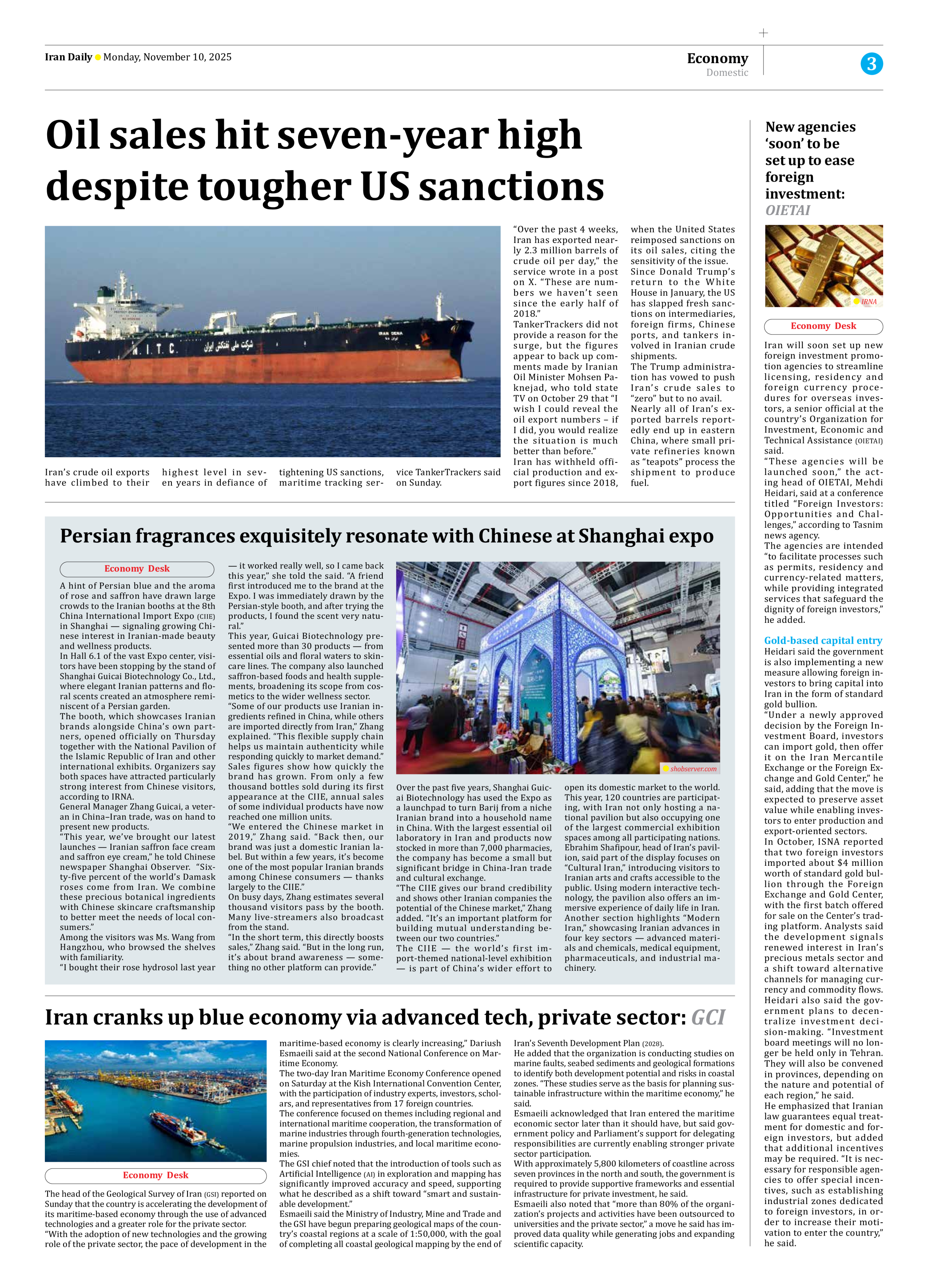


Iran cranks up blue economy via advanced tech, private sector:
The head of the Geological Survey of Iran (GSI) reported on Sunday that the country is accelerating the development of its maritime-based economy through the use of advanced technologies and a greater role for the private sector.
“With the adoption of new technologies and the growing role of the private sector, the pace of development in the maritime-based economy is clearly increasing,” Dariush Esmaeili said at the second National Conference on Maritime Economy.
The two-day Iran Maritime Economy Conference opened on Saturday at the Kish International Convention Center, with the participation of industry experts, investors, scholars, and representatives from 17 foreign countries.
The conference focused on themes including regional and international maritime cooperation, the transformation of marine industries through fourth-generation technologies, marine propulsion industries, and local maritime economies.
The GSI chief noted that the introduction of tools such as Artificial Intelligence (AI) in exploration and mapping has significantly improved accuracy and speed, supporting what he described as a shift toward “smart and sustainable development.”
Esmaeili said the Ministry of Industry, Mine and Trade and the GSI have begun preparing geological maps of the country’s coastal regions at a scale of 1:50,000, with the goal of completing all coastal geological mapping by the end of Iran’s Seventh Development Plan (2028).
He added that the organization is conducting studies on marine faults, seabed sediments and geological formations to identify both development potential and risks in coastal zones. “These studies serve as the basis for planning sustainable infrastructure within the maritime economy,” he said.
Esmaeili acknowledged that Iran entered the maritime economic sector later than it should have, but said government policy and Parliament’s support for delegating responsibilities are currently enabling stronger private sector participation.
With approximately 5,800 kilometers of coastline across seven provinces in the north and south, the government is required to provide supportive frameworks and essential infrastructure for private investment, he said.
Esmaeili also noted that “more than 80% of the organization’s projects and activities have been outsourced to universities and the private sector,” a move he said has improved data quality while generating jobs and expanding scientific capacity.