







Persian fragrances exquisitely resonate with Chinese at Shanghai expo
A hint of Persian blue and the aroma of rose and saffron have drawn large crowds to the Iranian booths at the 8th China International Import Expo (CIIE) in Shanghai — signaling growing Chinese interest in Iranian-made beauty and wellness products.
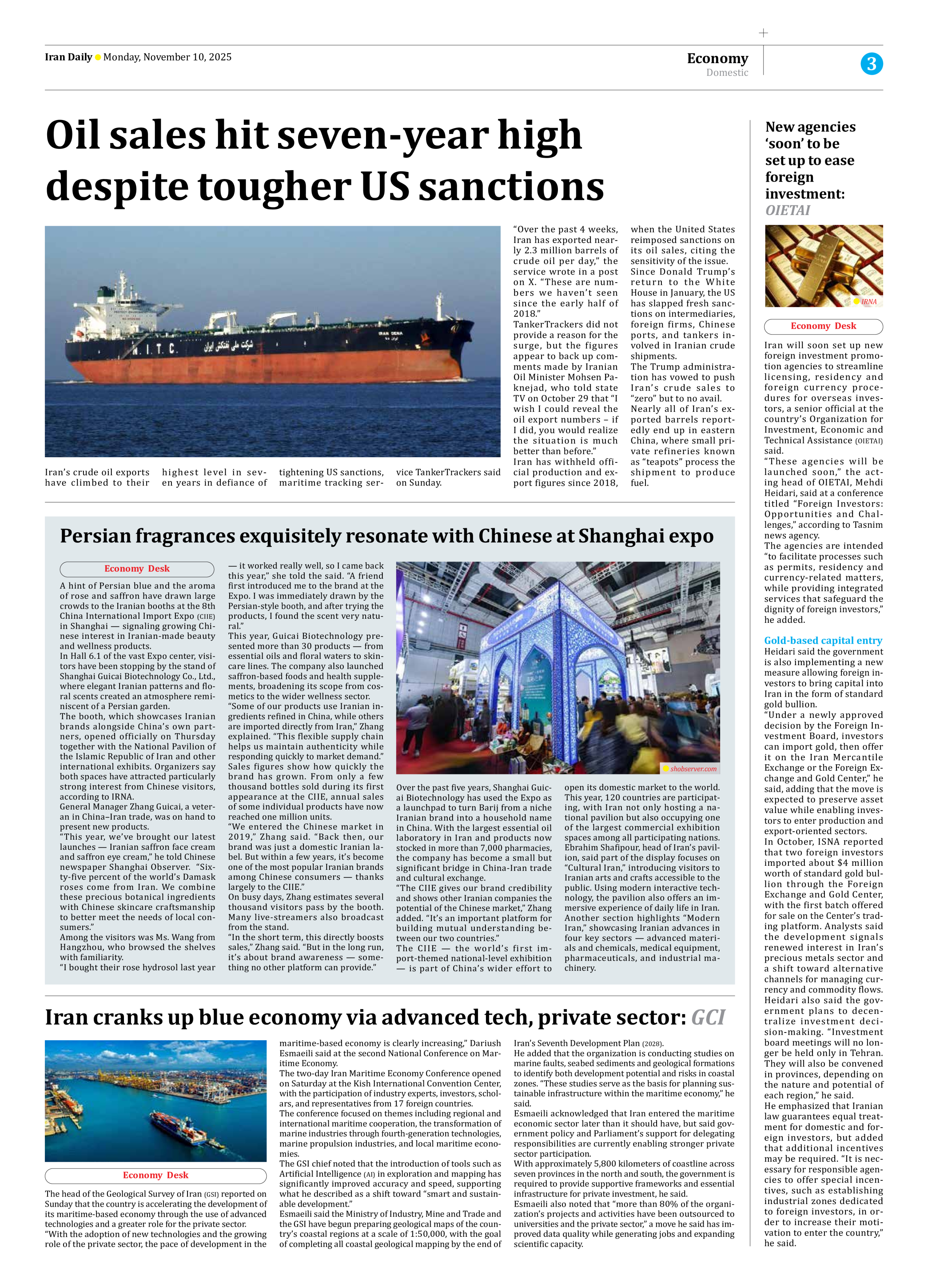
In Hall 6.1 of the vast Expo center, visitors have been stopping by the stand of Shanghai Guicai Biotechnology Co., Ltd., where elegant Iranian patterns and floral scents created an atmosphere reminiscent of a Persian garden.
The booth, which showcases Iranian brands alongside China’s own partners, opened officially on Thursday together with the National Pavilion of the Islamic Republic of Iran and other international exhibits. Organizers say both spaces have attracted particularly strong interest from Chinese visitors, according to IRNA.
General Manager Zhang Guicai, a veteran in China–Iran trade, was on hand to present new products.
“This year, we’ve brought our latest launches — Iranian saffron face cream and saffron eye cream,” he told Chinese newspaper Shanghai Observer. “Sixty-five percent of the world’s Damask roses come from Iran. We combine these precious botanical ingredients with Chinese skincare craftsmanship to better meet the needs of local consumers.”
Among the visitors was Ms. Wang from Hangzhou, who browsed the shelves with familiarity.
“I bought their rose hydrosol last year — it worked really well, so I came back this year,” she told the said. “A friend first introduced me to the brand at the Expo. I was immediately drawn by the Persian-style booth, and after trying the products, I found the scent very natural.”
This year, Guicai Biotechnology presented more than 30 products — from essential oils and floral waters to skincare lines. The company also launched saffron-based foods and health supplements, broadening its scope from cosmetics to the wider wellness sector.
“Some of our products use Iranian ingredients refined in China, while others are imported directly from Iran,” Zhang explained. “This flexible supply chain helps us maintain authenticity while responding quickly to market demand.”
Sales figures show how quickly the brand has grown. From only a few thousand bottles sold during its first appearance at the CIIE, annual sales of some individual products have now reached one million units.
“We entered the Chinese market in 2019,” Zhang said. “Back then, our brand was just a domestic Iranian label. But within a few years, it’s become one of the most popular Iranian brands among Chinese consumers — thanks largely to the CIIE.”
On busy days, Zhang estimates several thousand visitors pass by the booth. Many live-streamers also broadcast from the stand.
“In the short term, this directly boosts sales,” Zhang said. “But in the long run, it’s about brand awareness — something no other platform can provide.”
Over the past five years, Shanghai Guicai Biotechnology has used the Expo as a launchpad to turn Barij from a niche Iranian brand into a household name in China. With the largest essential oil laboratory in Iran and products now stocked in more than 7,000 pharmacies, the company has become a small but significant bridge in China-Iran trade and cultural exchange.
“The CIIE gives our brand credibility and shows other Iranian companies the potential of the Chinese market,” Zhang added. “It’s an important platform for building mutual understanding between our two countries.”
The CIIE — the world’s first import-themed national-level exhibition — is part of China’s wider effort to open its domestic market to the world. This year, 120 countries are participating, with Iran not only hosting a national pavilion but also occupying one of the largest commercial exhibition spaces among all participating nations.
Ebrahim Shafipour, head of Iran’s pavilion, said part of the display focuses on “Cultural Iran,” introducing visitors to Iranian arts and crafts accessible to the public. Using modern interactive technology, the pavilion also offers an immersive experience of daily life in Iran.
Another section highlights “Modern Iran,” showcasing Iranian advances in four key sectors — advanced materials and chemicals, medical equipment, pharmaceuticals, and industrial machinery.