







Regional Museum of Southeast Iran rejuvenates ancient civilization
The Regional Museum of Southeast Iran, one of the country’s most significant cultural institutions, stands as a testament to the rich history and heritage of Sistan and Baluchestan Province. Located in Zahedan, the museum offers visitors an extraordinary journey through millennia of human civilization on the Iranian Plateau — from prehistoric settlements to the Islamic era.
The museum’s vast collection, the result of decades of archaeological research by Iranian and international experts, includes artifacts unearthed from renowned sites such as Shahr-e Sukhteh (the Burnt City), Bampur Mound, and Jiroft. Exhibits range from stone tools and ancient pottery to metalwork, jewelry, and manuscripts, each piece narrating the story of a civilization that was once at the crossroads of trade and culture.
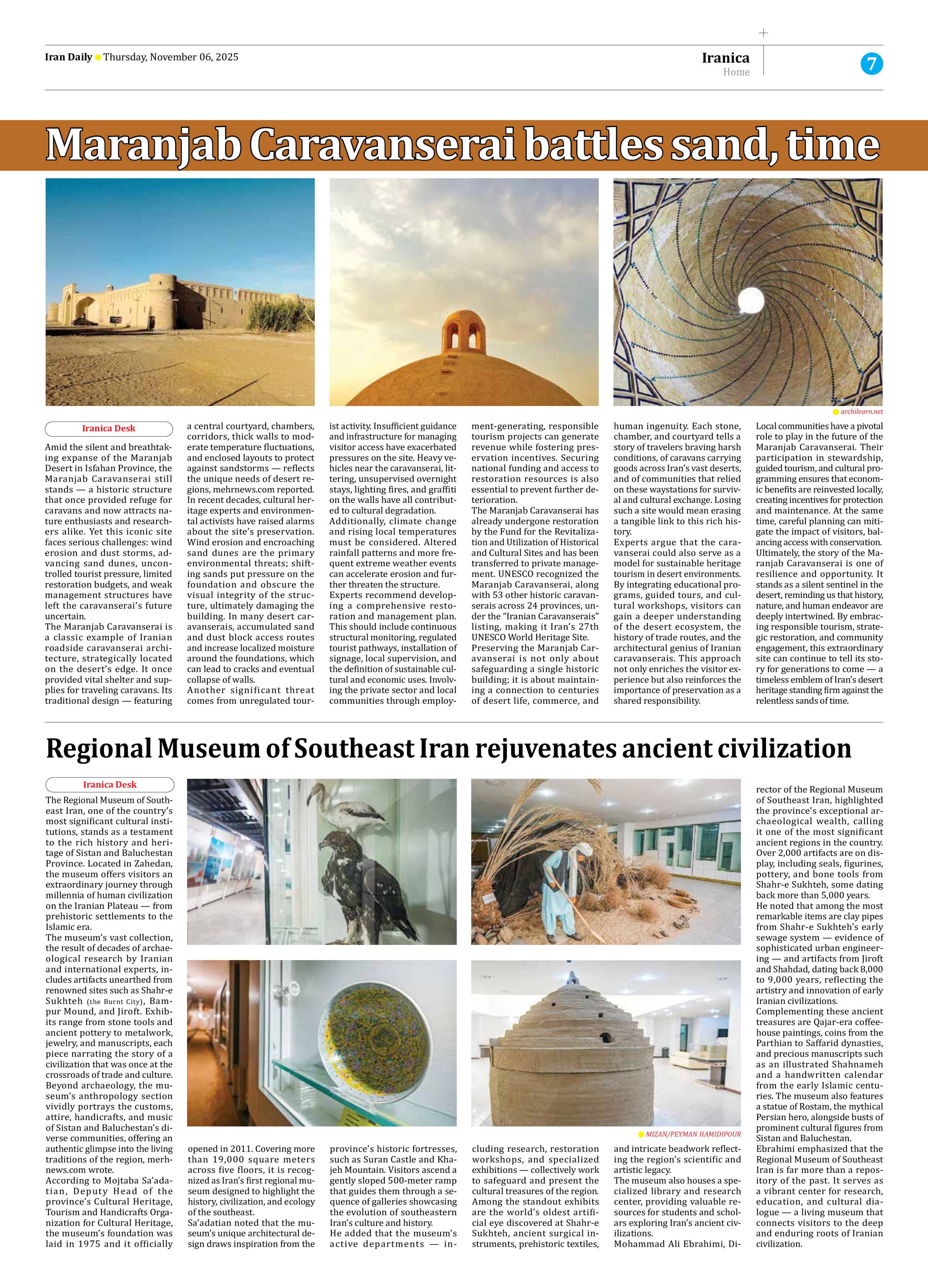
Beyond archaeology, the museum’s anthropology section vividly portrays the customs, attire, handicrafts, and music of Sistan and Baluchestan’s diverse communities, offering an authentic glimpse into the living traditions of the region, merhnews.com wrote.
According to Mojtaba Sa’adatian, Deputy Head of the province’s Cultural Heritage, Tourism and Handicrafts Organization for Cultural Heritage, the museum’s foundation was laid in 1975 and it officially opened in 2011. Covering more than 19,000 square meters across five floors, it is recognized as Iran’s first regional museum designed to highlight the history, civilization, and ecology of the southeast.
Sa’adatian noted that the museum’s unique architectural design draws inspiration from the province’s historic fortresses, such as Suran Castle and Khajeh Mountain. Visitors ascend a gently sloped 500-meter ramp that guides them through a sequence of galleries showcasing the evolution of southeastern Iran’s culture and history.
He added that the museum’s active departments — including research, restoration workshops, and specialized exhibitions — collectively work to safeguard and present the cultural treasures of the region. Among the standout exhibits are the world’s oldest artificial eye discovered at Shahr-e Sukhteh, ancient surgical instruments, prehistoric textiles, and intricate beadwork reflecting the region’s scientific and artistic legacy.
The museum also houses a specialized library and research center, providing valuable resources for students and scholars exploring Iran’s ancient civilizations.
Mohammad Ali Ebrahimi, Director of the Regional Museum of Southeast Iran, highlighted the province’s exceptional archaeological wealth, calling it one of the most significant ancient regions in the country. Over 2,000 artifacts are on display, including seals, figurines, pottery, and bone tools from Shahr-e Sukhteh, some dating back more than 5,000 years.
He noted that among the most remarkable items are clay pipes from Shahr-e Sukhteh’s early sewage system — evidence of sophisticated urban engineering — and artifacts from Jiroft and Shahdad, dating back 8,000 to 9,000 years, reflecting the artistry and innovation of early Iranian civilizations.
Complementing these ancient treasures are Qajar-era coffeehouse paintings, coins from the Parthian to Saffarid dynasties, and precious manuscripts such as an illustrated Shahnameh and a handwritten calendar from the early Islamic centuries. The museum also features a statue of Rostam, the mythical Persian hero, alongside busts of prominent cultural figures from Sistan and Baluchestan.
Ebrahimi emphasized that the Regional Museum of Southeast Iran is far more than a repository of the past. It serves as a vibrant center for research, education, and cultural dialogue — a living museum that connects visitors to the deep and enduring roots of Iranian civilization.