







Kashan teaches world how to live with desert
In the heart of Iran’s central desert lies a city woven from earth, wind, authenticity, tradition, and identity — Kashan.
A city where the sun rises through its windcatchers and light filters through the play of shadow and brightness in its narrow vaulted alleys, the sabats.
Here, architecture is the language of beauty — a philosophy of survival and of life itself.
Kashan’s recognition by UNESCO as a “Creative City of Architecture” stands as a seal of approval for its climatic wisdom, native ingenuity, and the enduring spirit of thought that has flowed through the soul of this city for centuries, according to mehrnews.com.
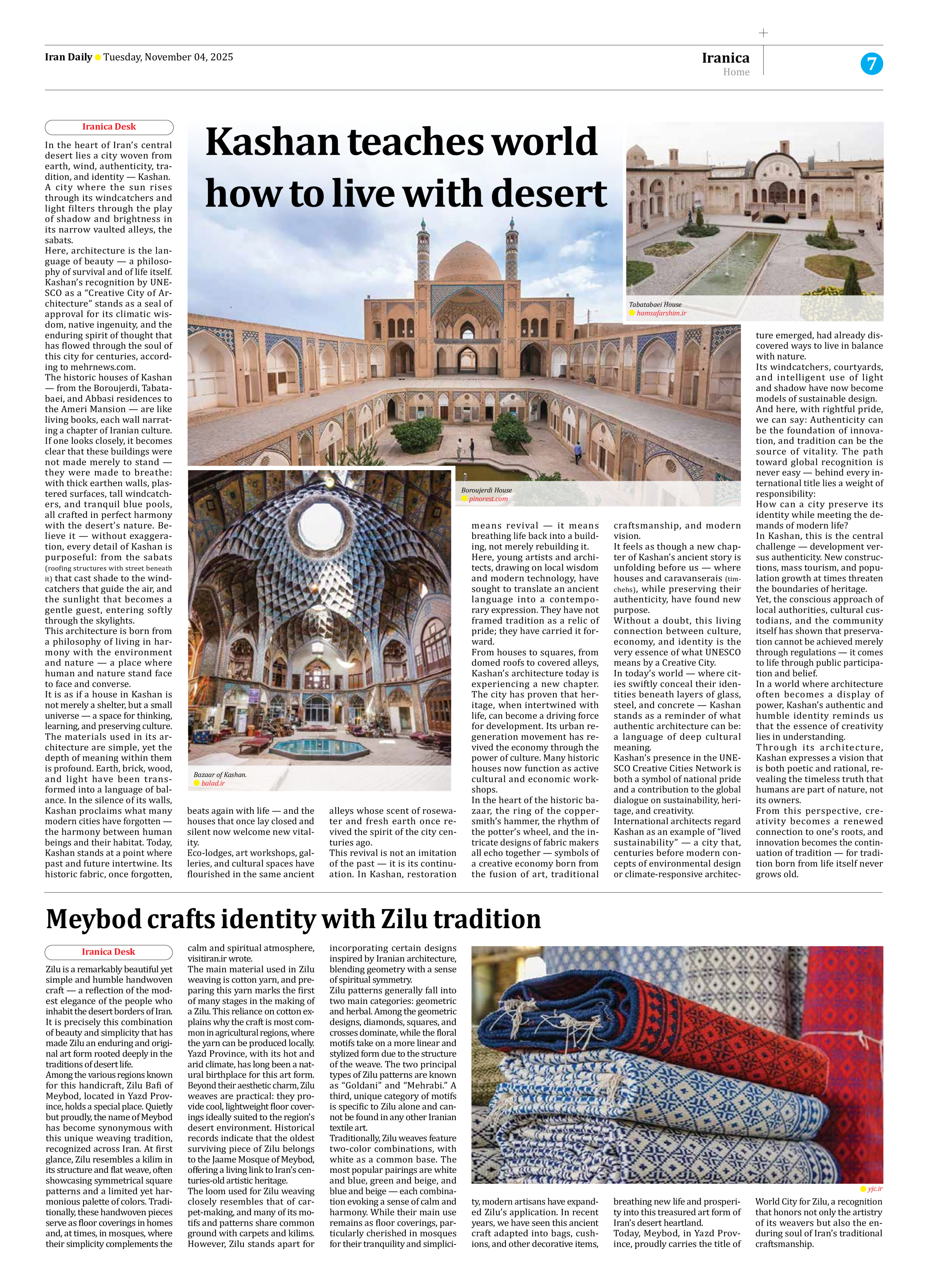
The historic houses of Kashan — from the Boroujerdi, Tabatabaei, and Abbasi residences to the Ameri Mansion — are like living books, each wall narrating a chapter of Iranian culture.
If one looks closely, it becomes clear that these buildings were not made merely to stand — they were made to breathe: with thick earthen walls, plastered surfaces, tall windcatchers, and tranquil blue pools, all crafted in perfect harmony with the desert’s nature. Believe it — without exaggeration, every detail of Kashan is purposeful: from the sabats (roofing structures with street beneath it) that cast shade to the windcatchers that guide the air, and the sunlight that becomes a gentle guest, entering softly through the skylights.
This architecture is born from a philosophy of living in harmony with the environment and nature — a place where human and nature stand face to face and converse.
It is as if a house in Kashan is not merely a shelter, but a small universe — a space for thinking, learning, and preserving culture.
The materials used in its architecture are simple, yet the depth of meaning within them is profound. Earth, brick, wood, and light have been transformed into a language of balance. In the silence of its walls, Kashan proclaims what many modern cities have forgotten — the harmony between human beings and their habitat. Today, Kashan stands at a point where past and future intertwine. Its historic fabric, once forgotten, beats again with life — and the houses that once lay closed and silent now welcome new vitality.
Eco-lodges, art workshops, galleries, and cultural spaces have flourished in the same ancient alleys whose scent of rosewater and fresh earth once revived the spirit of the city centuries ago.
This revival is not an imitation of the past — it is its continuation. In Kashan, restoration means revival — it means breathing life back into a building, not merely rebuilding it.
Here, young artists and architects, drawing on local wisdom and modern technology, have sought to translate an ancient language into a contemporary expression. They have not framed tradition as a relic of pride; they have carried it forward.
From houses to squares, from domed roofs to covered alleys, Kashan’s architecture today is experiencing a new chapter. The city has proven that heritage, when intertwined with life, can become a driving force for development. Its urban regeneration movement has revived the economy through the power of culture. Many historic houses now function as active cultural and economic workshops.
In the heart of the historic bazaar, the ring of the coppersmith’s hammer, the rhythm of the potter’s wheel, and the intricate designs of fabric makers all echo together — symbols of a creative economy born from the fusion of art, traditional craftsmanship, and modern vision.
It feels as though a new chapter of Kashan’s ancient story is unfolding before us — where houses and caravanserais (timchehs), while preserving their authenticity, have found new purpose.
Without a doubt, this living connection between culture, economy, and identity is the very essence of what UNESCO means by a Creative City.
In today’s world — where cities swiftly conceal their identities beneath layers of glass, steel, and concrete — Kashan stands as a reminder of what authentic architecture can be: a language of deep cultural meaning.
Kashan’s presence in the UNESCO Creative Cities Network is both a symbol of national pride and a contribution to the global dialogue on sustainability, heritage, and creativity.
International architects regard Kashan as an example of “lived sustainability” — a city that, centuries before modern concepts of environmental design or climate-responsive architecture emerged, had already discovered ways to live in balance with nature.
Its windcatchers, courtyards, and intelligent use of light and shadow have now become models of sustainable design.
And here, with rightful pride, we can say: Authenticity can be the foundation of innovation, and tradition can be the source of vitality. The path toward global recognition is never easy — behind every international title lies a weight of responsibility:
How can a city preserve its identity while meeting the demands of modern life?
In Kashan, this is the central challenge — development versus authenticity. New constructions, mass tourism, and population growth at times threaten the boundaries of heritage.
Yet, the conscious approach of local authorities, cultural custodians, and the community itself has shown that preservation cannot be achieved merely through regulations — it comes to life through public participation and belief.
In a world where architecture often becomes a display of power, Kashan’s authentic and humble identity reminds us that the essence of creativity lies in understanding.
Through its architecture, Kashan expresses a vision that is both poetic and rational, revealing the timeless truth that humans are part of nature, not its owners.
From this perspective, creativity becomes a renewed connection to one’s roots, and innovation becomes the continuation of tradition — for tradition born from life itself never grows old.