





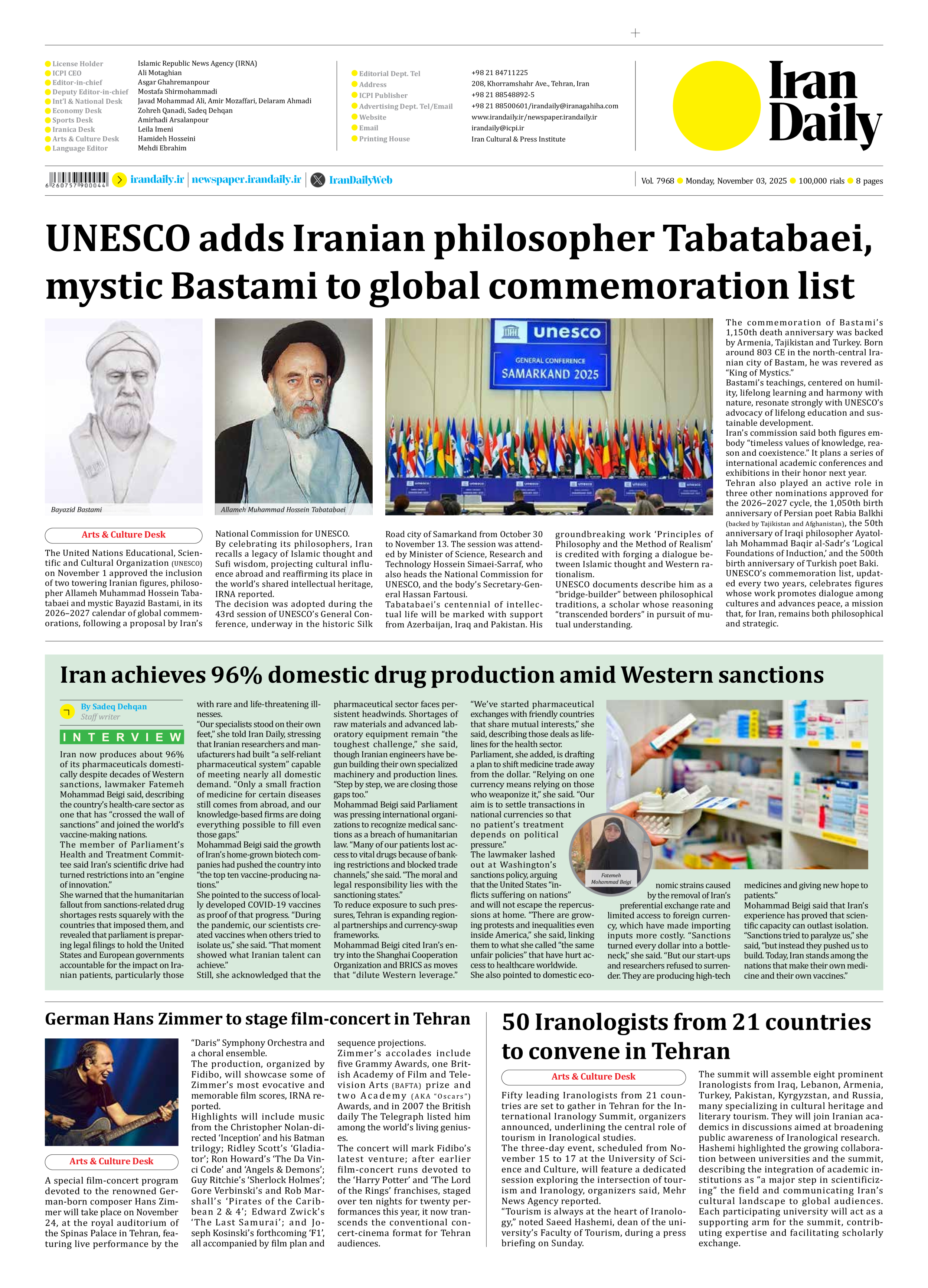


Iran achieves 96% domestic drug production amid Western sanctions
By Sadeq Dehqan
Staff writer
Iran now produces about 96% of its pharmaceuticals domestically despite decades of Western sanctions, lawmaker Fatemeh Mohammad Beigi said, describing the country’s health-care sector as one that has “crossed the wall of sanctions” and joined the world’s vaccine-making nations.
The member of Parliament’s Health and Treatment Committee said Iran’s scientific drive had turned restrictions into an “engine of innovation.”
She warned that the humanitarian fallout from sanctions-related drug shortages rests squarely with the countries that imposed them, and revealed that parliament is preparing legal filings to hold the United States and European governments accountable for the impact on Iranian patients, particularly those with rare and life-threatening illnesses.
“Our specialists stood on their own feet,” she told Iran Daily, stressing that Iranian researchers and manufacturers had built “a self-reliant pharmaceutical system” capable of meeting nearly all domestic demand. “Only a small fraction of medicine for certain diseases still comes from abroad, and our knowledge-based firms are doing everything possible to fill even those gaps.”
Mohammad Beigi said the growth of Iran’s home-grown biotech companies had pushed the country into “the top ten vaccine-producing nations.”
She pointed to the success of locally developed COVID-19 vaccines as proof of that progress. “During the pandemic, our scientists created vaccines when others tried to isolate us,” she said. “That moment showed what Iranian talent can achieve.”
Still, she acknowledged that the pharmaceutical sector faces persistent headwinds. Shortages of raw materials and advanced laboratory equipment remain “the toughest challenge,” she said, though Iranian engineers have begun building their own specialized machinery and production lines. “Step by step, we are closing those gaps too.”
Mohammad Beigi said Parliament was pressing international organizations to recognize medical sanctions as a breach of humanitarian law. “Many of our patients lost access to vital drugs because of banking restrictions and blocked trade channels,” she said. “The moral and legal responsibility lies with the sanctioning states.”
To reduce exposure to such pressures, Tehran is expanding regional partnerships and currency-swap frameworks.
Mohammad Beigi cited Iran’s entry into the Shanghai Cooperation Organization and BRICS as moves that “dilute Western leverage.” “We’ve started pharmaceutical exchanges with friendly countries that share mutual interests,” she said, describing those deals as lifelines for the health sector.
Parliament, she added, is drafting a plan to shift medicine trade away from the dollar. “Relying on one currency means relying on those who weaponize it,” she said. “Our aim is to settle transactions in national currencies so that no patient’s treatment depends on political pressure.”
The lawmaker lashed out at Washington’s sanctions policy, arguing that the United States “inflicts suffering on nations” and will not escape the repercussions at home. “There are growing protests and inequalities even inside America,” she said, linking them to what she called “the same unfair policies” that have hurt access to healthcare worldwide.
She also pointed to domestic economic strains caused by the removal of Iran’s preferential exchange rate and limited access to foreign currency, which have made importing inputs more costly. “Sanctions turned every dollar into a bottleneck,” she said. “But our start-ups and researchers refused to surrender. They are producing high-tech medicines and giving new hope to patients.”
Mohammad Beigi said that Iran’s experience has proved that scientific capacity can outlast isolation. “Sanctions tried to paralyze us,” she said, “but instead they pushed us to build. Today, Iran stands among the nations that make their own medicine and their own vaccines.”