







Experience surreal landscapes of Jask
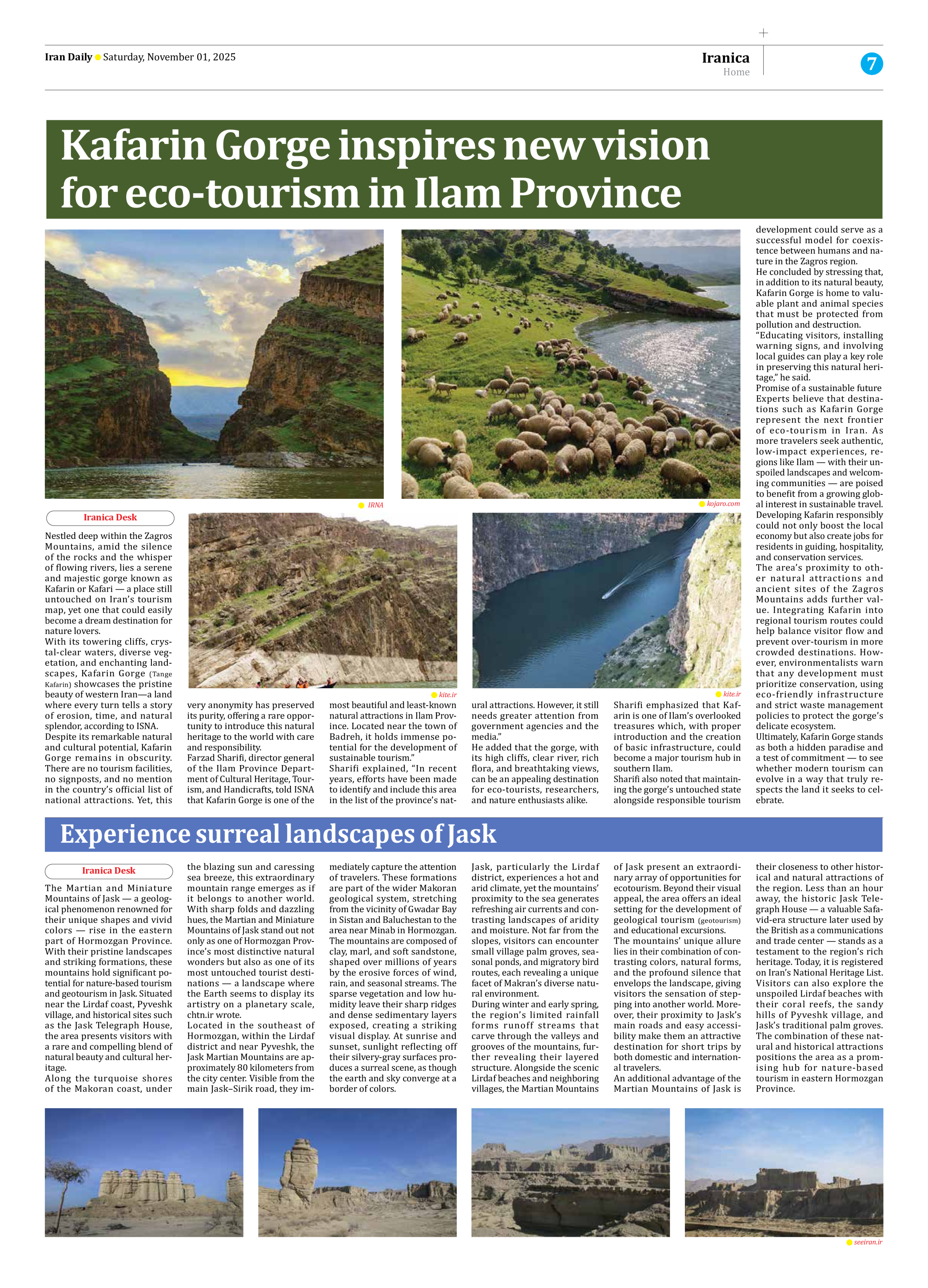
The Martian and Miniature Mountains of Jask — a geological phenomenon renowned for their unique shapes and vivid colors — rise in the eastern part of Hormozgan Province. With their pristine landscapes and striking formations, these mountains hold significant potential for nature-based tourism and geotourism in Jask. Situated near the Lirdaf coast, Pyveshk village, and historical sites such as the Jask Telegraph House, the area presents visitors with a rare and compelling blend of natural beauty and cultural heritage.
Along the turquoise shores of the Makoran coast, under the blazing sun and caressing sea breeze, this extraordinary mountain range emerges as if it belongs to another world. With sharp folds and dazzling hues, the Martian and Miniature Mountains of Jask stand out not only as one of Hormozgan Province’s most distinctive natural wonders but also as one of its most untouched tourist destinations — a landscape where the Earth seems to display its artistry on a planetary scale, chtn.ir wrote.
Located in the southeast of Hormozgan, within the Lirdaf district and near Pyveshk, the Jask Martian Mountains are approximately 80 kilometers from the city center. Visible from the main Jask–Sirik road, they immediately capture the attention of travelers. These formations are part of the wider Makoran geological system, stretching from the vicinity of Gwadar Bay in Sistan and Baluchestan to the area near Minab in Hormozgan.
The mountains are composed of clay, marl, and soft sandstone, shaped over millions of years by the erosive forces of wind, rain, and seasonal streams. The sparse vegetation and low humidity leave their sharp ridges and dense sedimentary layers exposed, creating a striking visual display. At sunrise and sunset, sunlight reflecting off their silvery-gray surfaces produces a surreal scene, as though the earth and sky converge at a border of colors.
Jask, particularly the Lirdaf district, experiences a hot and arid climate, yet the mountains’ proximity to the sea generates refreshing air currents and contrasting landscapes of aridity and moisture. Not far from the slopes, visitors can encounter small village palm groves, seasonal ponds, and migratory bird routes, each revealing a unique facet of Makran’s diverse natural environment.
During winter and early spring, the region’s limited rainfall forms runoff streams that carve through the valleys and grooves of the mountains, further revealing their layered structure. Alongside the scenic Lirdaf beaches and neighboring villages, the Martian Mountains of Jask present an extraordinary array of opportunities for ecotourism. Beyond their visual appeal, the area offers an ideal setting for the development of geological tourism (geotourism) and educational excursions.
The mountains’ unique allure lies in their combination of contrasting colors, natural forms, and the profound silence that envelops the landscape, giving visitors the sensation of stepping into another world. Moreover, their proximity to Jask’s main roads and easy accessibility make them an attractive destination for short trips by both domestic and international travelers.
An additional advantage of the Martian Mountains of Jask is their closeness to other historical and natural attractions of the region. Less than an hour away, the historic Jask Telegraph House — a valuable Safavid-era structure later used by the British as a communications and trade center — stands as a testament to the region’s rich heritage. Today, it is registered on Iran’s National Heritage List.
Visitors can also explore the unspoiled Lirdaf beaches with their coral reefs, the sandy hills of Pyveshk village, and Jask’s traditional palm groves. The combination of these natural and historical attractions positions the area as a promising hub for nature-based tourism in eastern Hormozgan Province.