







Fresh excavations begin at key historical sites of Qazvin Province
The head of the Archaeology Department at the Cultural Heritage, Tourism, and Handicrafts Organization of Qazvin Province has announced the launch of a new season of scientific excavations across the region’s historical sites.
Mohammadreza Asgari stated that fresh archaeological work will soon commence at Ebrahimabad Hill in Abyek and Kondor Hill in Takestan, while several other sites have already undergone exploration.
According to him, the excavation at Ebrahimabad Hill — a significant prehistoric settlement site — has received official authorization from the Research Institute of Cultural Heritage and is set to begin shortly under the supervision of Fazeli from the University of Tehran. This marks the second season of work at the site, following the first phase also directed by Dr. Fazeli.
Outlining the scientific objectives of the project, Asgari explained that researchers aim to study the evolution of early village life and architecture in the 6th millennium BCE, trace the development of agriculture on the Iranian Plateau through archaeobotanical and archaeozoological studies, and examine the ritual and belief systems of Neolithic and Chalcolithic communities, ISNA wrote.
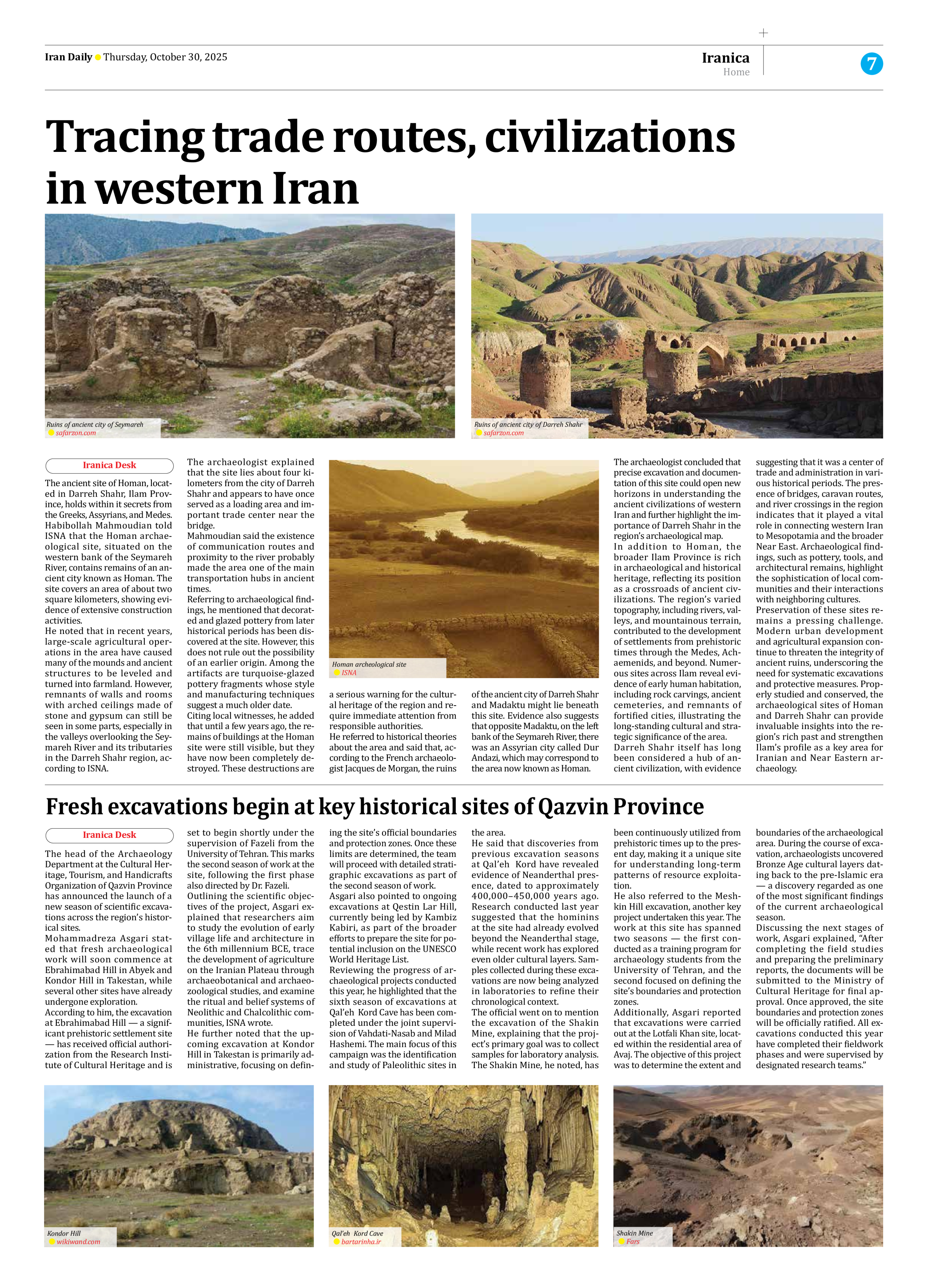
He further noted that the upcoming excavation at Kondor Hill in Takestan is primarily administrative, focusing on defining the site’s official boundaries and protection zones. Once these limits are determined, the team will proceed with detailed stratigraphic excavations as part of the second season of work.
Asgari also pointed to ongoing excavations at Qestin Lar Hill, currently being led by Kambiz Kabiri, as part of the broader efforts to prepare the site for potential inclusion on the UNESCO World Heritage List.
Reviewing the progress of archaeological projects conducted this year, he highlighted that the sixth season of excavations at Qal’eh Kord Cave has been completed under the joint supervision of Vahdati-Nasab and Milad Hashemi. The main focus of this campaign was the identification and study of Paleolithic sites in the area.
He said that discoveries from previous excavation seasons at Qal’eh Kord have revealed evidence of Neanderthal presence, dated to approximately 400,000–450,000 years ago. Research conducted last year suggested that the hominins at the site had already evolved beyond the Neanderthal stage, while recent work has explored even older cultural layers. Samples collected during these excavations are now being analyzed in laboratories to refine their chronological context.
The official went on to mention the excavation of the Shakin Mine, explaining that the project’s primary goal was to collect samples for laboratory analysis. The Shakin Mine, he noted, has been continuously utilized from prehistoric times up to the present day, making it a unique site for understanding long-term patterns of resource exploitation.
He also referred to the Meshkin Hill excavation, another key project undertaken this year. The work at this site has spanned two seasons — the first conducted as a training program for archaeology students from the University of Tehran, and the second focused on defining the site’s boundaries and protection zones.
Additionally, Asgari reported that excavations were carried out at the Lotfali Khan site, located within the residential area of Avaj. The objective of this project was to determine the extent and boundaries of the archaeological area. During the course of excavation, archaeologists uncovered Bronze Age cultural layers dating back to the pre-Islamic era — a discovery regarded as one of the most significant findings of the current archaeological season.
Discussing the next stages of work, Asgari explained, “After completing the field studies and preparing the preliminary reports, the documents will be submitted to the Ministry of Cultural Heritage for final approval. Once approved, the site boundaries and protection zones will be officially ratified. All excavations conducted this year have completed their fieldwork phases and were supervised by designated research teams.”