







Tracing trade routes, civilizations in western Iran
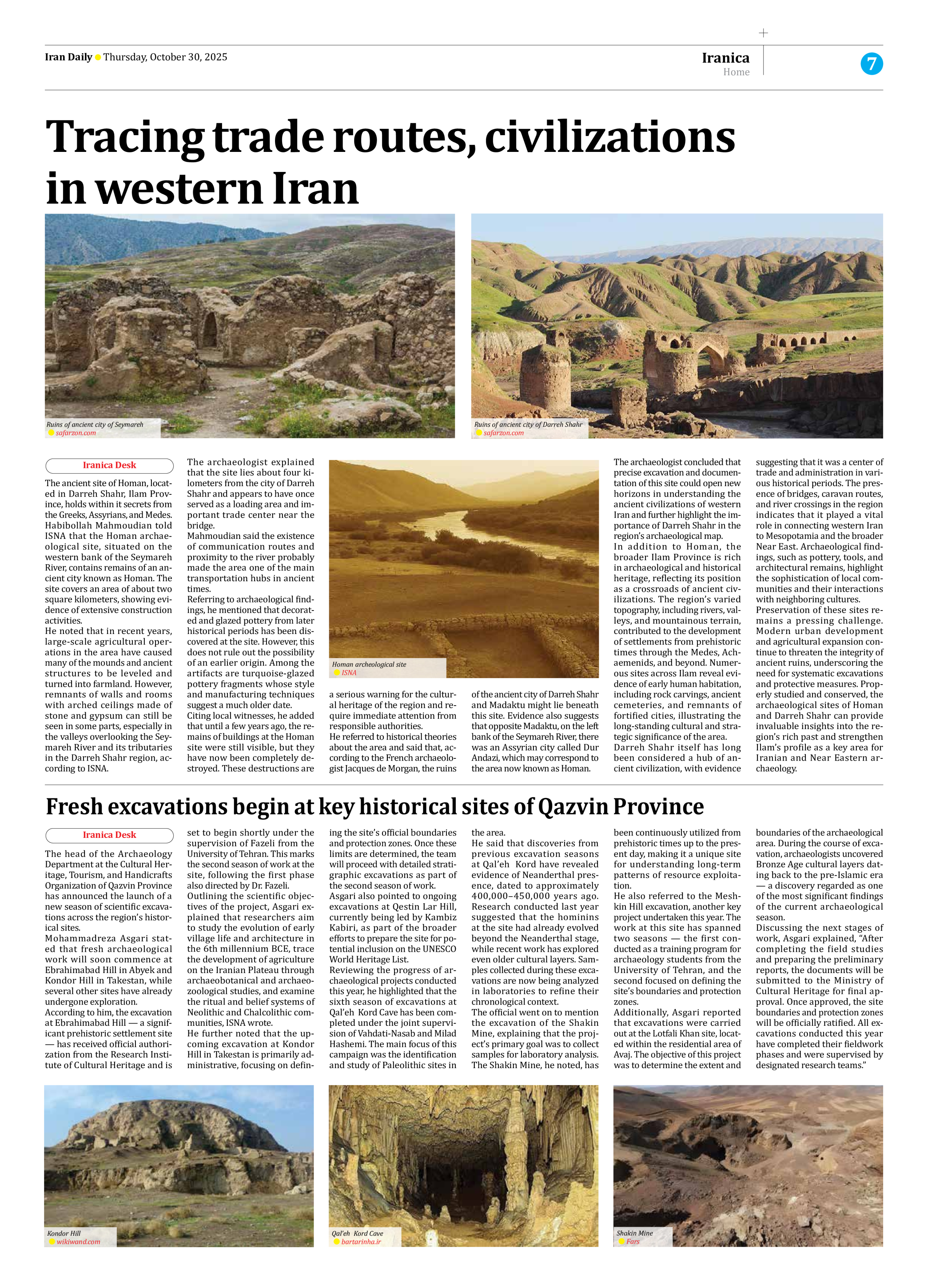
The ancient site of Homan, located in Darreh Shahr, Ilam Province, holds within it secrets from the Greeks, Assyrians, and Medes.
Habibollah Mahmoudian told ISNA that the Homan archaeological site, situated on the western bank of the Seymareh River, contains remains of an ancient city known as Homan. The site covers an area of about two square kilometers, showing evidence of extensive construction activities.
He noted that in recent years, large-scale agricultural operations in the area have caused many of the mounds and ancient structures to be leveled and turned into farmland. However, remnants of walls and rooms with arched ceilings made of stone and gypsum can still be seen in some parts, especially in the valleys overlooking the Seymareh River and its tributaries in the Darreh Shahr region, according to ISNA.
The archaeologist explained that the site lies about four kilometers from the city of Darreh Shahr and appears to have once served as a loading area and important trade center near the bridge.
Mahmoudian said the existence of communication routes and proximity to the river probably made the area one of the main transportation hubs in ancient times.
Referring to archaeological findings, he mentioned that decorated and glazed pottery from later historical periods has been discovered at the site. However, this does not rule out the possibility of an earlier origin. Among the artifacts are turquoise-glazed pottery fragments whose style and manufacturing techniques suggest a much older date.
Citing local witnesses, he added that until a few years ago, the remains of buildings at the Homan site were still visible, but they have now been completely destroyed. These destructions are a serious warning for the cultural heritage of the region and require immediate attention from responsible authorities.
He referred to historical theories about the area and said that, according to the French archaeologist Jacques de Morgan, the ruins of the ancient city of Darreh Shahr and Madaktu might lie beneath this site. Evidence also suggests that opposite Madaktu, on the left bank of the Seymareh River, there was an Assyrian city called Dur Andazi, which may correspond to the area now known as Homan.
The archaeologist concluded that precise excavation and documentation of this site could open new horizons in understanding the ancient civilizations of western Iran and further highlight the importance of Darreh Shahr in the region’s archaeological map.
In addition to Homan, the broader Ilam Province is rich in archaeological and historical heritage, reflecting its position as a crossroads of ancient civilizations. The region’s varied topography, including rivers, valleys, and mountainous terrain, contributed to the development of settlements from prehistoric times through the Medes, Achaemenids, and beyond. Numerous sites across Ilam reveal evidence of early human habitation, including rock carvings, ancient cemeteries, and remnants of fortified cities, illustrating the long-standing cultural and strategic significance of the area.
Darreh Shahr itself has long been considered a hub of ancient civilization, with evidence suggesting that it was a center of trade and administration in various historical periods. The presence of bridges, caravan routes, and river crossings in the region indicates that it played a vital role in connecting western Iran to Mesopotamia and the broader Near East. Archaeological findings, such as pottery, tools, and architectural remains, highlight the sophistication of local communities and their interactions with neighboring cultures.
Preservation of these sites remains a pressing challenge. Modern urban development and agricultural expansion continue to threaten the integrity of ancient ruins, underscoring the need for systematic excavations and protective measures. Properly studied and conserved, the archaeological sites of Homan and Darreh Shahr can provide invaluable insights into the region’s rich past and strengthen Ilam’s profile as a key area for Iranian and Near Eastern archaeology.