





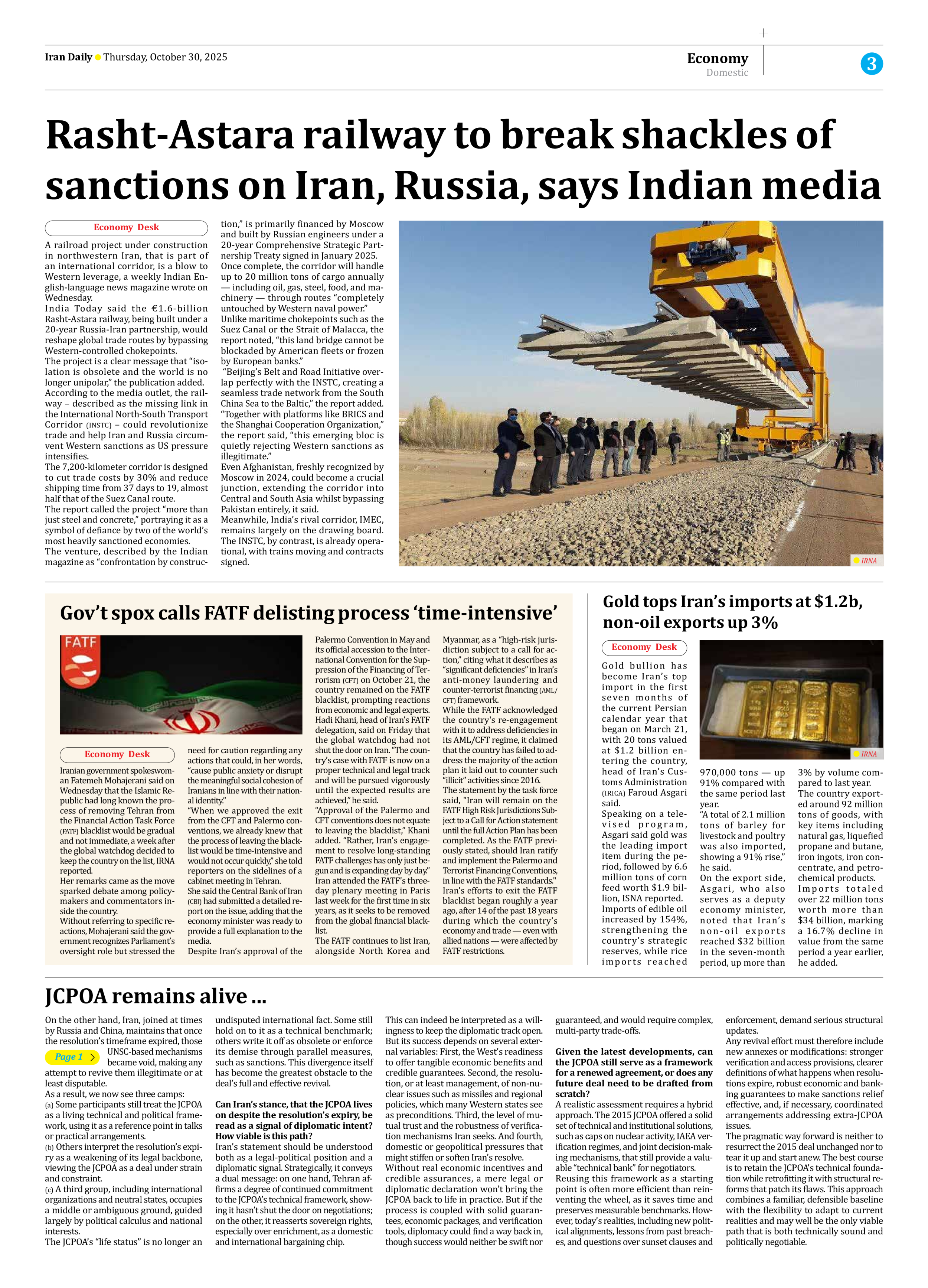


Gov’t spox calls FATF delisting process ‘time-intensive’
Iranian government spokeswoman Fatemeh Mohajerani said on Wednesday that the Islamic Republic had long known the process of removing Tehran from the Financial Action Task Force (FATF) blacklist would be gradual and not immediate, a week after the global watchdog decided to keep the country on the list, IRNA reported.
Her remarks came as the move sparked debate among policymakers and commentators inside the country.
Without referring to specific reactions, Mohajerani said the government recognizes Parliament’s oversight role but stressed the need for caution regarding any actions that could, in her words, “cause public anxiety or disrupt the meaningful social cohesion of Iranians in line with their national identity.”
“When we approved the exit from the CFT and Palermo conventions, we already knew that the process of leaving the blacklist would be time-intensive and would not occur quickly,” she told reporters on the sidelines of a cabinet meeting in Tehran.
She said the Central Bank of Iran (CBI) had submitted a detailed report on the issue, adding that the economy minister was ready to provide a full explanation to the media.
Despite Iran’s approval of the Palermo Convention in May and its official accession to the International Convention for the Suppression of the Financing of Terrorism (CFT) on October 21, the country remained on the FATF blacklist, prompting reactions from economic and legal experts.
Hadi Khani, head of Iran’s FATF delegation, said on Friday that the global watchdog had not shut the door on Iran. “The country’s case with FATF is now on a proper technical and legal track and will be pursued vigorously until the expected results are achieved,” he said.
“Approval of the Palermo and CFT conventions does not equate to leaving the blacklist,” Khani added. “Rather, Iran’s engagement to resolve long-standing FATF challenges has only just begun and is expanding day by day.”
Iran attended the FATF’s three-day plenary meeting in Paris last week for the first time in six years, as it seeks to be removed from the global financial blacklist.
The FATF continues to list Iran, alongside North Korea and Myanmar, as a “high-risk jurisdiction subject to a call for action,” citing what it describes as “significant deficiencies” in Iran’s anti-money laundering and counter-terrorist financing (AML/CFT) framework.
While the FATF acknowledged the country's re-engagement with it to address deficiencies in its AML/CFT regime, it claimed that the country has failed to address the majority of the action plan it laid out to counter such “illicit” activities since 2016.
The statement by the task force said, "Iran will remain on the FATF High Risk Jurisdictions Subject to a Call for Action statement until the full Action Plan has been completed. As the FATF previously stated, should Iran ratify and implement the Palermo and Terrorist Financing Conventions, in line with the FATF standards."
Iran’s efforts to exit the FATF blacklist began roughly a year ago, after 14 of the past 18 years during which the country’s economy and trade — even with allied nations — were affected by FATF restrictions.