







Rasht-Astara railway to break shackles of sanctions on Iran, Russia, says Indian media
A railroad project under construction in northwestern Iran, that is part of an international corridor, is a blow to Western leverage, a weekly Indian English-language news magazine wrote on Wednesday.
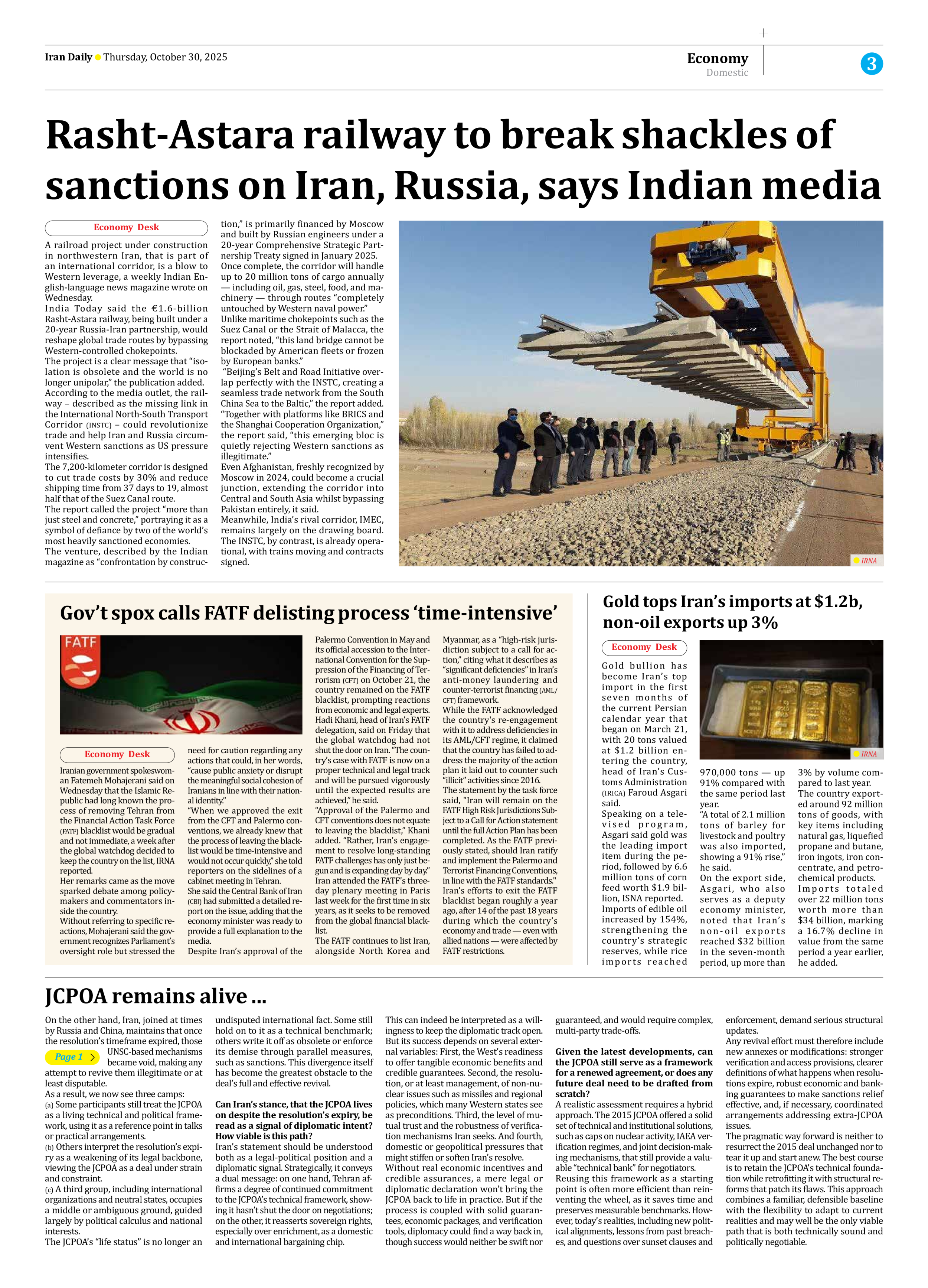
India Today said the €1.6-billion Rasht-Astara railway, being built under a 20-year Russia-Iran partnership, would reshape global trade routes by bypassing Western-controlled chokepoints.
The project is a clear message that “isolation is obsolete and the world is no longer unipolar,” the publication added.
According to the media outlet, the railway – described as the missing link in the International North-South Transport Corridor (INSTC) – could revolutionize trade and help Iran and Russia circumvent Western sanctions as US pressure intensifies.
The 7,200-kilometer corridor is designed to cut trade costs by 30% and reduce shipping time from 37 days to 19, almost half that of the Suez Canal route.
The report called the project “more than just steel and concrete,” portraying it as a symbol of defiance by two of the world’s most heavily sanctioned economies.
The venture, described by the Indian magazine as “confrontation by construction,” is primarily financed by Moscow and built by Russian engineers under a 20-year Comprehensive Strategic Partnership Treaty signed in January 2025.
Once complete, the corridor will handle up to 20 million tons of cargo annually — including oil, gas, steel, food, and machinery — through routes “completely untouched by Western naval power.”
Unlike maritime chokepoints such as the Suez Canal or the Strait of Malacca, the report noted, “this land bridge cannot be blockaded by American fleets or frozen by European banks.”
“Beijing’s Belt and Road Initiative overlap perfectly with the INSTC, creating a seamless trade network from the South China Sea to the Baltic,” the report added.
“Together with platforms like BRICS and the Shanghai Cooperation Organization,” the report said, “this emerging bloc is quietly rejecting Western sanctions as illegitimate.”
Even Afghanistan, freshly recognized by Moscow in 2024, could become a crucial junction, extending the corridor into Central and South Asia whilst bypassing Pakistan entirely, it said.
Meanwhile, India’s rival corridor, IMEC, remains largely on the drawing board. The INSTC, by contrast, is already operational, with trains moving and contracts signed.