







Introduction to the book:
Religion and Environmental Ethics
From conflict to overlapping consensus
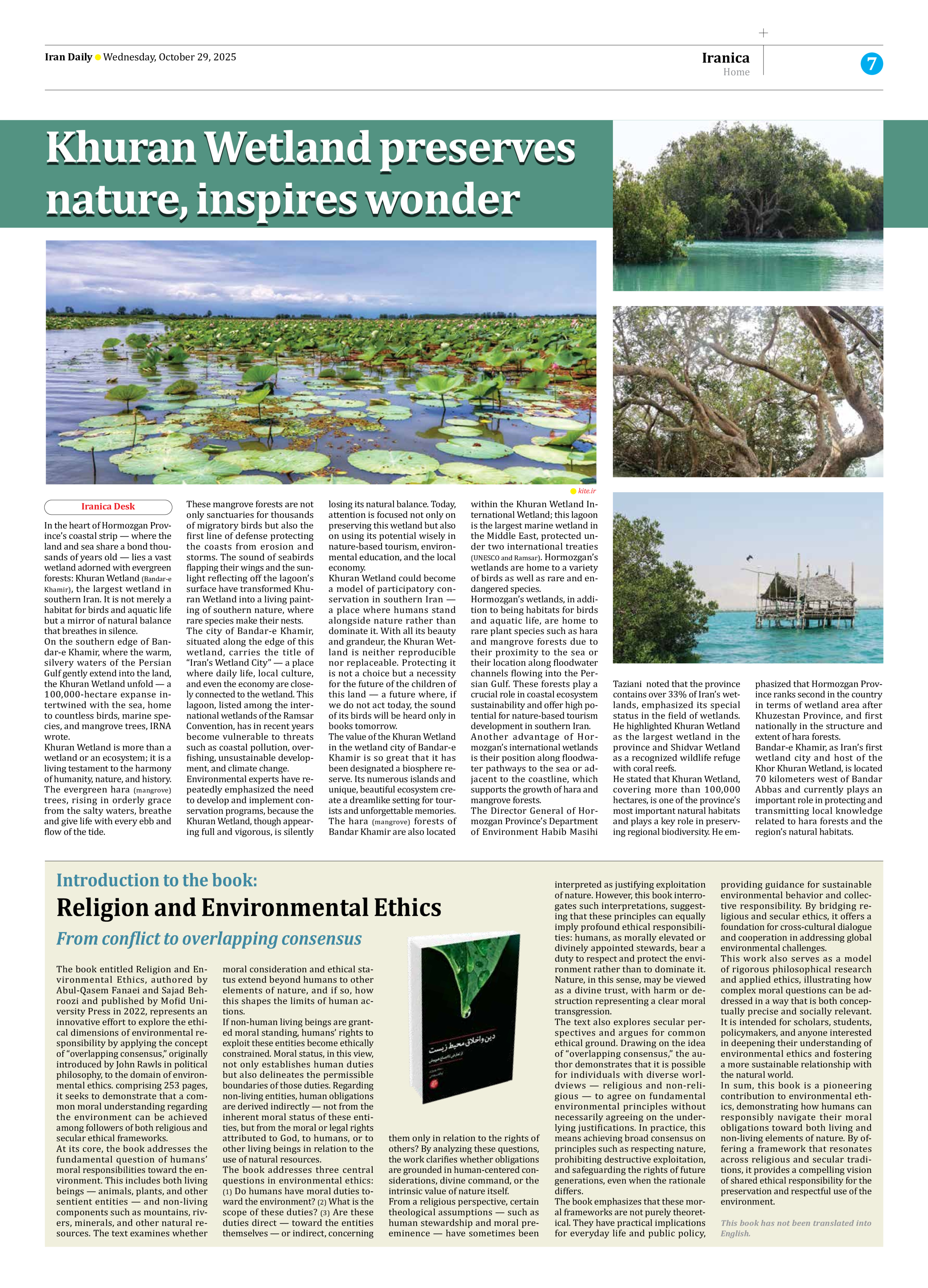
The book entitled Religion and Environmental Ethics, authored by Abul-Qasem Fanaei and Sajad Behroozi and published by Mofid University Press in 2022, represents an innovative effort to explore the ethical dimensions of environmental responsibility by applying the concept of “overlapping consensus,” originally introduced by John Rawls in political philosophy, to the domain of environmental ethics. comprising 253 pages, it seeks to demonstrate that a common moral understanding regarding the environment can be achieved among followers of both religious and secular ethical frameworks.
At its core, the book addresses the fundamental question of humans’ moral responsibilities toward the environment. This includes both living beings — animals, plants, and other sentient entities — and non-living components such as mountains, rivers, minerals, and other natural resources. The text examines whether moral consideration and ethical status extend beyond humans to other elements of nature, and if so, how this shapes the limits of human actions.
If non-human living beings are granted moral standing, humans’ rights to exploit these entities become ethically constrained. Moral status, in this view, not only establishes human duties but also delineates the permissible boundaries of those duties. Regarding non-living entities, human obligations are derived indirectly — not from the inherent moral status of these entities, but from the moral or legal rights attributed to God, to humans, or to other living beings in relation to the use of natural resources.
The book addresses three central questions in environmental ethics: (1) Do humans have moral duties toward the environment? (2) What is the scope of these duties? (3) Are these duties direct — toward the entities themselves — or indirect, concerning them only in relation to the rights of others? By analyzing these questions, the work clarifies whether obligations are grounded in human-centered considerations, divine command, or the intrinsic value of nature itself.
From a religious perspective, certain theological assumptions — such as human stewardship and moral preeminence — have sometimes been interpreted as justifying exploitation of nature. However, this book interrogates such interpretations, suggesting that these principles can equally imply profound ethical responsibilities: humans, as morally elevated or divinely appointed stewards, bear a duty to respect and protect the environment rather than to dominate it. Nature, in this sense, may be viewed as a divine trust, with harm or destruction representing a clear moral transgression.
The text also explores secular perspectives and argues for common ethical ground. Drawing on the idea of “overlapping consensus,” the author demonstrates that it is possible for individuals with diverse worldviews — religious and non-religious — to agree on fundamental environmental principles without necessarily agreeing on the underlying justifications. In practice, this means achieving broad consensus on principles such as respecting nature, prohibiting destructive exploitation, and safeguarding the rights of future generations, even when the rationale differs.
The book emphasizes that these moral frameworks are not purely theoretical. They have practical implications for everyday life and public policy, providing guidance for sustainable environmental behavior and collective responsibility. By bridging religious and secular ethics, it offers a foundation for cross-cultural dialogue and cooperation in addressing global environmental challenges.
This work also serves as a model of rigorous philosophical research and applied ethics, illustrating how complex moral questions can be addressed in a way that is both conceptually precise and socially relevant. It is intended for scholars, students, policymakers, and anyone interested in deepening their understanding of environmental ethics and fostering a more sustainable relationship with the natural world.
In sum, this book is a pioneering contribution to environmental ethics, demonstrating how humans can responsibly navigate their moral obligations toward both living and non-living elements of nature. By offering a framework that resonates across religious and secular traditions, it provides a compelling vision of shared ethical responsibility for the preservation and respectful use of the environment.
This book has not been translated into English.