





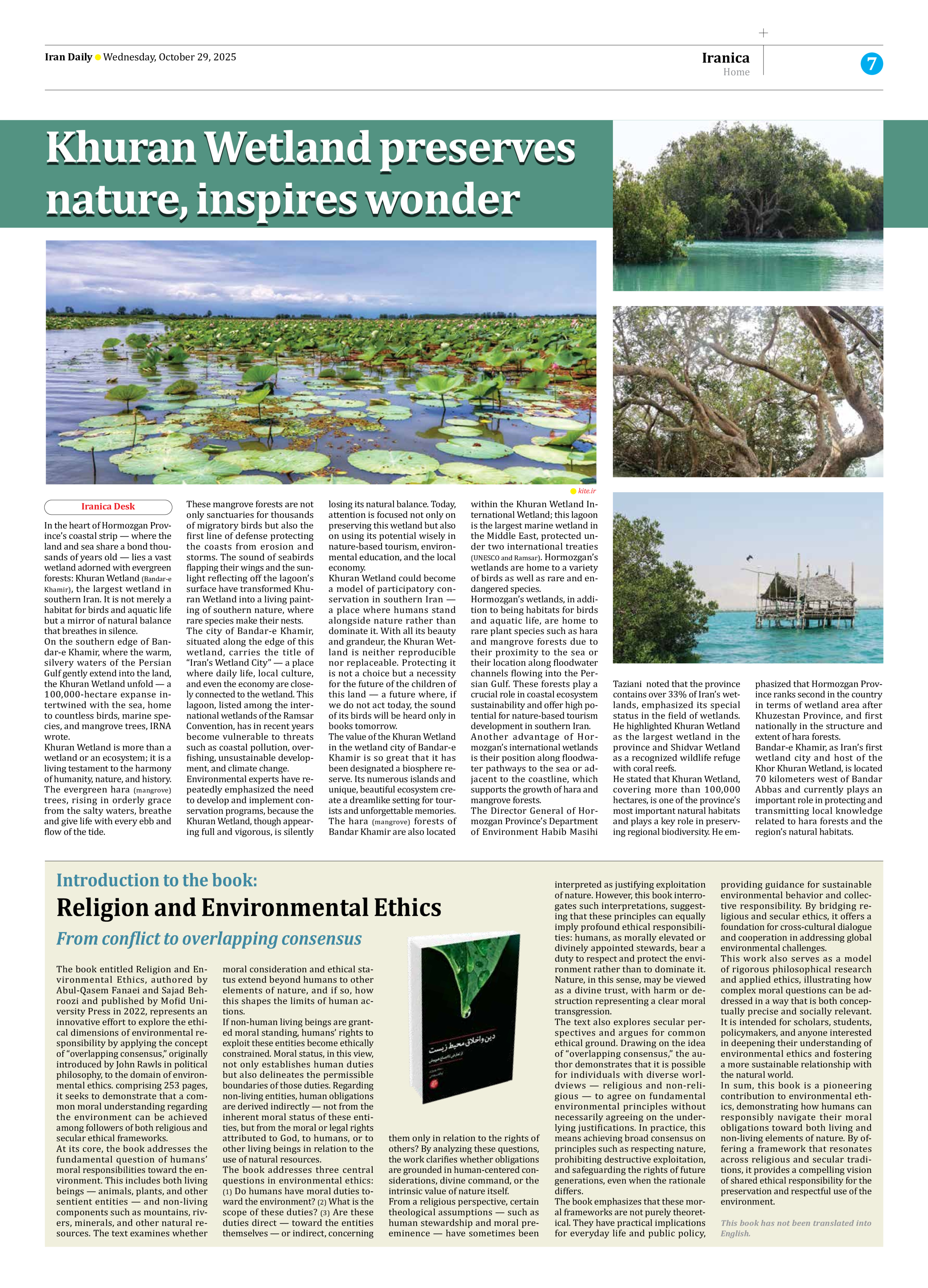


Khuran Wetland preserves nature, inspires wonder
In the heart of Hormozgan Province’s coastal strip — where the land and sea share a bond thousands of years old — lies a vast wetland adorned with evergreen forests: Khuran Wetland (Bandar-e Khamir), the largest wetland in southern Iran. It is not merely a habitat for birds and aquatic life but a mirror of natural balance that breathes in silence.
On the southern edge of Bandar-e Khamir, where the warm, silvery waters of the Persian Gulf gently extend into the land, the Khuran Wetland unfold — a 100,000-hectare expanse intertwined with the sea, home to countless birds, marine species, and mangrove trees, IRNA wrote.
Khuran Wetland is more than a wetland or an ecosystem; it is a living testament to the harmony of humanity, nature, and history. The evergreen hara (mangrove) trees, rising in orderly grace from the salty waters, breathe and give life with every ebb and flow of the tide.
These mangrove forests are not only sanctuaries for thousands of migratory birds but also the first line of defense protecting the coasts from erosion and storms. The sound of seabirds flapping their wings and the sunlight reflecting off the lagoon’s surface have transformed Khuran Wetland into a living painting of southern nature, where rare species make their nests.
The city of Bandar-e Khamir, situated along the edge of this wetland, carries the title of “Iran’s Wetland City” — a place where daily life, local culture, and even the economy are closely connected to the wetland. This lagoon, listed among the international wetlands of the Ramsar Convention, has in recent years become vulnerable to threats such as coastal pollution, overfishing, unsustainable development, and climate change.
Environmental experts have repeatedly emphasized the need to develop and implement conservation programs, because the Khuran Wetland, though appearing full and vigorous, is silently losing its natural balance. Today, attention is focused not only on preserving this wetland but also on using its potential wisely in nature-based tourism, environmental education, and the local economy.
Khuran Wetland could become a model of participatory conservation in southern Iran — a place where humans stand alongside nature rather than dominate it. With all its beauty and grandeur, the Khuran Wetland is neither reproducible nor replaceable. Protecting it is not a choice but a necessity for the future of the children of this land — a future where, if we do not act today, the sound of its birds will be heard only in books tomorrow.
The value of the Khuran Wetland in the wetland city of Bandar-e Khamir is so great that it has been designated a biosphere reserve. Its numerous islands and unique, beautiful ecosystem create a dreamlike setting for tourists and unforgettable memories.
The hara (mangrove) forests of Bandar Khamir are also located within the Khuran Wetland International Wetland; this lagoon is the largest marine wetland in the Middle East, protected under two international treaties (UNESCO and Ramsar). Hormozgan’s wetlands are home to a variety of birds as well as rare and endangered species.
Hormozgan’s wetlands, in addition to being habitats for birds and aquatic life, are home to rare plant species such as hara and mangrove forests due to their proximity to the sea or their location along floodwater channels flowing into the Persian Gulf. These forests play a crucial role in coastal ecosystem sustainability and offer high potential for nature-based tourism development in southern Iran.
Another advantage of Hormozgan’s international wetlands is their position along floodwater pathways to the sea or adjacent to the coastline, which supports the growth of hara and mangrove forests.
The Director General of Hormozgan Province’s Department of Environment Habib Masihi Taziani noted that the province contains over 33% of Iran’s wetlands, emphasized its special status in the field of wetlands. He highlighted Khuran Wetland as the largest wetland in the province and Shidvar Wetland as a recognized wildlife refuge with coral reefs.
He stated that Khuran Wetland, covering more than 100,000 hectares, is one of the province’s most important natural habitats and plays a key role in preserving regional biodiversity. He emphasized that Hormozgan Province ranks second in the country in terms of wetland area after Khuzestan Province, and first nationally in the structure and extent of hara forests.
Bandar-e Khamir, as Iran’s first wetland city and host of the Khor Khuran Wetland, is located 70 kilometers west of Bandar Abbas and currently plays an important role in protecting and transmitting local knowledge related to hara forests and the region’s natural habitats.