







Marivan keeps heritage alive through craft
In the winding alleyways of Marivan, performance is not limited to the stage. Every home, workshop, and marketplace transforms into a living tableau of art and daily life. Here, creativity spills beyond the boundaries of the theater, into the hands of artisans who shape wood, yarn, and wool into expressions of culture, identity, and memory.
Cultural events have long been recognized as engines of tourism and local economic growth — a role especially vital in regions like Kurdistan, where traditional crafts are deeply interwoven with everyday life. The gathering of artists, performers, and visitors in Marivan offers an opportunity to blend art, business, and community identity in a celebration of creativity and heritage, Mehr News Agency wrote.
The 18th Marivan International Festival of Street Theater, taking place from October 26 to 30, features a diverse program including open competitions, children and youth performances, traditional rituals, international showcases, the “Nishtiman” (homeland) section, and educational workshops. The festival’s convergence of national and international artists, alongside local spectators and tourists, provides an ideal setting to promote Marivan’s renowned handicrafts and encourage visitors to take home a piece of the city’s artistic spirit.
A city of crafts, creativity
Marivan is known not only for its cultural festivals but also for its rich tradition of handmade crafts. Visitors looking to explore and purchase local goods can visit the city’s main bazaar, the Zarivar Lake local market, or the Bashmaq border market. Among the most treasured local creations are the Daf and Tanbur, two iconic Kurdish musical instruments made by skilled artisans whose craftsmanship keeps centuries-old traditions alive.
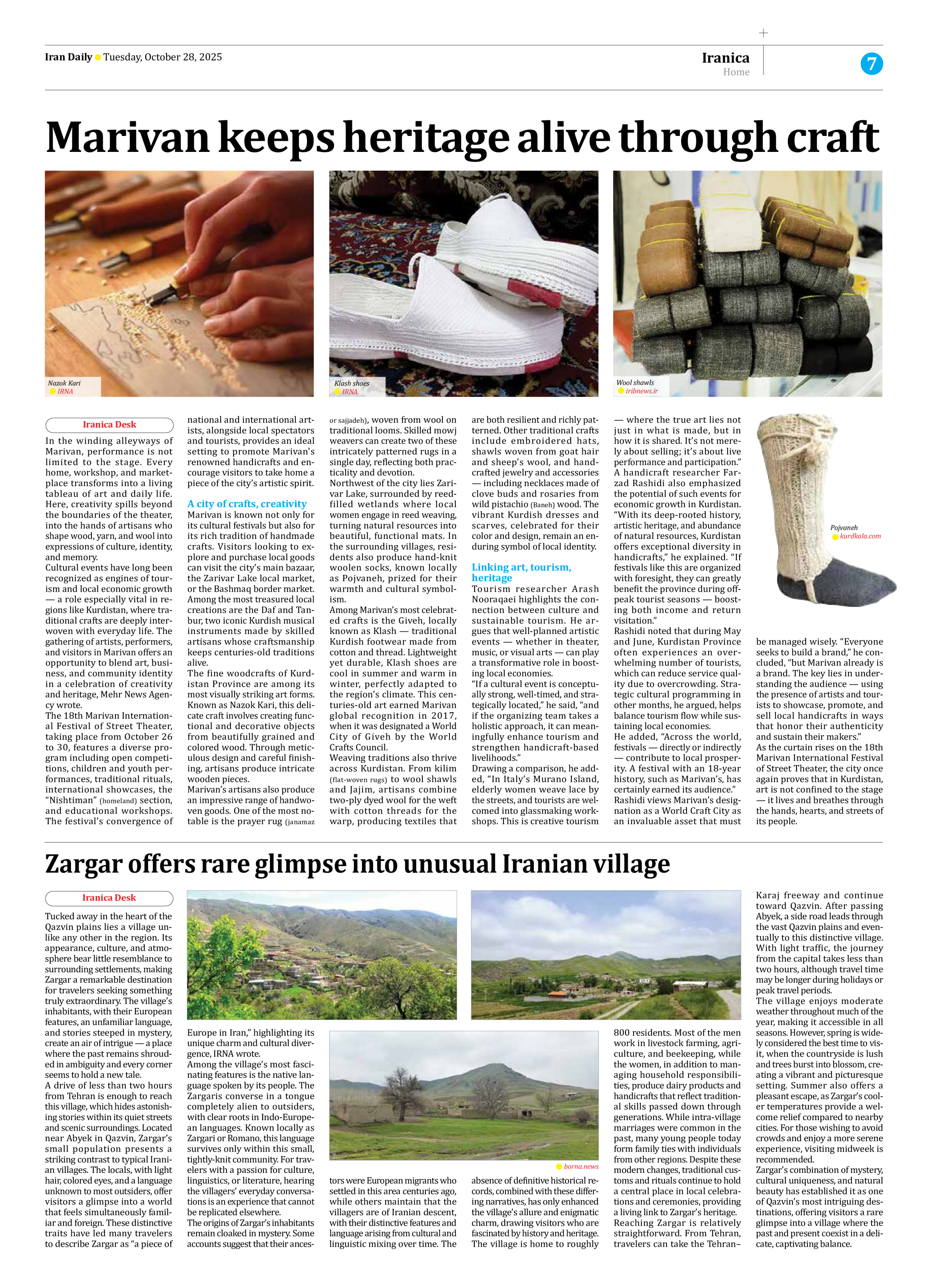
The fine woodcrafts of Kurdistan Province are among its most visually striking art forms. Known as Nazok Kari, this delicate craft involves creating functional and decorative objects from beautifully grained and colored wood. Through meticulous design and careful finishing, artisans produce intricate wooden pieces.
Marivan’s artisans also produce an impressive range of handwoven goods. One of the most notable is the prayer rug (janamaz or sajjadeh), woven from wool on traditional looms. Skilled mowj weavers can create two of these intricately patterned rugs in a single day, reflecting both practicality and devotion.
Northwest of the city lies Zarivar Lake, surrounded by reed-filled wetlands where local women engage in reed weaving, turning natural resources into beautiful, functional mats. In the surrounding villages, residents also produce hand-knit woolen socks, known locally as Pojvaneh, prized for their warmth and cultural symbolism.
Among Marivan’s most celebrated crafts is the Giveh, locally known as Klash — traditional Kurdish footwear made from cotton and thread. Lightweight yet durable, Klash shoes are cool in summer and warm in winter, perfectly adapted to the region’s climate. This centuries-old art earned Marivan global recognition in 2017, when it was designated a World City of Giveh by the World Crafts Council.
Weaving traditions also thrive across Kurdistan. From kilim (flat-woven rugs) to wool shawls and Jajim, artisans combine two-ply dyed wool for the weft with cotton threads for the warp, producing textiles that are both resilient and richly patterned. Other traditional crafts include embroidered hats, shawls woven from goat hair and sheep’s wool, and handcrafted jewelry and accessories — including necklaces made of clove buds and rosaries from wild pistachio (Baneh) wood. The vibrant Kurdish dresses and scarves, celebrated for their color and design, remain an enduring symbol of local identity.
Linking art, tourism, heritage
Tourism researcher Arash Nooraqaei highlights the connection between culture and sustainable tourism. He argues that well-planned artistic events — whether in theater, music, or visual arts — can play a transformative role in boosting local economies.
“If a cultural event is conceptually strong, well-timed, and strategically located,” he said, “and if the organizing team takes a holistic approach, it can meaningfully enhance tourism and strengthen handicraft-based livelihoods.”
Drawing a comparison, he added, “In Italy’s Murano Island, elderly women weave lace by the streets, and tourists are welcomed into glassmaking workshops. This is creative tourism — where the true art lies not just in what is made, but in how it is shared. It’s not merely about selling; it’s about live performance and participation.”
A handicraft researcher Farzad Rashidi also emphasized the potential of such events for economic growth in Kurdistan. “With its deep-rooted history, artistic heritage, and abundance of natural resources, Kurdistan offers exceptional diversity in handicrafts,” he explained. “If festivals like this are organized with foresight, they can greatly benefit the province during off-peak tourist seasons — boosting both income and return visitation.”
Rashidi noted that during May and June, Kurdistan Province often experiences an overwhelming number of tourists, which can reduce service quality due to overcrowding. Strategic cultural programming in other months, he argued, helps balance tourism flow while sustaining local economies.
He added, “Across the world, festivals — directly or indirectly — contribute to local prosperity. A festival with an 18-year history, such as Marivan’s, has certainly earned its audience.”
Rashidi views Marivan’s designation as a World Craft City as an invaluable asset that must be managed wisely. “Everyone seeks to build a brand,” he concluded, “but Marivan already is a brand. The key lies in understanding the audience — using the presence of artists and tourists to showcase, promote, and sell local handicrafts in ways that honor their authenticity and sustain their makers.”
As the curtain rises on the 18th Marivan International Festival of Street Theater, the city once again proves that in Kurdistan, art is not confined to the stage — it lives and breathes through the hands, hearts, and streets of its people.