





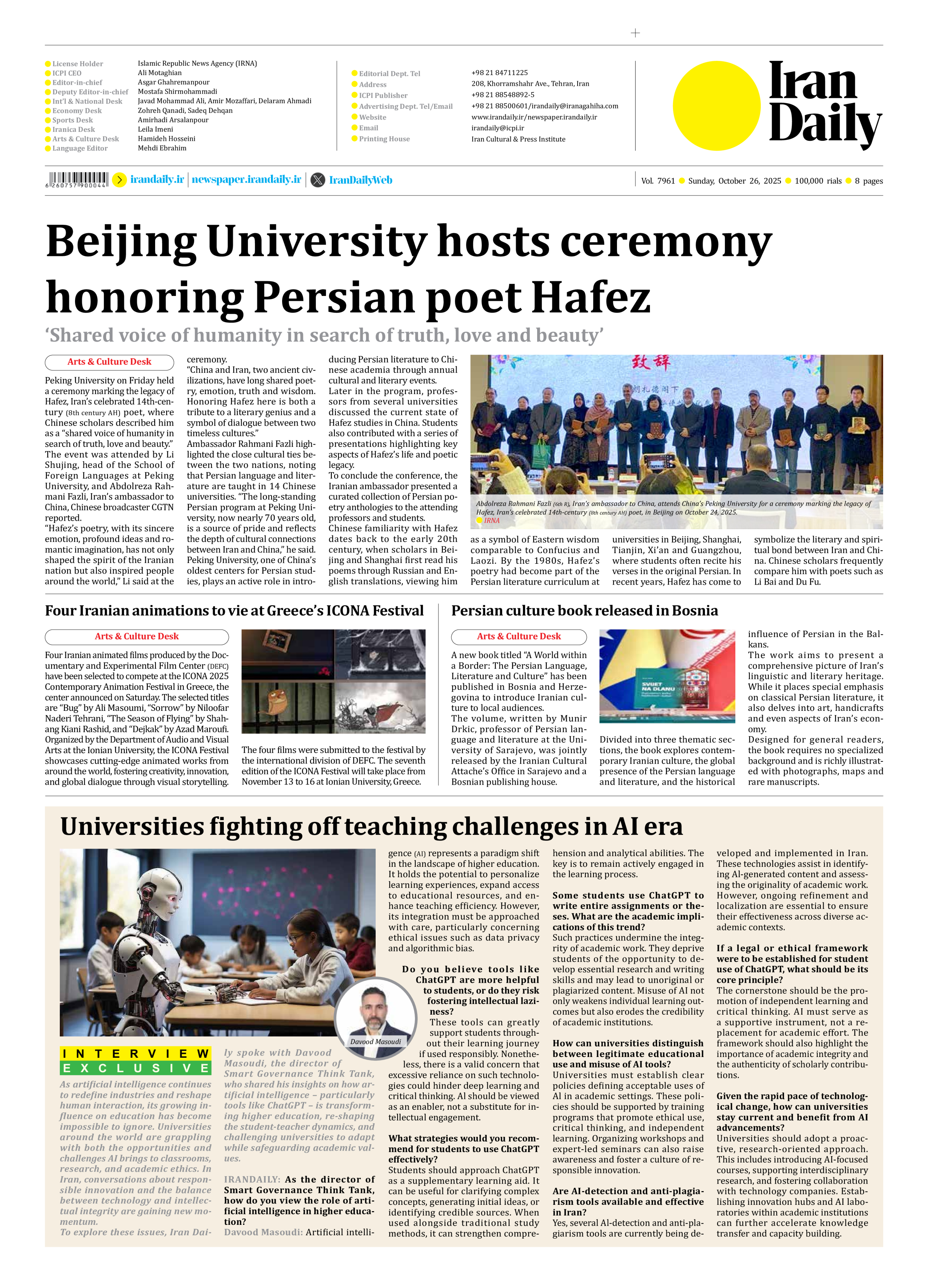


Universities fighting off teaching challenges in AI era
As artificial intelligence continues to redefine industries and reshape human interaction, its growing influence on education has become impossible to ignore. Universities around the world are grappling with both the opportunities and challenges AI brings to classrooms, research, and academic ethics. In Iran, conversations about responsible innovation and the balance between technology and intellectual integrity are gaining new momentum.
To explore these issues, Iran Daily spoke with Davood Masoudi, the director of Smart Governance Think Tank, who shared his insights on how artificial intelligence – particularly tools like ChatGPT – is transforming higher education, re-shaping the student-teacher dynamics, and challenging universities to adapt while safeguarding academic values.
IRANDAILY: As the director of Smart Governance Think Tank, how do you view the role of artificial intelligence in higher education?
Davood Masoudi: Artificial intelligence (AI) represents a paradigm shift in the landscape of higher education. It holds the potential to personalize learning experiences, expand access to educational resources, and enhance teaching efficiency. However, its integration must be approached with care, particularly concerning ethical issues such as data privacy and algorithmic bias.
Do you believe tools like ChatGPT are more helpful to students, or do they risk fostering intellectual laziness?
These tools can greatly support students throughout their learning journey if used responsibly. Nonetheless, there is a valid concern that excessive reliance on such technologies could hinder deep learning and critical thinking. Al should be viewed as an enabler, not a substitute for intellectual engagement.
What strategies would you recommend for students to use ChatGPT effectively?
Students should approach ChatGPT as a supplementary learning aid. It can be useful for clarifying complex concepts, generating initial ideas, or identifying credible sources. When used alongside traditional study methods, it can strengthen comprehension and analytical abilities. The key is to remain actively engaged in the learning process.
Some students use ChatGPT to write entire assignments or theses. What are the academic implications of this trend?
Such practices undermine the integrity of academic work. They deprive students of the opportunity to develop essential research and writing skills and may lead to unoriginal or plagiarized content. Misuse of AI not only weakens individual learning outcomes but also erodes the credibility of academic institutions.
How can universities distinguish between legitimate educational use and misuse of AI tools?
Universities must establish clear policies defining acceptable uses of Al in academic settings. These policies should be supported by training programs that promote ethical use, critical thinking, and independent learning. Organizing workshops and expert-led seminars can also raise awareness and foster a culture of responsible innovation.
Are AI-detection and anti-plagiarism tools available and effective in Iran?
Yes, several Al-detection and anti-plagiarism tools are currently being developed and implemented in Iran. These technologies assist in identifying Al-generated content and assessing the originality of academic work. However, ongoing refinement and localization are essential to ensure their effectiveness across diverse academic contexts.
If a legal or ethical framework were to be established for student use of ChatGPT, what should be its core principle?
The cornerstone should be the promotion of independent learning and critical thinking. AI must serve as a supportive instrument, not a replacement for academic effort. The framework should also highlight the importance of academic integrity and the authenticity of scholarly contributions.
Given the rapid pace of technological change, how can universities stay current and benefit from AI advancements?
Universities should adopt a proactive, research-oriented approach. This includes introducing AI-focused courses, supporting interdisciplinary research, and fostering collaboration with technology companies. Establishing innovation hubs and AI laboratories within academic institutions can further accelerate knowledge transfer and capacity building.