







Beijing University hosts ceremony honoring Persian poet Hafez
‘Shared voice of humanity in search of truth, love and beauty’
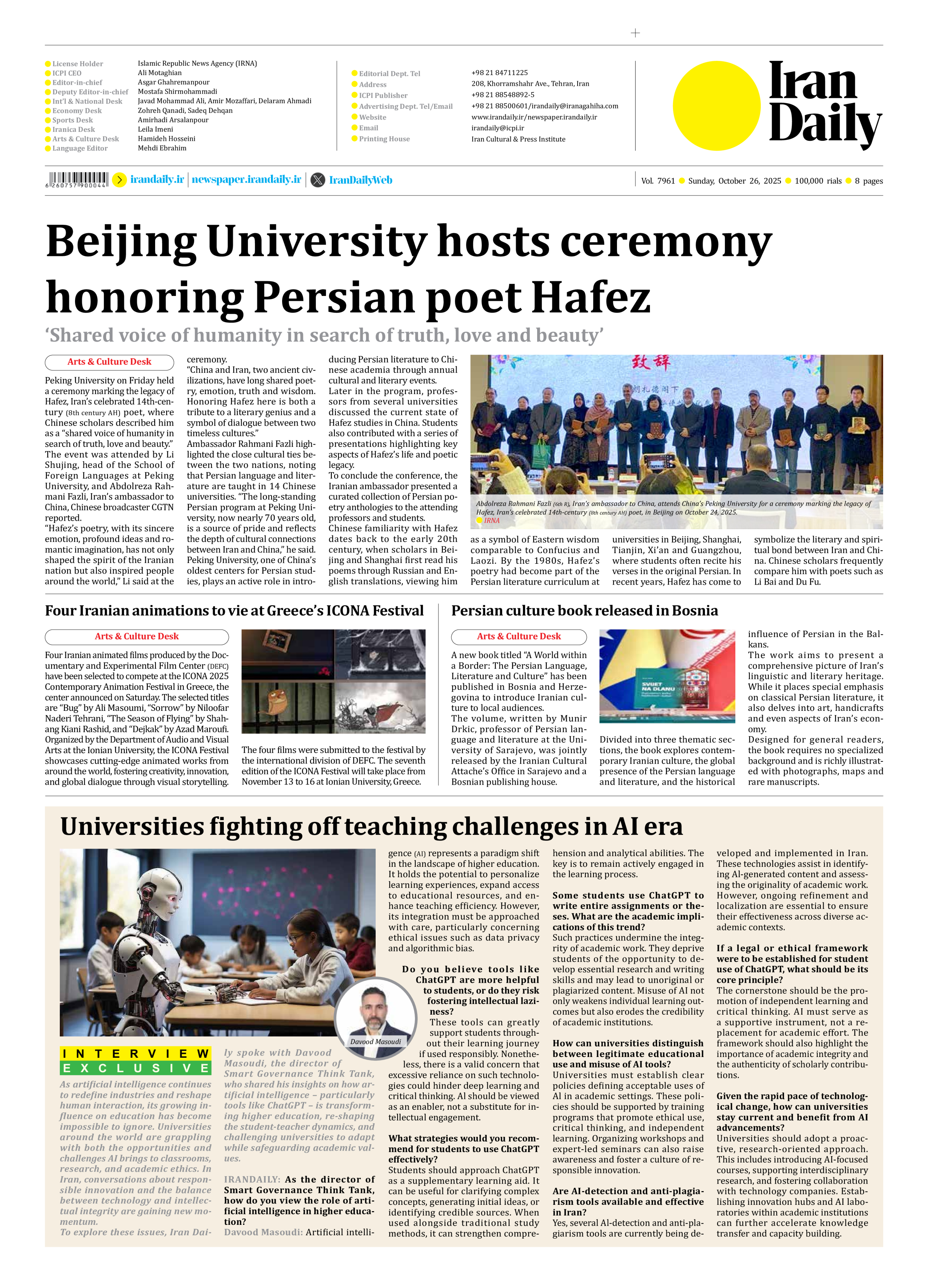
Peking University on Friday held a ceremony marking the legacy of Hafez, Iran’s celebrated 14th-century (8th century AH) poet, where Chinese scholars described him as a “shared voice of humanity in search of truth, love and beauty.”
The event was attended by Li Shujing, head of the School of Foreign Languages at Peking University, and Abdolreza Rahmani Fazli, Iran’s ambassador to China, Chinese broadcaster CGTN reported.
“Hafez’s poetry, with its sincere emotion, profound ideas and romantic imagination, has not only shaped the spirit of the Iranian nation but also inspired people around the world,” Li said at the ceremony.
“China and Iran, two ancient civilizations, have long shared poetry, emotion, truth and wisdom. Honoring Hafez here is both a tribute to a literary genius and a symbol of dialogue between two timeless cultures.”
Ambassador Rahmani Fazli highlighted the close cultural ties between the two nations, noting that Persian language and literature are taught in 14 Chinese universities. “The long-standing Persian program at Peking University, now nearly 70 years old, is a source of pride and reflects the depth of cultural connections between Iran and China,” he said.
Peking University, one of China’s oldest centers for Persian studies, plays an active role in introducing Persian literature to Chinese academia through annual cultural and literary events.
Later in the program, professors from several universities discussed the current state of Hafez studies in China. Students also contributed with a series of presentations highlighting key aspects of Hafez’s life and poetic legacy.
To conclude the conference, the Iranian ambassador presented a curated collection of Persian poetry anthologies to the attending professors and students.
Chinese familiarity with Hafez dates back to the early 20th century, when scholars in Beijing and Shanghai first read his poems through Russian and English translations, viewing him as a symbol of Eastern wisdom comparable to Confucius and Laozi. By the 1980s, Hafez’s poetry had become part of the Persian literature curriculum at universities in Beijing, Shanghai, Tianjin, Xi’an and Guangzhou, where students often recite his verses in the original Persian. In recent years, Hafez has come to symbolize the literary and spiritual bond between Iran and China. Chinese scholars frequently compare him with poets such as Li Bai and Du Fu.