





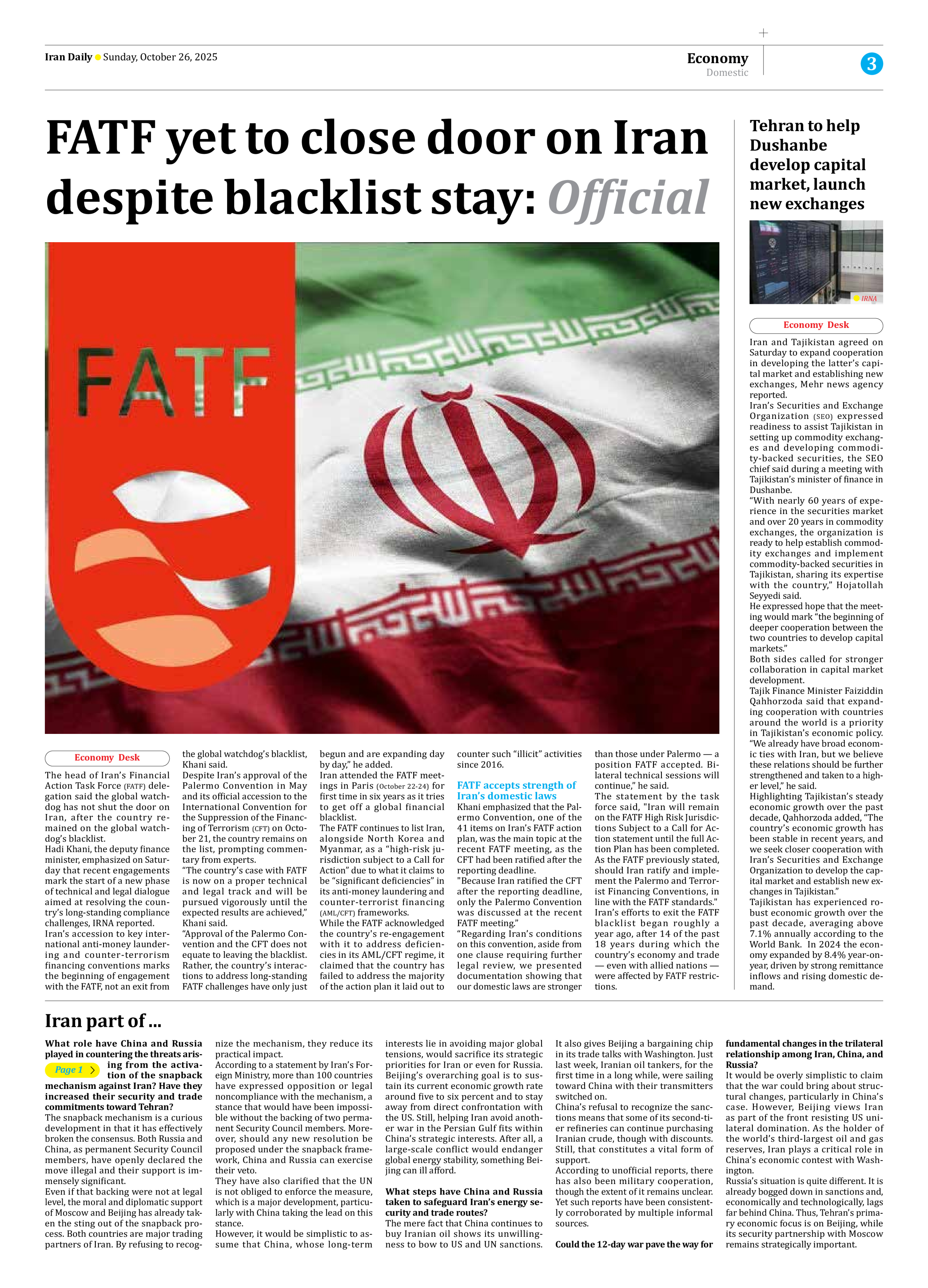


FATF yet to close door on Iran despite blacklist stay: Official
The head of Iran’s Financial Action Task Force (FATF) delegation said the global watchdog has not shut the door on Iran, after the country remained on the global watchdog’s blacklist.
Hadi Khani, the deputy finance minister, emphasized on Saturday that recent engagements mark the start of a new phase of technical and legal dialogue aimed at resolving the country’s long-standing compliance challenges, IRNA reported.
Iran’s accession to key international anti-money laundering and counter-terrorism financing conventions marks the beginning of engagement with the FATF, not an exit from the global watchdog’s blacklist, Khani said.
Despite Iran’s approval of the Palermo Convention in May and its official accession to the International Convention for the Suppression of the Financing of Terrorism (CFT) on October 21, the country remains on the list, prompting commentary from experts.
“The country’s case with FATF is now on a proper technical and legal track and will be pursued vigorously until the expected results are achieved,” Khani said.
“Approval of the Palermo Convention and the CFT does not equate to leaving the blacklist. Rather, the country’s interactions to address long-standing FATF challenges have only just begun and are expanding day by day,” he added.
Iran attended the FATF meetings in Paris (October 22-24) for first time in six years as it tries to get off a global financial blacklist.
The FATF continues to list Iran, alongside North Korea and Myanmar, as a “high-risk jurisdiction subject to a Call for Action” due to what it claims to be “significant deficiencies” in its anti-money laundering and counter-terrorist financing (AML/CFT) frameworks.
While the FATF acknowledged the country's re-engagement with it to address deficiencies in its AML/CFT regime, it claimed that the country has failed to address the majority of the action plan it laid out to counter such “illicit” activities since 2016.
FATF accepts strength of Iran’s domestic laws
Khani emphasized that the Palermo Convention, one of the 41 items on Iran’s FATF action plan, was the main topic at the recent FATF meeting, as the CFT had been ratified after the reporting deadline.
"Because Iran ratified the CFT after the reporting deadline, only the Palermo Convention was discussed at the recent FATF meeting.”
“Regarding Iran’s conditions on this convention, aside from one clause requiring further legal review, we presented documentation showing that our domestic laws are stronger than those under Palermo — a position FATF accepted. Bilateral technical sessions will continue,” he said.
The statement by the task force said, "Iran will remain on the FATF High Risk Jurisdictions Subject to a Call for Action statement until the full Action Plan has been completed. As the FATF previously stated, should Iran ratify and implement the Palermo and Terrorist Financing Conventions, in line with the FATF standards."
Iran’s efforts to exit the FATF blacklist began roughly a year ago, after 14 of the past 18 years during which the country’s economy and trade — even with allied nations — were affected by FATF restrictions.