







Urmia’s rich heritage, cultural legacy left unnoticed
Every city with a rich history and civilization possesses its own heroes, as well as cultural and artistic figures, by which the city is recognized and remembered. The entrance to a city is often the first point of contact, introducing it through its symbols, landmarks, and monuments. Unfortunately, the entrance to the historic city of Urmia, the capital city of West Azarbaijan Province, lacks such defining elements.
Beyond the city entrance, even the main squares fail to exhibit signs of historical or cultural symbolism. Urmia has distinguished figures such as Safi al-Din al-Urmawi, the shining star of Islamic music; martyred commanders like Mehdi and Hamid Bakeri; and highly skilled painters and sculptors like Zein al-Abedin Goharani — each of whom could serve as a powerful symbol of the city’s rich culture and historical legacy according to IRNA.
In addition, Urmia is a prominent producer of delicious and unique products, including grapes and apples. Yet, no symbols or monuments celebrating these local specialties are present elsewhere in the city to capture the attention of visitors and highlight the city’s identity.
In this city, historical monuments could easily have been installed to ignite the curiosity of travelers and guests, even briefly, inviting them to explore a corner of the region’s rich past. Urmia itself is like an encyclopedia — a treasure trove and an album of history, civilization, culture, and art. Yet this vital aspect has been neglected, leaving this ancient city, unlike many others, devoid of meaningful historical and cultural markers.
The only tributes created to honor notable artists or figures are the busts installed at most intersections. These busts lack elegance and artistic quality and are so poorly crafted that it is often difficult to identify which individual they are meant to commemorate.
By contrast, in the squares and various locations of Maragheh, a historic city in East Azarbaijan Province, statues and monuments celebrating cultural and historical figures have been carefully installed. Visitors entering Maragheh naturally become connected to its ancient heritage.
An expert in the field of arts highlighted in an interview that Urmia has produced numerous talented figures, including Dolu Mustafa in Ashik music, as well as Safi al-Din al-Urmawi, who excelled in music and calligraphy. A stamp featuring al-Urmawi was issued by UNESCO fifty years ago, and his art has been recognized as a part of the world’s cultural heritage. Yet, nowhere in Urmia — not even a street — bears the name of this celebrated artist.
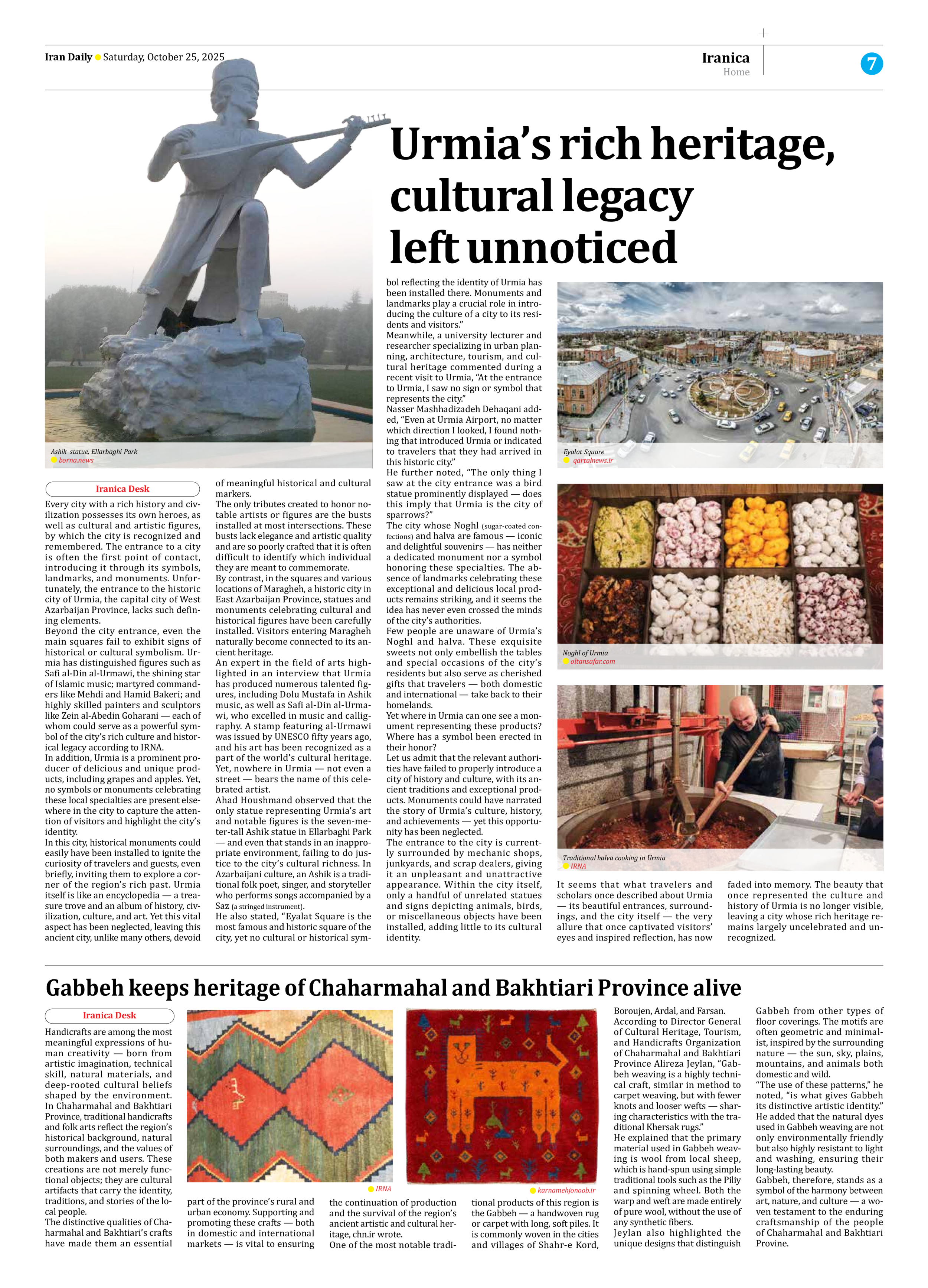
Ahad Houshmand observed that the only statue representing Urmia’s art and notable figures is the seven-meter-tall Ashik statue in Ellarbaghi Park — and even that stands in an inappropriate environment, failing to do justice to the city’s cultural richness. In Azarbaijani culture, an Ashik is a traditional folk poet, singer, and storyteller who performs songs accompanied by a Saz (a stringed instrument).
He also stated, “Eyalat Square is the most famous and historic square of the city, yet no cultural or historical symbol reflecting the identity of Urmia has been installed there. Monuments and landmarks play a crucial role in introducing the culture of a city to its residents and visitors.”
Meanwhile, a university lecturer and researcher specializing in urban planning, architecture, tourism, and cultural heritage commented during a recent visit to Urmia, “At the entrance to Urmia, I saw no sign or symbol that represents the city.”
Nasser Mashhadizadeh Dehaqani added, “Even at Urmia Airport, no matter which direction I looked, I found nothing that introduced Urmia or indicated to travelers that they had arrived in this historic city.”
He further noted, “The only thing I saw at the city entrance was a bird statue prominently displayed — does this imply that Urmia is the city of sparrows?”
The city whose Noghl (sugar-coated confections) and halva are famous — iconic and delightful souvenirs — has neither a dedicated monument nor a symbol honoring these specialties. The absence of landmarks celebrating these exceptional and delicious local products remains striking, and it seems the idea has never even crossed the minds of the city’s authorities.
Few people are unaware of Urmia’s Noghl and halva. These exquisite sweets not only embellish the tables and special occasions of the city’s residents but also serve as cherished gifts that travelers — both domestic and international — take back to their homelands.
Yet where in Urmia can one see a monument representing these products? Where has a symbol been erected in their honor?
Let us admit that the relevant authorities have failed to properly introduce a city of history and culture, with its ancient traditions and exceptional products. Monuments could have narrated the story of Urmia’s culture, history, and achievements — yet this opportunity has been neglected.
The entrance to the city is currently surrounded by mechanic shops, junkyards, and scrap dealers, giving it an unpleasant and unattractive appearance. Within the city itself, only a handful of unrelated statues and signs depicting animals, birds, or miscellaneous objects have been installed, adding little to its cultural identity.
It seems that what travelers and scholars once described about Urmia — its beautiful entrances, surroundings, and the city itself — the very allure that once captivated visitors’ eyes and inspired reflection, has now faded into memory. The beauty that once represented the culture and history of Urmia is no longer visible, leaving a city whose rich heritage remains largely uncelebrated and unrecognized.