







President says production, exports key to overcoming ‘cruel sanctions’
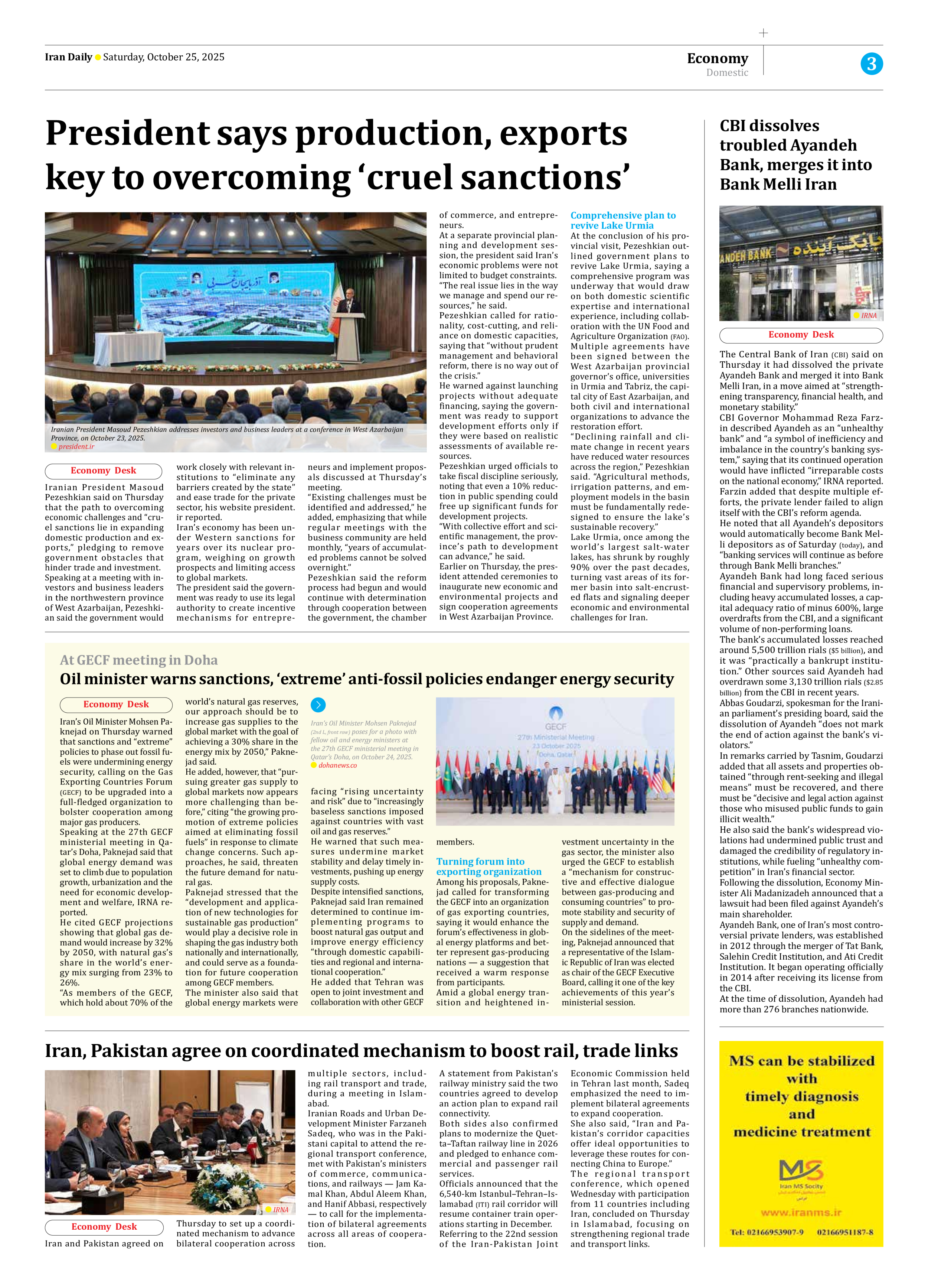
Iranian President Masoud Pezeshkian said on Thursday that the path to overcoming economic challenges and “cruel sanctions lie in expanding domestic production and exports,” pledging to remove government obstacles that hinder trade and investment.
Speaking at a meeting with investors and business leaders in the northwestern province of West Azarbaijan, Pezeshkian said the government would work closely with relevant institutions to “eliminate any barriers created by the state” and ease trade for the private sector, his website president.ir reported.
Iran’s economy has been under Western sanctions for years over its nuclear program, weighing on growth prospects and limiting access to global markets.
The president said the government was ready to use its legal authority to create incentive mechanisms for entrepreneurs and implement proposals discussed at Thursday’s meeting.
“Existing challenges must be identified and addressed,” he added, emphasizing that while regular meetings with the business community are held monthly, “years of accumulated problems cannot be solved overnight.”
Pezeshkian said the reform process had begun and would continue with determination through cooperation between the government, the chamber of commerce, and entrepreneurs.
At a separate provincial planning and development session, the president said Iran’s economic problems were not limited to budget constraints.
“The real issue lies in the way we manage and spend our resources,” he said.
Pezeshkian called for rationality, cost-cutting, and reliance on domestic capacities, saying that “without prudent management and behavioral reform, there is no way out of the crisis.”
He warned against launching projects without adequate financing, saying the government was ready to support development efforts only if they were based on realistic assessments of available resources.
Pezeshkian urged officials to take fiscal discipline seriously, noting that even a 10% reduction in public spending could free up significant funds for development projects.
“With collective effort and scientific management, the province’s path to development can advance,” he said.
Earlier on Thursday, the president attended ceremonies to inaugurate new economic and environmental projects and sign cooperation agreements in West Azarbaijan Province.
Comprehensive plan to revive Lake Urmia
At the conclusion of his provincial visit, Pezeshkian outlined government plans to revive Lake Urmia, saying a comprehensive program was underway that would draw on both domestic scientific expertise and international experience, including collaboration with the UN Food and Agriculture Organization (FAO).
Multiple agreements have been signed between the West Azarbaijan provincial governor’s office, universities in Urmia and Tabriz, the capital city of East Azarbaijan, and both civil and international organizations to advance the restoration effort.
“Declining rainfall and climate change in recent years have reduced water resources across the region,” Pezeshkian said. “Agricultural methods, irrigation patterns, and employment models in the basin must be fundamentally redesigned to ensure the lake’s sustainable recovery.”
Lake Urmia, once among the world’s largest salt-water lakes, has shrunk by roughly 90% over the past decades, turning vast areas of its former basin into salt-encrusted flats and signaling deeper economic and environmental challenges for Iran.