







Minister calls for water cooperation among Muslim nations at OIC meeting
Iran’s Energy Minister Abbas Aliabadi on Wednesday urged Muslim countries to work together on water management an at ministerial meeting of the Organization of Islamic Cooperation (OIC), calling it both “a technical necessity and a faith-based responsibility toward present and future generations.”
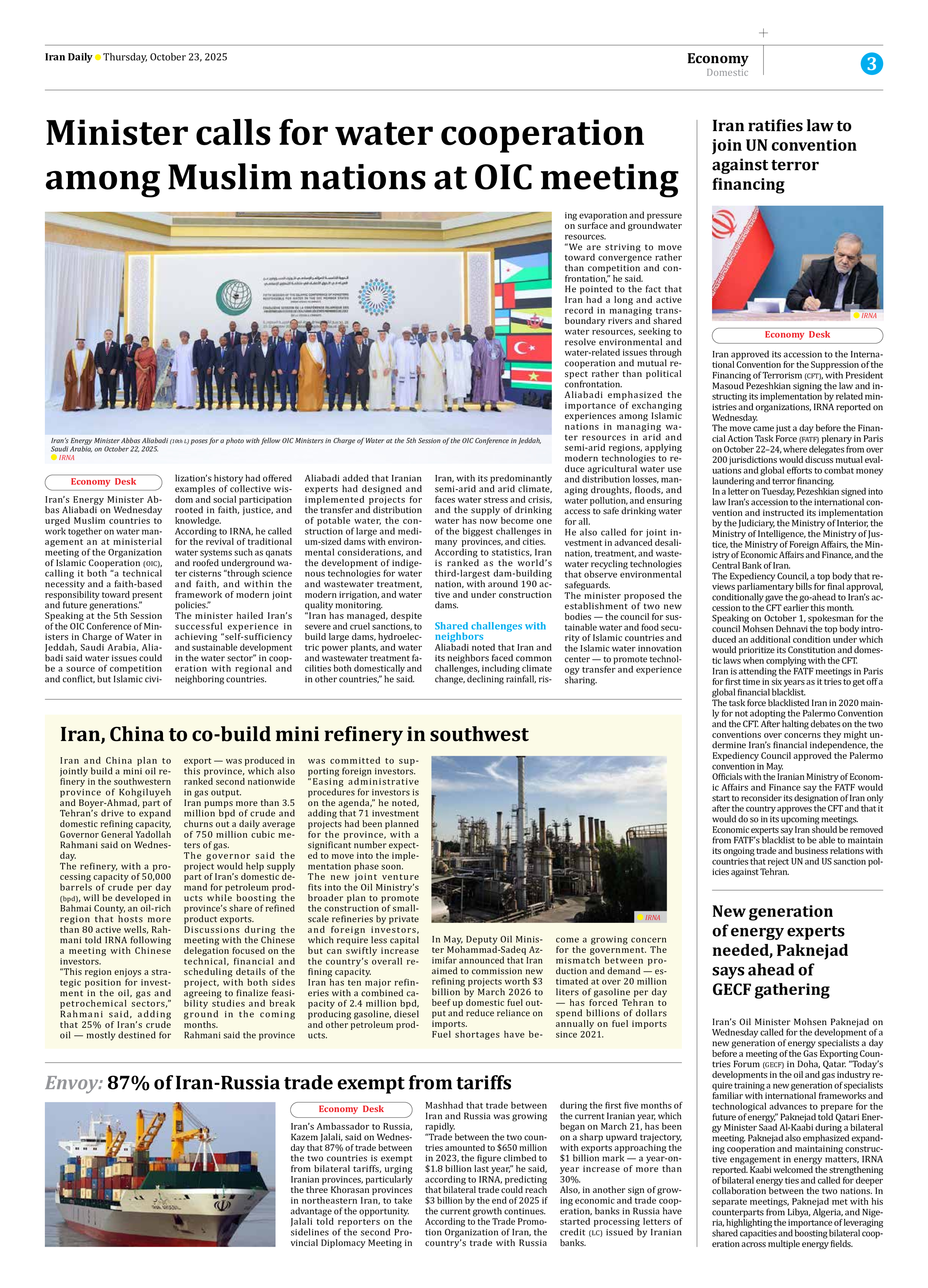
Speaking at the 5th Session of the OIC Conference of Ministers in Charge of Water in Jeddah, Saudi Arabia, Aliabadi said water issues could be a source of competition and conflict, but Islamic civilization’s history had offered examples of collective wisdom and social participation rooted in faith, justice, and knowledge.
According to IRNA, he called for the revival of traditional water systems such as qanats and roofed underground water cisterns “through science and faith, and within the framework of modern joint policies.”
The minister hailed Iran’s successful experience in achieving “self-sufficiency and sustainable development in the water sector” in cooperation with regional and neighboring countries.
Aliabadi added that Iranian experts had designed and implemented projects for the transfer and distribution of potable water, the construction of large and medium-sized dams with environmental considerations, and the development of indigenous technologies for water and wastewater treatment, modern irrigation, and water quality monitoring.
“Iran has managed, despite severe and cruel sanctions, to build large dams, hydroelectric power plants, and water and wastewater treatment facilities both domestically and in other countries,” he said.
Iran, with its predominantly semi-arid and arid climate, faces water stress and crisis, and the supply of drinking water has now become one of the biggest challenges in many provinces, and cities.
According to statistics, Iran is ranked as the world’s third-largest dam-building nation, with around 190 active and under construction dams.
Shared challenges with neighbors
Aliabadi noted that Iran and its neighbors faced common challenges, including climate change, declining rainfall, rising evaporation and pressure on surface and groundwater resources.
“We are striving to move toward convergence rather than competition and confrontation,” he said.
He pointed to the fact that Iran had a long and active record in managing transboundary rivers and shared water resources, seeking to resolve environmental and water-related issues through cooperation and mutual respect rather than political confrontation.
Aliabadi emphasized the importance of exchanging experiences among Islamic nations in managing water resources in arid and semi-arid regions, applying modern technologies to reduce agricultural water use and distribution losses, managing droughts, floods, and water pollution, and ensuring access to safe drinking water for all.
He also called for joint investment in advanced desalination, treatment, and wastewater recycling technologies that observe environmental safeguards.
The minister proposed the establishment of two new bodies — the council for sustainable water and food security of Islamic countries and the Islamic water innovation center — to promote technology transfer and experience sharing.