







Iran’s handicrafts poised for ‘major change’, says deputy minister
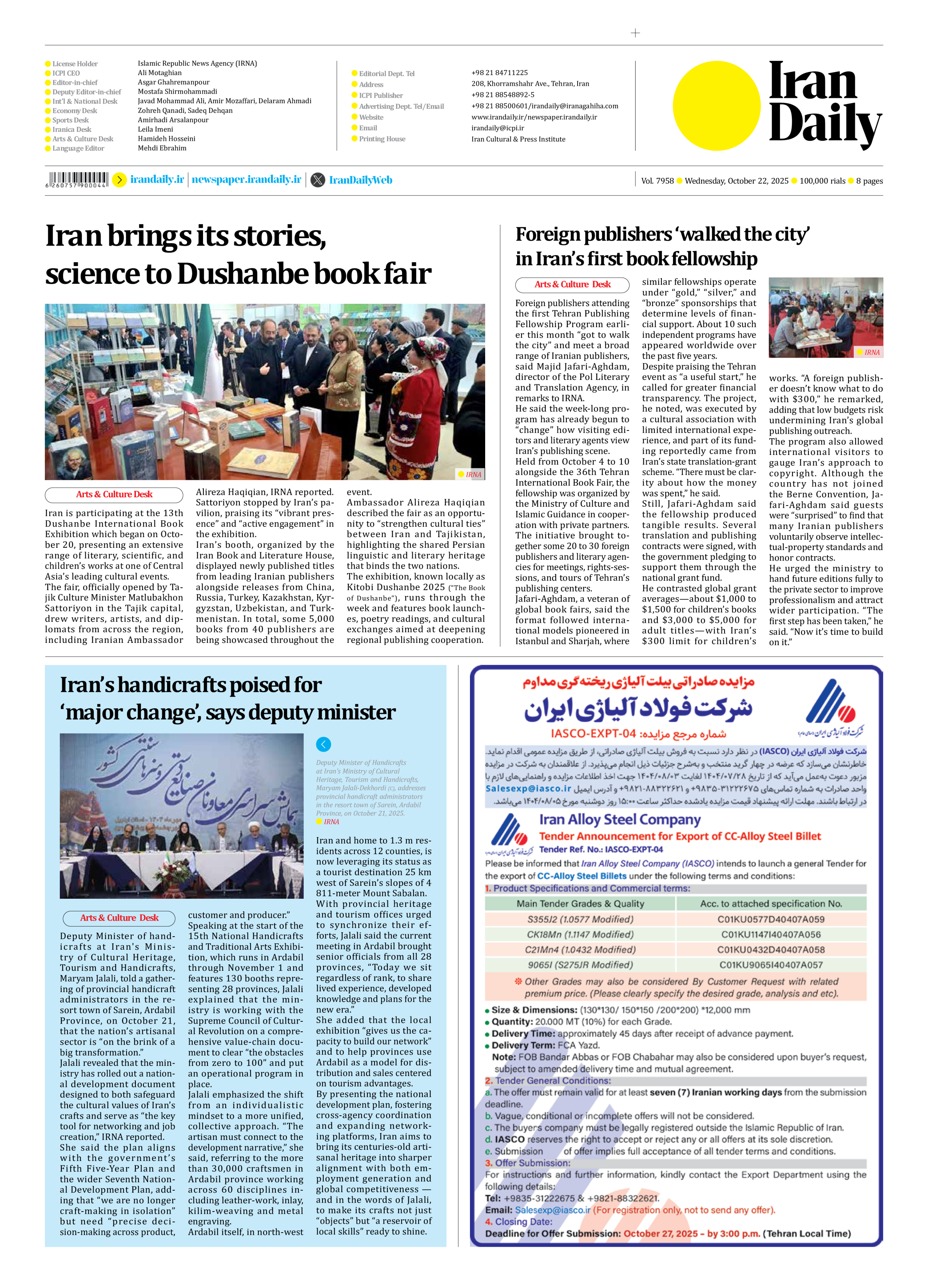
Deputy Minister of handicrafts at Iran's Ministry of Cultural Heritage, Tourism and Handicrafts, Maryam Jalali, told a gathering of provincial handicraft administrators in the resort town of Sarein, Ardabil Province, on October 21, that the nation’s artisanal sector is “on the brink of a big transformation.”
Jalali revealed that the ministry has rolled out a national development document designed to both safeguard the cultural values of Iran’s crafts and serve as “the key tool for networking and job creation,” IRNA reported.
She said the plan aligns with the government’s Fifth Five-Year Plan and the wider Seventh National Development Plan, adding that “we are no longer craft-making in isolation” but need “precise decision-making across product, customer and producer.”
Speaking at the start of the 15th National Handicrafts and Traditional Arts Exhibition, which runs in Ardabil through November 1 and features 130 booths representing 28 provinces, Jalali explained that the ministry is working with the Supreme Council of Cultural Revolution on a comprehensive value-chain document to clear “the obstacles from zero to 100” and put an operational program in place.
Jalali emphasized the shift from an individualistic mindset to a more unified, collective approach. “The artisan must connect to the development narrative,” she said, referring to the more than 30,000 craftsmen in Ardabil province working across 60 disciplines including leather-work, inlay, kilim-weaving and metal engraving.
Ardabil itself, in north-west Iran and home to 1.3 m residents across 12 counties, is now leveraging its status as a tourist destination 25 km west of Sarein’s slopes of 4 811-meter Mount Sabalan.
With provincial heritage and tourism offices urged to synchronize their efforts, Jalali said the current meeting in Ardabil brought senior officials from all 28 provinces, “Today we sit regardless of rank, to share lived experience, developed knowledge and plans for the new era.”
She added that the local exhibition “gives us the capacity to build our network” and to help provinces use Ardabil as a model for distribution and sales centered on tourism advantages.
By presenting the national development plan, fostering cross-agency coordination and expanding networking platforms, Iran aims to bring its centuries-old artisanal heritage into sharper alignment with both employment generation and global competitiveness — and in the words of Jalali, to make its crafts not just “objects” but “a reservoir of local skills” ready to shine.