





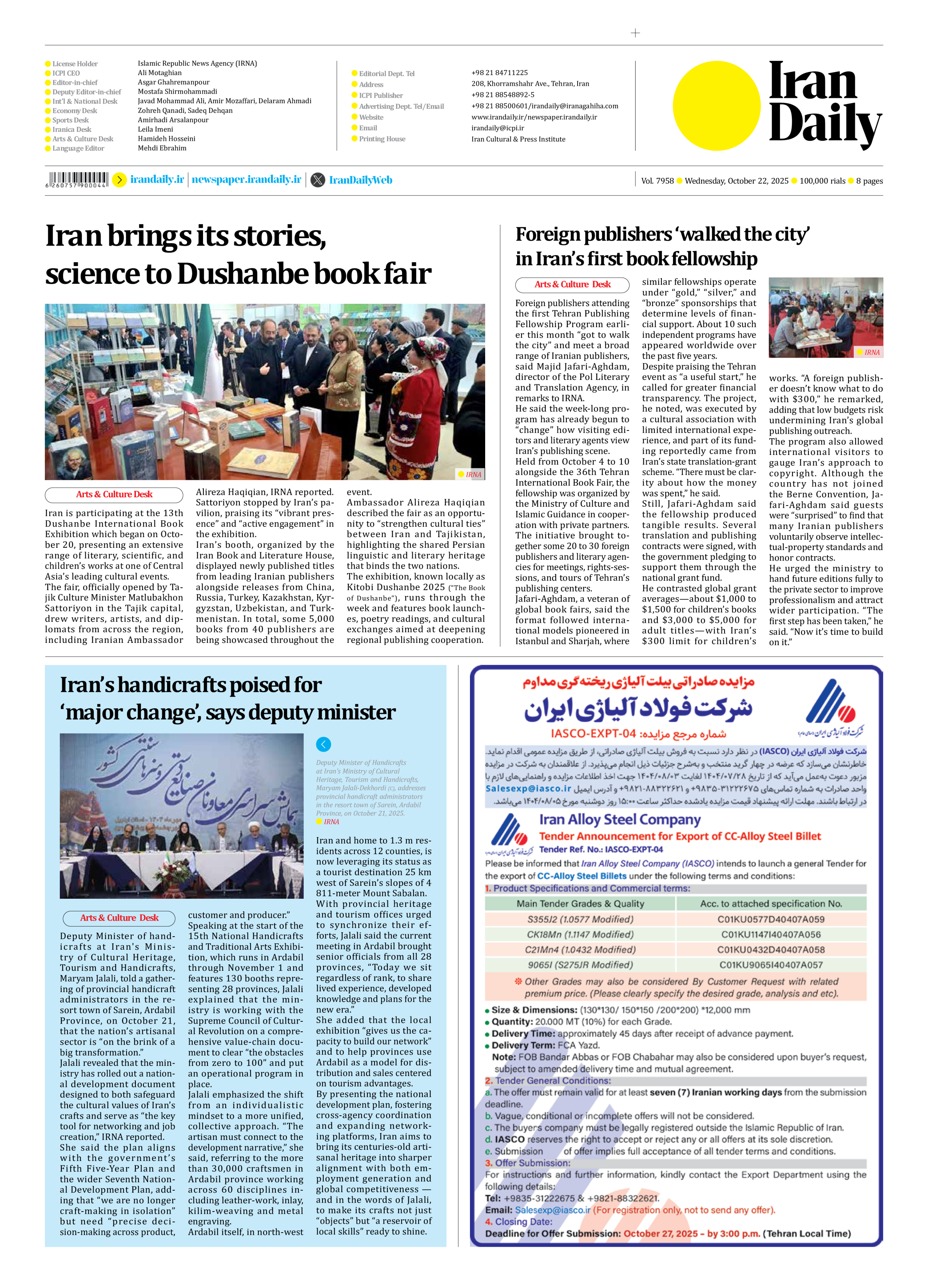


Foreign publishers ‘walked the city’ in Iran’s first book fellowship
Foreign publishers attending the first Tehran Publishing Fellowship Program earlier this month “got to walk the city” and meet a broad range of Iranian publishers, said Majid Jafari-Aghdam, director of the Pol Literary and Translation Agency, in remarks to IRNA.
He said the week-long program has already begun to “change” how visiting editors and literary agents view Iran’s publishing scene.
Held from October 4 to 10 alongside the 36th Tehran International Book Fair, the fellowship was organized by the Ministry of Culture and Islamic Guidance in cooperation with private partners. The initiative brought together some 20 to 30 foreign publishers and literary agencies for meetings, rights-sessions, and tours of Tehran’s publishing centers.
Jafari-Aghdam, a veteran of global book fairs, said the format followed international models pioneered in Istanbul and Sharjah, where similar fellowships operate under “gold,” “silver,” and “bronze” sponsorships that determine levels of financial support. About 10 such independent programs have appeared worldwide over the past five years.
Despite praising the Tehran event as “a useful start,” he called for greater financial transparency. The project, he noted, was executed by a cultural association with limited international experience, and part of its funding reportedly came from Iran’s state translation-grant scheme. “There must be clarity about how the money was spent,” he said.
Still, Jafari-Aghdam said the fellowship produced tangible results. Several translation and publishing contracts were signed, with the government pledging to support them through the national grant fund.
He contrasted global grant averages—about $1,000 to $1,500 for children’s books and $3,000 to $5,000 for adult titles—with Iran’s $300 limit for children’s works. “A foreign publisher doesn’t know what to do with $300,” he remarked, adding that low budgets risk undermining Iran’s global publishing outreach.
The program also allowed international visitors to gauge Iran’s approach to copyright. Although the country has not joined the Berne Convention, Jafari-Aghdam said guests were “surprised” to find that many Iranian publishers voluntarily observe intellectual-property standards and honor contracts.
He urged the ministry to hand future editions fully to the private sector to improve professionalism and attract wider participation. “The first step has been taken,” he said. “Now it’s time to build on it.”